Bergamasco

Bergamasco Sheepdog

Quick Facts

🐕 Breed Group
Herding Group
📏 Size Category
Medium to Large
📏 Height
Males: 23.5 inches, Females: 22 inches
⚖️ Weight
Males: 70-84 pounds, Females: 57-71 pounds
⏱️ Life Expectancy
13-15 years
🧣 Coat Type
Three distinct hair types forming naturally matted flocks
🎨 Coat Colors
Gray to black, merle, Isabella, and fawn
😀 Temperament
Patient, observant, loyal, intelligent
🏃 Exercise Needs
Moderate
🎓 Training Difficulty
Moderate - independent but problem-solving oriented
👶 Good with Children
Yes, gentle and patient
🐾 Good with Other Pets
Generally good with socialization

Other Names & Breed Recognition

Bergamasco is the shortened form of Bergamasco Sheepdog - the name most people who encounter this breed in conversation, in dog parks, or in breed literature actually use. The full name Bergamasco Sheepdog is the official designation used by the AKC, the FCI, and other registries, but in everyday speech the second word gets dropped, and the shortened form has become the de facto common name in most English-speaking countries. If you hear someone talk about their Bergamasco, they are talking about the same dog as the Bergamasco Sheepdog; there is no distinction between the two in terms of breed, standard, or identity.

The name itself derives from the Bergamo region of northern Italy - specifically the alpine valleys and high pastures above the city of Bergamo in Lombardy - where this herding breed was developed and has worked for centuries. The dogs were bred to assist shepherds in managing flocks in terrain that was steep, cold, and demanding of a dog with both physical resilience and enough independent judgment to handle situations that arose far from the shepherd's direct supervision. The name is therefore a geographic identifier, situating the breed precisely in the landscape that shaped its characteristics.

In Italian the breed is known as Cane da Pastore Bergamasco, which translates directly to Bergamo Shepherd Dog. The FCI uses this full Italian form in its official classification. Italian enthusiasts and breeders often use simply Bergamasco as an informal shorthand in the same way English speakers do. The breed is occasionally called the Bergamese Shepherd in older English texts, a slight anglicization of the Italian geographic adjective, though this variant has largely fallen out of use in favor of the direct transliteration.

The AKC granted the Bergamasco Sheepdog full recognition in 2015, placing it in the Herding Group where its working heritage belongs. Prior to full recognition the breed had participated in the AKC Miscellaneous Class. The parent club in the United States is the Bergamasco Sheepdog Club of America, and the parent club responsible for the international standard and breed oversight in Europe is the Italian breed club operating under FCI coordination. For any registry search, breeder directory lookup, or health database inquiry, the full name Bergamasco Sheepdog should be used, as the shortened form may not retrieve complete results.

Bergamasco Organizations & Standards

The national parent club in the United States is the Bergamasco Sheepdog Club of America, which works with the AKC to maintain the breed standard and promote responsible breeding and ownership practices. The Italian parent club, operating in coordination with the FCI, maintains the international standard that serves as the basis for how the breed is evaluated and judged worldwide. The FCI classifies the Bergamasco in Group 1 (Sheepdogs and Cattle Dogs), Section 1 (Sheepdogs), which places it alongside other historic European herding breeds.

The AKC standard calls for a medium to large, strongly built dog presenting a rustic, harmonious appearance. Males typically stand approximately 23.5 inches at the withers and weigh between 70 and 84 pounds; females stand around 22 inches and weigh between 57 and 71 pounds. The most distinctive element described in the standard is, naturally, the coat - the standard specifies three distinct hair types: the fine, greasy "dog hair," the longer, stronger "goat hair," and the soft undercoat wool. These three types interweave during the maturation process to form the characteristic flat mats called flocks, which should cover the entire body from the middle of the back downward. The head hair parts naturally in the middle and falls forward to partially cover the eyes, which is correct and intentional rather than a grooming oversight.

For health testing, the National Bergamasco Sheepdog Alliance recommends OFA certification for hip dysplasia in both parents before any breeding - and suggests asking about grandparent hip status as well, since the relatively small gene pool in this breed makes multi-generation health transparency especially valuable. Certification that both parents have received a recent ophthalmologist examination with normal results is also recommended, given that progressive retinal atrophy and cataracts have been documented in the breed. A cardiac check for heart murmurs after four months of age is the third recommended test for breeding stock.

Buyers should ask specifically for documentation of hip OFA certification and ophthalmologist eye results for both parents. Given the small gene pool of this breed in the United States, working with breeders who are transparent about multi-generational health data and who use Embark or equivalent comprehensive DNA panel testing in addition to standard OFA requirements is strongly encouraged by informed breed community members. Any breeder who cannot or will not produce documentation for these basic health tests should prompt serious caution in a prospective buyer.

The Kennel Club in the UK classifies the Bergamasco Sheepdog in the Pastoral Group, and the breed is fully recognized there. Prospective UK owners should contact the UK breed club for breeder referrals, as importing from Italy or the United States remains an option for those who cannot find domestically available litters.

Kennel Club Recognition

  • American Kennel Club (AKC): Recognized in 2015, Herding Group
  • United Kennel Club (UKC): Recognized, Herding Dog Group
  • FCI: Recognized, Group 1 - Sheepdogs and Cattle Dogs
  • The Kennel Club (UK): Recognized, Pastoral Group

Bergamasco Physical Description

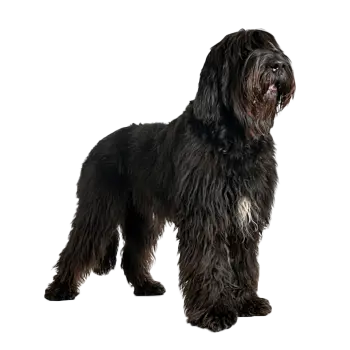
Before anything else, you see the coat. That is simply the reality of encountering a Bergamasco - the dog's remarkable covering of naturally formed, flat rope-like mats dominates the visual impression so completely that everything else seems secondary. But underneath that extraordinary coat is a strongly built, well-proportioned working dog that was shaped by centuries of demanding physical labor in alpine terrain. Understanding the Bergamasco means seeing the whole animal, not just the wool.

The body is slightly longer than tall, with a straight, strong back and well-developed musculature throughout. The chest is broad and deep, the ribs well-sprung, the loin short and muscular. The overall structure communicates endurance and versatility rather than speed - this is a dog built to work all day over rough ground, not to sprint. The legs are straight and well-boned, the feet rounded with thick, hard pads suited to rocky alpine terrain. The hindquarters are well-angulated and provide the power for both sustained movement across steep terrain and the quick changes of direction that herding work demands.

The head is broad and long, with a slightly convex skull and a muzzle that is roughly equal in length to the skull. The jaws are strong, the nose broad and black. The eyes are large, oval, and set slightly obliquely; in gray and black dogs, eye color is dark brown, while lighter-colored dogs may have hazel or amber eyes. The ears are thin and flexible, hanging flat against the head from a high set, triangular in shape, and soft in texture. In adult dogs, the long facial hair falls forward over the forehead, partially covering the eyes - this is not grooming neglect but a breed characteristic that actually serves a protective function in field conditions, shielding the eyes from wind and sun in the high alpine environment.

The tail is strong at the root, tapering toward the tip, and reaches approximately to the hock. It is carried low at rest and raised to a curve when the dog is active and alert. The tail, like the rest of the rear body, is covered in the characteristic flocked coat once the dog has reached maturity.

The coat itself is worth extended description because it is unlike anything else in the dog world and requires specific knowledge to manage correctly. Three distinct hair types are present: a fine, oily undercoat layer called "dog hair," a longer, stronger outer layer called "goat hair," and a soft, woolly undercoat. As the dog matures, these three types interweave spontaneously to form flat mats - called flocks - that should cover the body from approximately the mid-back downward. The flocks are not rounded cords like those of a Puli or Komondor; they are flat and broad, with irregular edges. Getting the flocks right during the first two years of development requires regular hands-on work to separate them correctly as they form. Once fully flocked, the coat is largely self-maintaining but still requires periodic checking and separating to prevent adjacent flocks from felting together.

Colors include all shades of gray through black, as well as merle patterns and Isabella (a pale fawn) in the FCI standard. White is acceptable in the FCI standard but not recognized under AKC. The overall impression is of a substantial, serious working dog wearing one of the most unusual and visually arresting coats in the entire canine world.

Movement in the Bergamasco should be free and flowing, with good reach and drive, covering ground efficiently without wasted effort. The correct gait reflects the breed's purpose: a dog capable of covering varied mountain terrain all day long, combining endurance with agility in a single athletic package.

Affectionate With Family
The Bergamasco is deeply devoted to its household and shows warmth through close physical presence - this is a dog that wants to be with its people and makes that clear every day.
Good With Young Children
Patient and calm by nature, the Bergamasco tends to tolerate children well, though its herding instincts mean early socialization and teaching children proper approach remain important.
Good With Other Dogs
Generally sociable with other dogs, particularly those it has been raised alongside; the Bergamasco's even temperament makes multi-dog households workable with proper introductions.
Shedding Level
Once the flocks are fully formed, the coat does not shed in any meaningful way - it is one of the lowest-shedding breeds you will find, which surprises people expecting otherwise from all that hair.
Coat Grooming Frequency
The first two years of coat development require significant hands-on work to form the flocks correctly; once fully flocked, maintenance drops considerably but never disappears entirely.
Drooling Level
Not a drooling breed - the Bergamasco is clean-mouthed and does not leave the kind of facial-hair moisture issues common in some other long-coated herding breeds.
Coat Type
The Bergamasco's three-layered, naturally flocking coat is unlike anything else in the dog world - it requires specific knowledge to manage correctly during formation and should not be brushed out once flocked.
Openness To Strangers
Neither immediately friendly nor strongly suspicious, the Bergamasco takes a measured approach to new people - polite reserve followed by gradual warming rather than either effusive greeting or wariness.
Playfulness Level
Playful and engaged with its family, though the Bergamasco's play tends toward the thoughtful and interactive rather than the high-energy, non-stop variety seen in sporting breeds.
Watchdog/Protective Nature
Alert to changes in its environment and will bark to notify the household, but the Bergamasco is not an aggressive guarding breed - awareness and communication are its style.
Adaptability Level
Adaptable to varied living situations as long as its exercise and mental engagement needs are met; extremely hot and humid climates are hard on the flocked coat and should be managed carefully.
Trainability Level
Highly intelligent and motivated to work with its owner when that relationship is built on trust; the Bergamasco thinks through problems rather than reflexively executing commands.

Bergamasco History & Development

The Bergamasco's history is rooted in the alpine valleys above Bergamo, where transhumance - the seasonal movement of flocks between lowland winter pastures and high mountain summer grazing - was a way of life for centuries. The dogs that accompanied those flocks needed to be capable of working independently over steep and often difficult terrain, making decisions without constant handler direction, and surviving the physical demands of life at altitude through cold seasons. The Bergamasco coat, which looks like an impractical ornament to modern eyes, is actually functional alpine equipment: the flat flocks provide insulation from cold and protection against the bites of wolves, which were a real threat to mountain flocks.

The breed's exact origins are debated, as they are for most ancient working breeds with long pre-registration histories. What is established is that dogs of the Bergamasco type have been present in the alpine regions of northern Italy for well over a thousand years, and that the breed was already recognized as distinct from other Italian shepherd types well before formal breed documentation began in the 19th and early 20th centuries. The breed was known locally by its geographic name - dogs of the Bergamo region - and that identification has persisted into modern breed naming.

The World Wars severely affected the breed, as they did many European working dogs. With agricultural labor disrupted and traditional transhumance practices interrupted, the Bergamasco population dropped dramatically during the mid-20th century. Dedicated Italian breeders, working with the support of the Italian kennel club and eventually the FCI, undertook recovery efforts that preserved the breed and gradually rebuilt its numbers from a small remaining population. The breed owes its survival as a distinct and healthy type to that focused conservation effort, and the work done by those breeders during a difficult period is the reason the Bergamasco exists today as a registered, healthy breed rather than a lost type.

In the United States, interest in the breed grew slowly from the 1990s onward, initially driven by enthusiasts who had encountered the dogs in Europe and recognized their qualities as family companions and versatile working dogs. The AKC granted full recognition in 2015, giving American owners access to formal registration and the competitive and health registry infrastructure that comes with it. The breed remains relatively uncommon in North America, with a small but knowledgeable community of owners and breeders who are generally very willing to educate prospective owners about the realities of coat management and temperament.

The full name Bergamasco Sheepdog accurately situates the breed - a sheepdog, from Bergamo - but the shortened form that most people use in conversation reflects a natural linguistic process. The dog is simply known as the Bergamasco now, and that shortened form carries the full weight of the breed's identity and history with it.

Prospective owners who encounter the shortened name Bergamasco in conversation or online should know they are looking at exactly the same animal and the same body of breed knowledge - the two names describe one breed.

Bergamasco Temperament & Personality

The Bergamasco was developed for a specific kind of work that rewards a specific kind of thinking. A dog managing a flock on alpine terrain without constant handler supervision needed to observe, assess, and act on its own judgment - not react mechanically to commands issued from close range. That independent assessment, built through centuries of selection for dogs that could be trusted to make good decisions when the shepherd was not watching, is the defining feature of the Bergamasco's temperament. This is a dog that thinks about what it is doing, and that changes how you have to approach life with one.

Patience is one of this breed's most consistently noted qualities. Where many herding breeds operate at high, sustained intensity, the Bergamasco tends toward a more measured, deliberate engagement with the world. It watches before it acts. It assesses the situation. It will figure out what you want if you give it the space to do so, which means training sessions that allow the dog to problem-solve are often more productive than rigid repetition drills. The breed community consistently describes this dog as a genuine thinking partner rather than a command-following tool.

The attachment to family is deep and tends to express itself through presence rather than performance. A Bergamasco wants to be wherever its people are - not necessarily seeking constant physical contact, but reliably positioned where it can see what is happening and be part of the household. This attentiveness means the dog is rarely caught off guard, which connects to its effectiveness as a watchdog: not aggressive, but consistently aware. Visitors who give the dog space to observe and approach on its own timeline are rewarded with gradual, genuine acceptance.

With strangers, the Bergamasco takes a measured approach. It is neither aggressively suspicious nor immediately friendly. The default is polite observation, followed by gradual acceptance once the dog has had time to assess. Forced or rushed introductions make the process slower, not faster. Letting visitors allow the dog to approach on its own schedule consistently produces better outcomes than trying to manage the interaction from the human side.

Herding instincts are present and sometimes surface around children or other pets, particularly younger dogs that have not had sufficient exposure to the variety of situations that trigger the behavior. Early socialization - specifically positive exposure to children, other animals, and varied environments during the critical puppy development windows - shapes how the adult dog navigates those situations. A well-socialized Bergamasco raised alongside children is generally a gentle and patient family member. A Bergamasco raised in social isolation tends toward greater wariness and is harder to settle in a busy household.

The Bergamasco does not suit owners who want a push-button dog that executes commands without question. It suits owners who appreciate a genuine relationship with an intelligent, observant animal whose cooperation is freely given rather than mechanically trained. Get that dynamic right and you end up with one of the most rewarding companions in the herding group.

Bergamasco Family Life & Living Requirements

The Bergamasco is a family-oriented dog that does best when treated as a genuine household member rather than a yard dog or a working animal kept at arm's length. This is a breed that needs human contact and mental engagement - isolation or benign neglect produce a dog that is restless, anxious, and increasingly difficult to manage. Given appropriate inclusion in daily life, the Bergamasco is one of the calmer and more adaptable herding breeds you can choose.

The flocked coat has some specific environmental implications. In hot, humid climates - particularly in the American South during summer - the coat holds heat in ways that make the dog genuinely uncomfortable. Air conditioning is not an optional luxury in those conditions; it is necessary management. The coat also dries slowly after bathing or getting wet in the rain, which requires planning to prevent the interior of the mat from staying damp long enough to develop mildew. A high-velocity dryer is the appropriate tool for drying a flocked coat, not toweling or air drying.

The coat also acts as a collection vehicle for whatever the dog moves through - grass clippings, pine needles, twigs, and leaves all get carried inside on the flocks. Regular checks after outdoor time, and accepting that you will be vacuuming up this collected debris, is part of realistic Bergamasco ownership. Some people find it a minor inconvenience; others find it more significant. Honest self-assessment before acquiring one is worthwhile. The breed is not suitable for extremely fastidious households where dog-related debris causes genuine stress.

Children and the Bergamasco can absolutely work together well. The breed's patience and calm make it a reasonable family dog for households with kids, though supervision of interactions with very young children remains important as with any large breed. The dog's natural herding instinct may express itself as boundary-setting behavior around groups of children playing, which is worth being aware of and managing through training rather than allowing to become a pattern. Teaching children from the start to approach the dog with respect and to recognize basic body language signals is time well spent with this or any herding breed.

Exercise outside in heat should be timed thoughtfully - early morning or evening outings during hot weather, keeping sessions shorter when humidity is high, and always providing access to fresh water and shade. Managing the environmental needs of this breed's coat is simply part of ownership.

Bergamasco Training & Exercise Needs

The Bergamasco's exercise needs are moderate compared to many herding breeds, which often surprises people expecting an alpine working dog to require marathon-level activity. Daily walks, access to a fenced yard for free movement, and regular interactive play sessions keep the breed in good physical and mental condition without requiring an owner with a competitive athletic lifestyle. The key is consistency rather than intensity - this dog does better with reliable daily activity than with sporadic bursts of heavy exercise separated by long sedentary stretches.

Mental engagement matters as much as physical exercise for this breed. The Bergamasco's problem-solving intelligence, honed by a working history that rewarded independent judgment, needs outlets. Puzzle feeders, interactive games, learning new skills, and activities that allow the dog to figure things out rather than simply execute stored commands are all good investments. A physically exercised but mentally understimulated Bergamasco will find its own outlets, which are rarely the ones the owner would choose.

Training works best when it respects the dog's thinking nature. Short sessions with clear goals, built on positive reinforcement and the dog's genuine desire to cooperate with people it trusts, produce solid results over time. Long, repetitive drill sessions where the dog is expected to simply execute without understanding bore this breed and produce a dog that looks for ways to disengage. The Bergamasco responds well to being given the chance to figure out what is wanted rather than having every behavior mechanically shaped step by step. This is a dog that will meet you halfway if you let it.

Consistent training and socialization from puppyhood make an enormous difference in the adult Bergamasco's range of comfortable behaviors. The herding instincts are manageable with early exposure; the watchfulness around strangers becomes appropriate rather than excessive with broad early socialization; the independence channels into problem-solving cooperation rather than selective listening. The investment made during the first year of the dog's life shapes what the next 12 to 14 years look like, and with this breed the payoff for that early work is substantial.

The Bergamasco can excel in herding trials, rally, and agility when given the opportunity - the breed's intelligence and physical capability make it competitive in canine sports that reward thinking dogs. These activities also provide the combination of physical and mental engagement that keeps this breed at its best. Owners who pursue sport with this dog consistently report that it deepens the relationship between dog and handler.

Bergamasco Health Concerns

The Bergamasco is a generally healthy breed with a lifespan of 13 to 15 years, long by the standards of a dog its size. The breed's history of selection for working soundness in demanding conditions has produced a constitutionally robust animal, but a few health concerns are documented and worth understanding before acquiring one of these dogs.

Overall, the Bergamasco is not a high-maintenance health breed, and prospective owners who work with health-testing breeders and maintain appropriate weight and exercise levels give their dog the best odds of reaching the upper end of its generous lifespan.

Common Health Issues

  • Hip Dysplasia: The primary orthopedic concern in the breed, with evidence of occurrence across all lines - No predictive DNA test exists, making OFA or PennHIP radiographic evaluation of breeding stock the main prevention tool.
  • Cancer: Along with hip dysplasia, malignancy is identified as the leading cause of shortened lifespan in the Bergamasco - No breed-specific cancer type is uniquely elevated, but general cancer risk warrants monitoring.
  • Progressive Retinal Atrophy - PRA, : A degenerative eye disease causing progressive vision loss; documented in the breed and screened through ophthalmologist examination of breeding stock.
  • Cataracts: Hereditary cataracts have been documented in the breed alongside PRA - Ophthalmologist eye exams of both parents before breeding are the recommended detection method.
  • Degenerative Myelopathy - DM, Carrier Status: Carriers do not develop DM themselves but can pass the mutation to offspring; DNA panel testing (Embark or equivalent) identifies carrier status and allows breeders to avoid producing affected pups through informed pairings.

Preventive Care & Health Monitoring

  • OFA Hip Evaluation or PennHIP: Required for breeding stock - Buyers should ask for OFA-certified hip results for both parents and, ideally, both sets of grandparents.
  • Ophthalmologist Eye Exam: Current examination by a board-certified veterinary ophthalmologist for both parents - With normal results, before any litter is produced.
  • Cardiac Check: Evaluation for heart murmurs after four months of age - Recommended for breeding animals.
  • Comprehensive DNA Panel - Embark or equivalent, : Identifies degenerative myelopathy carrier status and screens for 170+ other testable genetic conditions; increasingly standard practice among responsible Bergamasco breeders.
  • Coat Management as Health Practice: Proper flock formation and maintenance prevents the skin moisture accumulation that can lead to chronic skin infections - The grooming protocol is also a health protocol.

Bergamasco Grooming & Maintenance

The Bergamasco coat requires a specific conversation before you get one of these dogs, because what it needs is not what you might assume looking at the dog. More hair does not mean more brushing - in fact, brushing out a fully flocked Bergamasco would destroy the coat. What the coat requires instead is knowledgeable hands-on management during the first two years of development, and then periodic maintenance to keep the formed flocks healthy and separated from each other after that.

During the first two years, the three layers of hair - the fine dog hair, the coarser goat hair, and the soft wool undercoat - begin to interweave and mat together. The owner's job during this period is to work through the coat regularly with their hands, separating developing mats into individual flat flocks of the right shape and size rather than allowing the entire coat to felt into an unmanageable mass. This process takes time and requires learning directly from your breeder or from someone who has done it before. Skipping this phase or doing it incorrectly creates coat problems that are difficult to correct later.

Once the flocks are fully formed - typically sometime in the second year - the maintenance requirement drops considerably but does not disappear. Periodic separation of adjacent flocks that are beginning to grow together keeps the coat healthy and airy. Bathing should be done as needed but planned carefully, because the dense flocked coat takes an extremely long time to dry. A high-velocity dryer that moves air through the flocks rather than just over the surface is the correct tool; allowing the coat to air dry creates conditions where the interior of the mat stays damp long enough to develop mildew or skin irritation. Some owners in hot climates manage the coat in a shorter trim that maintains the flocked structure without the full floor-length volume. Show dogs must be kept in full coat.

Ears, nails, and teeth follow standard maintenance schedules: ear inspection and cleaning weekly, nail trimming every two to three weeks, and teeth brushing several times a week. Checking the ears and trimming the hair inside the ear canal opening when it becomes excessive is also part of routine care.