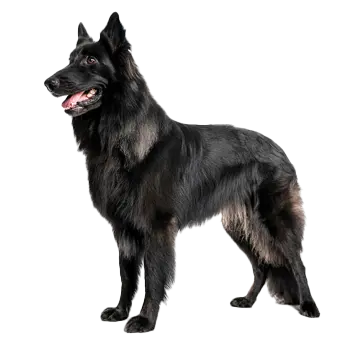
The Belgian Sheepdog's first impression is of a black dog carrying itself with unmistakable alertness - head up, ears forward, watching everything. The overall silhouette is square and balanced, with no exaggerated features in any direction. This is a dog built to work in the field and cover ground efficiently, and it looks the part without the extreme proportions that sometimes creep into heavily line-bred show dogs.
The head is long and refined without being narrow, with a flat skull approximately equal in length to the muzzle. The forehead is moderately rounded between the ears but not domed. The stop is moderate, neither abrupt like a brachycephalic breed nor absent like a sighthound. The muzzle tapers gradually to the nose, which should be black. Lips are tight and black. The bite is scissors or level, with scissors preferred. A poorly developed head or a coarse, heavy skull is considered a fault.
The eyes are medium-sized, slightly almond-shaped, and set obliquely in the skull. Brown is the correct color, with dark eyes preferred. The expression - alert, questioning, intense - is one of the breed's most distinctive features. A soft or dull expression is considered a functional fault in a breed whose attentiveness is part of its working character. The ears are small, triangular, stiff, and carried upright. Ear set is high on the skull. Soft, folded, or hound-like ears are incorrect.
The neck is muscular and slightly arched, blending cleanly into well-laid-back shoulders. Throatiness or a ewe neck would compromise the clean carriage that defines the breed's appearance. The topline is level from withers to the slight fall of the croup. The chest is not broad but has reasonable depth, reaching to the elbow. The ribs are well-sprung without being barrel-shaped, giving the dog lung capacity without interfering with its free, sweeping movement.
The tail is strong at its base and reaches at least to the hock when hanging naturally. In action it is raised, forming a gentle curve, but should never curl over the back or be carried laterally. A tail carried flat and low at rest, or tucked in nervous dogs, is a behavioral flag as much as a physical one.
Forequarters feature clean, well-angulated shoulders with upper arms approximately equal in length to the shoulder blades. The elbows are close to the body but not bound. Pasterns are medium in length and slightly sloped. The feet are round, cat-footed, with arched toes and well-padded soles - working feet built for terrain. Hindquarters are powerful and angulated to match the front, with well-developed thighs and a hock that is firm and perpendicular to the ground. The double suspension gallop of a sound Belgian Sheepdog is effortless and covers significant ground with minimal apparent effort.
The coat is where this breed makes its most dramatic visual statement. The outer coat is long, straight, and abundant with a texture that is neither harsh like a wire coat nor soft like a silky toy breed - somewhere between, with enough body to lay properly and shed debris. The undercoat is dense, soft, and serves as the thermal layer in both cold and wet weather. Around the neck and chest the coat forms a pronounced mane or ruff that is noticeably heavier in males. The legs carry fringing, and the tail is well-plumed. The face - muzzle, cheeks, and ears - is covered in shorter, velvety hair.
Color is simple: solid black. The standard permits small amounts of white on the chin, muzzle tip, chest, and toes, and allows frost on the muzzle of older dogs. Any other color is a disqualification under AKC rules. The black is typically a rich, deep shade when the coat is in good condition, and can take on a slightly brownish cast in sun-bleached or nutritionally compromised coats.
Males stand 24 to 26 inches at the withers and typically weigh 55 to 75 pounds. Females are smaller and lighter at 22 to 24 inches and 45 to 60 pounds. The sexual dimorphism is clear to the eye - males carry more coat in the mane and are noticeably more masculine in head and body, while females are leaner and more refined without appearing slight. An oversized, heavy dog loses the elegance that is central to this breed's standard.
Movement is one of the Belgian Sheepdog's hallmarks. At a trot the dog covers ground with a smooth, ground-eating stride that is effortless to watch and clearly efficient in practice. There should be no wasted vertical motion - the back stays level and the reach and drive from front and rear are well-matched. At speed the dog single-tracks, converging toward a center line without crossing. Hackney gait, crabbing, or a choppy stride are all movement faults that suggest structural problems underneath the coat.
Affectionate With Family
★★★★☆
The Belgian Sheepdog forms a deep, committed bond with its household and is warm and attentive with people it knows well. It is not a casual lap dog but shows genuine devotion through constant awareness of and responsiveness to its family.
Good With Young Children
★★★☆☆
This breed can do well with children it has been raised alongside, but its herding instincts mean it may attempt to chase or circle fast-moving small children. Supervision is important, and very young children may find its energy and intensity overwhelming.
Good With Other Dogs
★★★☆☆
Belgian Sheepdogs can live peacefully with dogs they know, but same-sex tension and territorial behavior around unfamiliar dogs is not uncommon, particularly in intact or undersocialized animals. Early, consistent socialization makes a meaningful difference.
Shedding Level
★★★★☆
The long black double coat sheds year-round at a steady rate, with heavier seasonal blows in spring and fall. Black hair on light furniture and clothing is a constant reality of living with this breed.
Coat Grooming Frequency
★★★☆☆
The coat needs brushing two to three times per week to prevent tangles at the collar, behind the ears, and in the leg feathering. During seasonal shedding, daily brushing is necessary to manage the volume of loose coat.
Drooling Level
★☆☆☆☆
The Belgian Sheepdog is a dry-mouthed breed. Drooling is essentially a non-issue and not a factor in daily life with this dog.
Coat Type
★★★★☆
The long, abundant double coat with its dense undercoat and profuse mane around the neck and chest is a moderate maintenance commitment. It is not as demanding as the corded Bergamasco but requires consistent attention to stay tangle-free and healthy.
Openness To Strangers
★★☆☆☆
This breed is naturally reserved and watchful around people it does not know, which is a direct expression of its guarding and herding heritage. With proper socialization it can be neutral and polite, but it rarely warms up to strangers the way a more outgoing breed would.
Playfulness Level
★★★★☆
Belgian Sheepdogs retain a strong play drive well into adulthood and genuinely enjoy games, fetch, and interactive training sessions. Their play often has a purposeful edge to it - they want to chase, retrieve, or work, not just tumble around.
Watchdog/Protective Nature
★★★★★
This breed is a serious watchdog with territorial instincts and the alertness to back them up. It will notice everything out of place and is not shy about voicing its opinion. Protective behavior is a core part of this breed's character.
Adaptability Level
★★★☆☆
The Belgian Sheepdog can adapt to various living situations if its exercise needs are fully met, but it is not a dog that does well with boredom or confinement. It is better suited to homes with space and a committed handler than to sedentary apartment life.
Trainability Level
★★★★★
This is one of the most trainable breeds in the herding group. It learns quickly, retains commands reliably, and performs in demanding sports like Schutzhund, agility, and search and rescue. The challenge is keeping training interesting - this dog knows when you are going through the motions.