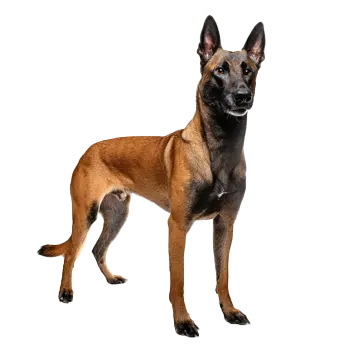
The Belgian Malinois is a dog that does not waste a single structural element on anything non-functional. Every aspect of the breed's build reflects what the dog was made to do: cover ground all day at an efficient trot, respond instantly to commands, and move with the combination of speed and precision that defines a world-class working dog. Standing 24 to 26 inches at the shoulder and weighing 60 to 80 pounds (males), this is a medium-sized breed that is deceptively powerful - lean rather than heavy, but capable of astonishing athletic output.
The head is the first thing you notice, and specifically the face - the Malinois wears a characteristic black mask that covers the muzzle and extends up around the eyes, contrasting sharply with the fawn or mahogany body coat. This combination of the black mask and the almond-shaped, dark-brown eyes creates an expression of intense, focused alertness that experienced working dog people immediately recognize. The head is long and lean, with a flat skull and a muzzle equal in length to the skull. There is a moderate stop. The jaws are strong, and the bite is scissors. The black nose matches the mask.
The ears are triangular, moderately large, and carried rigidly upright with the opening facing forward. Set high on the skull, they reinforce the impression that this dog is always listening, always pointed toward the source of any stimulus. The ears move independently, tracking sounds with the precision of a radar array. This is not a dog that you approach without being noticed - its peripheral awareness and sound sensitivity are extraordinary.
The neck is moderately long, strong, slightly arched, and well-muscled. It flows cleanly into well-laid shoulders. The topline is firm and level from withers to croup. The chest is deep, reaching to the elbow, with well-sprung ribs. The loin is short, muscular, and tight. The croup slopes gently toward the tail, which is thick at the base, reaches at least to the hock, and is carried in a gentle upward curve when the dog is active. A tail carried flat or dragging indicates a depressed or exhausted dog - the normal working Malinois carries its tail with energy.
The forelegs are straight and parallel, with strong bone that is dense without being heavy. Feet are round and catlike, with well-arched toes and strong pads built for work on varied terrain. The hindquarters are the engine: powerful, well-angulated, with substantial second thighs that deliver the explosive acceleration and sustained driving force that make this breed capable of running sustained pursuit distances that exhaust other breeds. When moving at a trot, the Malinois covers ground with a long, reaching stride and minimal vertical motion - the ideal military and herding trot that can be maintained all day.
The coat is one of the breed's most practical features - short, straight, and hard-textured, lying flat against the body with a dense undercoat that provides insulation. There is slightly longer hair on the neck forming a ruff that is more pronounced in males, and slightly longer hair on the tail and backs of the thighs. The coat is weather-resistant and largely self-maintaining. It sheds continuously at a low level and blows coat twice annually when the volume increases substantially.
Color is fawn to rich mahogany with black-tipped outer hairs that give the coat a characteristic overlay or shading effect. The black mask is a required standard feature. The ears should be black or very dark. Small amounts of white on the chest and the tips of the toes are permitted. The depth of the base color varies from individual to individual and line to line, ranging from light fawn that is almost cream to a rich, warm red-mahogany. Both are correct; preference is not specified in the standard.
Sexual dimorphism is pronounced. Males are distinctly more masculine and substantial than females, with a broader, more powerful head and greater overall bone and muscle mass. Females are refined enough to be clearly female at a glance. The weight difference - up to 20 pounds between the sexes - reflects genuine structural difference, not just scale variation. The square proportions required by the standard - height at shoulder approximately equal to body length from shoulder point to hip - give both sexes a compact, athletic appearance that distinguishes the Belgian type from the longer-bodied herding breeds. Overall, the Malinois should convey a sense of readiness - a dog that is relaxed but not lazy, attentive but not anxious, and physically capable of immediate explosive action from a standing position.
Affectionate With Family
★★★★☆
The Malinois bonds intensely with its handler and family and is genuinely affectionate with the people it trusts. This is not a standoffish breed at home - it wants to be close to its people and notices everything they do.
Good With Young Children
★★☆☆☆
Not recommended for households with young children without careful management. The Malinois's high drive, speed, and herding instincts create real risk around toddlers and unpredictable small children. Better suited to households with older kids who can interact appropriately.
Good With Other Dogs
★★☆☆☆
Can be dominant, reactive, or overly intense with other dogs - particularly during play that escalates. Early socialization and ongoing management are needed. Not reliably safe in dog-park scenarios with unknown dogs.
Shedding Level
★★★★☆
Year-round moderate shedding increases significantly twice a year during coat blows. The short coat leaves fine, dense hairs embedded in fabric and upholstery that require consistent management.
Coat Grooming Frequency
★★☆☆☆
The short coat is genuinely low-maintenance. Weekly brushing handles routine shedding; a deshedding tool during coat blows is helpful. No professional grooming required.
Drooling Level
★☆☆☆☆
Clean-mouthed and tidy. Drooling is not a characteristic of this breed.
Coat Type
★★☆☆☆
A short, straight, hard-textured outer coat with a dense undercoat. The coat is weather-resistant and requires minimal care - probably the most wash-and-go coat of the four Belgian varieties.
Openness To Strangers
★★☆☆☆
Reserved and watchful with strangers - this is a breed bred to guard and protect, and its default response to the unfamiliar is alert assessment rather than social enthusiasm. Proper socialization shapes how this manifests in practice.
Playfulness Level
★★★★☆
Highly playful and toy-motivated - the Malinois's prey drive makes it a willing, enthusiastic play partner for the right handler. This drive is also the foundation for bite sport and detection work.
Watchdog/Protective Nature
★★★★★
Natural guardian instincts are among the strongest of any herding breed. The Malinois is alert, responsive, and physically capable of meaningful protection - not a dog to acquire without a plan for managing those instincts.
Adaptability Level
★★☆☆☆
This breed needs purpose, work, and an experienced handler. It can theoretically live in a variety of environments but only with daily, intensive engagement. Without that, it becomes a destructive, anxious, or potentially dangerous dog.
Trainability Level
★★★★★
Perhaps the most trainable breed in the working dog world. The Malinois learns with stunning speed and works with commitment that few breeds can match. This trainability also means that bad habits, fear, and aggression develop with the same speed as good behaviors.