Belgian Griffon

Brussels Griffon

Quick Facts

🐕 Breed Group
Toy Group
📏 Size Category
Toy
📏 Height
Males: 7-10 inches, Females: 7-10 inches
⚖️ Weight
Males: 8-10 pounds, Females: 6-9 pounds
⏱️ Life Expectancy
12-15 years
🧣 Coat Type
Rough (wiry) or smooth; the Belgian Griffon is the rough-coated non-red variety
🎨 Coat Colors
Black, black and tan, or red with a black mask (any color except solid red)
😀 Temperament
Devoted, lively, alert, self-important
🏃 Exercise Needs
Low to moderate
🎓 Training Difficulty
Moderate - intelligent but stubborn
👶 Good with Children
Better with older, gentle children; fragile for rough play
🐾 Good with Other Pets
Generally good with other pets

Other Names & Breed Recognition

The Belgian Griffon is one of three closely related varieties that together make up what is registered in the United States and most English-speaking countries simply as the Brussels Griffon. Understanding the distinction requires a brief detour into Belgian breed classification, where these three varieties are treated as separate entities: the Griffon Bruxellois (Brussels Griffon in English), the Griffon Belge (Belgian Griffon in English), and the Petit Brabancon. All three are grouped together under the Brussels Griffon registration in the AKC and CKC, but in Belgium and under the FCI, they are classified individually.

The color and coat are what separate them. The Brussels Griffon is the rough-coated variety in solid red. The Belgian Griffon is the rough-coated variety in any color other than solid red - typically black, black and tan, or red with a black mask. The Petit Brabancon is the smooth-coated version in any of these colors. The body type, size, temperament, and health profile are identical across all three. If you have been looking for information about a small Belgian dog with a wiry coat in a non-red color, the Belgian Griffon page is where you have landed.

In practice, the Belgian Griffon name surfaces most frequently in discussions of Belgian and FCI breed classification, in breed histories that discuss the original Belgian varieties, and among enthusiasts who know the breed well enough to use the specific variety names. Most people in North America simply call all three varieties Griffons or Brussels Griffons regardless of coat color, and that is the name the American Brussels Griffon Association and the AKC use for the group.

The breed also carries informal names within the community, including Griff or Griffs as a general shortened form. The expressive, human-like face has generated many comparisons over the years - Belgian folk songs historically described these dogs as bearded dogs, a reference to the fringe around the muzzle that gives the face its characteristic look. That same face earned one Griffon named Verdell a starring role in the 1997 film As Good as It Gets, introducing the breed to millions of people who had never encountered one before.

Belgian Griffon Organizations & Standards

The primary breed organization in the United States is the American Brussels Griffon Association, which serves as the AKC parent club for the breed and covers all three varieties - the Brussels Griffon, the Belgian Griffon, and the Petit Brabancon - under the Brussels Griffon registration. The Association maintains the breed standard, offers a Champions for Health program that recognizes breeders based on health testing activity, and provides breeder referral and rescue resources for the breed.

In Belgium, the Griffon Bruxellois Club and associated organizations oversee the three varieties under the FCI framework. The FCI classifies all three as small Belgian dogs in Group 9, Section 3, and maintains separate breed standards for each variety that account for their specific color and coat characteristics. The Belgian standard is the origin document from which all other registries derive their standards.

The AKC breed standard describes a small, stocky dog with a domed skull, short, truncated face, broad chest, level topline, and a short tail - historically docked, though this practice is increasingly restricted in many countries. Weight should fall between 8 and 10 pounds for males and 6 to 9 pounds for females, though some individuals run slightly heavier. The standard emphasizes the almost human expression created by the combination of large, wide-set eyes, prominent chin, and the fringe of wiry hair that forms the beard and fringe. This expression - alert, self-assured, and slightly comedic - is considered the defining characteristic of the breed.

For health testing, the American Brussels Griffon Association recommends OFA patella evaluation, OFA hip evaluation, OFA thyroid evaluation, CERF eye examination, an ERG test for progressive retinal atrophy, and an MRI for syringomyelia. Patella and eye testing are particularly emphasized. The Champions for Health program awards recognition tiers to breeders based on how many of these tests they complete and publish. Buyers should ask for documentation of health clearances and verify them through the OFA database. The club does not require all breeders to publish results, so buyers must ask directly rather than assuming clearances have been obtained.

The Kennel Club in the United Kingdom recognizes all three varieties in the Toy Group. The breed is relatively rare outside Belgium, France, and the United States, though dedicated breed clubs in multiple countries work to maintain healthy populations. The small gene pool worldwide makes health transparency programs particularly important - responsible breeders who publish test results contribute meaningfully to the breed's long-term wellbeing.

Kennel Club Recognition

  • American Kennel Club (AKC): Recognized in 1910, Toy Group
  • United Kennel Club (UKC): Recognized, Companion Breeds
  • Canadian Kennel Club (CKC): Recognized, Toy Group
  • FCI: Recognized, Group 9 - Companion and Toy Dogs
  • The Kennel Club (UK): Recognized, Toy Group

Belgian Griffon Physical Description

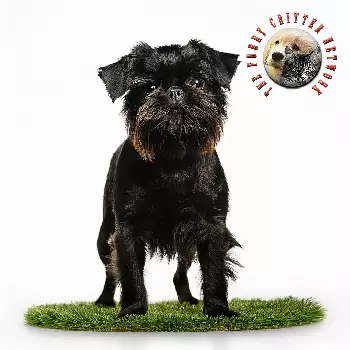
The Belgian Griffon is a toy dog with a face that stops people in their tracks. The combination of large, dark, wide-set eyes, a short pushed-in muzzle, prominent rounded chin, and the wiry fringe of beard and mustache creates a visage that has been compared to a Wookiee, an Ewok, a very small old man, and assorted other things people find when they look into those enormous dark eyes. It is not an exaggeration to say that this is one of the most distinctive faces in the entire dog world. There is genuinely nothing else that looks quite like a Griffon.

The skull is large for the body and domed, giving the head a rounded appearance. The stop - the junction between the muzzle and the skull - is abrupt and deep. The muzzle is very short, turned upward at the tip, and this upward tilt is an important feature of the breed standard. The nose is wide and black. The chin is broad and prominent, and the jaw has a slight undershot bite that is required by the standard. The teeth and tongue should not show when the mouth is closed.

The body is small and compact. The chest is broad for the dog's size, the ribs well-sprung, and the topline level from withers to croup. The legs are straight and sturdy - not delicate or fine-boned as one might expect in a toy breed. The feet are cat-like and tightly padded. Despite the small dimensions, there is a solidity to the Griffon's construction that makes them feel more substantial than their weight suggests when you pick one up.

The rough coat of the Belgian Griffon is wiry, harsh, and stands off the body rather than lying flat. It forms the characteristic beard and mustache around the muzzle that are the most expressive features of the face. The coat on the body is dense and should feel harsh rather than soft - when the coat softens, it loses its proper texture and the dog loses some of its characteristic look. Hand-stripping is the grooming method that maintains proper coat texture; clipping tends to soften and flatten the coat over time.

Color distinguishes the Belgian Griffon from its Brussels Griffon sibling. Where the Brussels Griffon is red, the Belgian Griffon comes in black, black and tan, or red with a black mask. All are acceptable under the standard. The black coat should be solid and free from rust tones, and the tan markings in black and tan dogs appear in the traditional locations - above the eyes, on the cheeks, chest, and lower legs. The pigment is black throughout, including nose, eyelid rims, and lips, which gives black and black-and-tan Belgian Griffons a slightly more formal look than the warmer palette of the red Brussels Griffon variety.

The overall impression of a well-conformed Belgian Griffon is of a dog that is simultaneously sturdy and expressive - small but not fragile-looking, with a square, compact body under that remarkable face. The neck is short and arched. The back is level and short. The hindquarters are rounded and muscular. Everything about the physical construction is meant to be compact and balanced, not miniaturized or elongated.

In motion, the Griffon moves with a purposeful, energetic trot that reflects its confident temperament. The legs should move straight with good extension and drive. A Griffon that moves awkwardly or shows lameness may be experiencing patellar luxation, which is worth monitoring and discussing with a veterinarian familiar with small breeds. Sound, effortless movement is a health indicator in this breed, not just an aesthetic standard to observe in the show ring.

Affectionate With Family
The Belgian Griffon is intensely devoted to its people and will follow them from room to room throughout the day. They bond deeply and take their companion role seriously, offering constant presence and affection.
Good With Young Children
This is a small, somewhat fragile dog that does not hold up well to rough handling. Older children who treat dogs gently can do well with a Griffon; young children and toddlers are generally a poor match.
Good With Other Dogs
The Belgian Griffon typically gets along well with other dogs, particularly those of similar size. Their self-confident nature may lead them to challenge dogs much larger than themselves, which requires owner awareness.
Shedding Level
The rough-coated Belgian Griffon sheds minimally. The smooth-coated Petit Brabancon variety sheds more noticeably during seasonal changes. Both are manageable in terms of coat maintenance.
Coat Grooming Frequency
The rough coat requires regular brushing and periodic hand-stripping or trimming to maintain its texture and appearance. Monthly professional grooming or diligent home care keeps the coat in good condition.
Drooling Level
Drooling is essentially absent in this breed. Despite the flat face, Griffons are tidy dogs in this respect.
Coat Type
The Belgian Griffon has a wiry, harsh rough coat that stands off the body and forms the characteristic beard and fringe around the face. The texture requires hand-stripping to maintain its proper feel.
Openness To Strangers
Griffons can be reserved with new people but usually warm up once they have assessed the situation on their own terms. Early socialization produces more confident adults who adapt smoothly to meeting strangers.
Playfulness Level
Belgian Griffons are lively and playful, with a streak of silliness that delights their owners. They enjoy games and interactive play, and their enthusiasm for activity is disproportionate to their size.
Watchdog/Protective Nature
Alert and quick to notice changes in the environment, the Griffon makes a reliable household alarm. They are not protective in a physical sense, but their bark is persistent and hard to miss.
Adaptability Level
Few breeds adapt as readily to varied living situations as the Griffon. City apartment or country home, active household or quiet one - the Griffon adjusts to what its people provide, as long as they are present.
Trainability Level
Intelligent but capable of selective hearing when something seems more interesting than the lesson at hand. Positive reinforcement with food rewards works best. The breed responds poorly to harsh methods or repetitive drilling.

Belgian Griffon History & Development

The Belgian Griffon and its closely related varieties trace their origins to the stables and coachhouses of 19th century Brussels, where small, rough-coated terrier-type dogs were kept to catch the rats that were a persistent problem in any establishment that housed horses. These dogs - scrappy, tenacious, and effective at their job - were the foundation stock that Belgian coachmen eventually refined into the companion dog we know today.

The transformation from working rat-catcher to aristocratic companion happened relatively quickly once Belgian nobles and eventually royalty took notice of these compact, expressive little dogs. The critical development was a series of deliberate crosses with other breeds - primarily the black Pug, which introduced the flat face and rounded skull, and the English Toy Spaniel, which contributed to the coat texture and size. The Affenpinscher is also cited as an early contributor. By the 1870s, the rough-coated Belgian dogs with their remarkable faces had caught the attention of Queen Marie Henriette of Belgium, who became an enthusiastic promoter and breeder of the variety. Royal patronage dramatically accelerated the breed's popularity both in Belgium and across Europe.

The three Belgian varieties - the Brussels Griffon, the Belgian Griffon, and the Petit Brabancon - were established by Belgian breeders in the 1880s and a formal breed standard was set in 1883. The Club du Griffon Bruxellois was founded in Brussels in 1889. The Brussels Griffon (red rough coat), the Belgian Griffon (non-red rough coat), and the Petit Brabancon (smooth coat) were recognized as distinct varieties distinguished by coat and color, though all three were treated as products of the same breeding program.

The breed reached England in the early 1890s and was registered in the English Stud Book by 1898. It arrived in the United States in the early 1900s and the AKC recognized it in 1910. The two World Wars devastated the Belgian Griffon population as they had so many European breeds, and the breed came close to extinction after World War II. British breeders made the most significant contribution to the revival, and it is largely thanks to their efforts that the breed survived into the 1950s and regained population.

Today, the three varieties are registered together under the Brussels Griffon name in North America. The Belgian Griffon name remains in use in FCI countries and in breed historical discussions, preserving the original Belgian classification that recognized the distinction between the red rough-coated variety and the non-red rough-coated variety as a meaningful difference worthy of separate identity.

The Belgian Griffon name is preserved in FCI registration and in the vocabulary of breed historians as an acknowledgment that these three varieties, though related and often interbred, represent distinct contributions to a shared heritage. The non-red coat colors that define the Belgian Griffon variety likely reflect the influence of the black Pug cross more directly than the red coat does. Whether called Belgian Griffon, Brussels Griffon, or simply Griff, the dog at the end of the name is the same intensely devoted, expressive, irreplaceable companion that Belgian coachmen accidentally created in the stables of the 19th century.

Belgian Griffon Temperament & Personality

The Belgian Griffon is a small dog that does not know it is small. It carries itself with a self-importance that would be more appropriate in a breed ten times its size, and it approaches new situations, new people, and other animals with a confidence that can tip over into bravado if not channeled by a sensible owner. This is not aggression - it is an attitude, and it is one of the most endearing things about the breed if you have the right frame of mind for it.

Devoted does not fully capture what this breed is to its people. The Belgian Griffon is one of those dogs that operates as a shadow, a constant companion in every room, present at every activity, and very much of the opinion that whatever you are doing would benefit from its involvement. Owners describe a quality of attention and emotional sensitivity that makes the Griffon feel unusually attuned to human moods. These dogs read people well, respond to subtle changes in tone and body language, and are genuinely distressed when separated from their person for extended periods.

The flip side of that deep attachment is a susceptibility to separation anxiety that is real and worth managing proactively. A Belgian Griffon that has not been taught to tolerate alone time from puppyhood can develop patterns of distress - barking, destructive behavior, house training regression - when left alone that are difficult to address in an adult dog. Teaching the dog that short departures are normal, boring, and that you will always return is one of the most important things a new Griffon owner can do in the first weeks of ownership.

With strangers, the Belgian Griffon tends to hold back and assess before deciding to engage. Some are genuinely shy if not socialized broadly as puppies. Well-socialized individuals are more likely to eventually warm to new people, though they typically direct their most generous affection toward the people who live with them. The breed is not a social butterfly in the manner of a Labrador - it saves its heart for its household.

The intelligence is real. Griffons learn quickly, notice everything, and can be resourceful problem-solvers when motivated by food or a goal they have set for themselves. That same intelligence drives their tendency to find the training boring once they have figured out what is being asked. Keeping sessions short, novel, and generously rewarded produces the best results. The breed does not take well to repetitive drilling, correction-based methods, or any approach that damages the trust it has placed in its person.

One characteristic that takes some new owners by surprise is the Griffon's opinion of its own importance relative to the other animals in the household. These dogs will challenge dogs many times their own size and will generally proceed without registering that the size difference exists. This confident self-assessment is charming in most situations and requires owner management in others. Early socialization and clear household structure help channel this quality productively.

Belgian Griffon Family Life & Living Requirements

The Belgian Griffon is one of the most adaptable dogs in the toy group in terms of living situation. It functions equally well in a city apartment and a country home, with an active family and with a quieter household, because what it needs most is human company rather than square footage or a specific type of environment. A Griffon with its person in a studio apartment is more content than a Griffon alone in a large house, which is a practical reality that prospective owners should weigh honestly against their daily schedules.

This breed is best suited to households where someone is home reliably for most of the day. A retired person, a remote worker, or a family where one adult is typically home represents the ideal Griffon household. Long days alone are genuinely difficult for this breed and produce the separation anxiety and associated behaviors that end up in rescue. If your lifestyle involves regular long absences, a different breed with more emotional self-sufficiency is a kinder choice.

Belgian Griffons and young children are not naturally the best combination. The dog's small, fine-boned structure means it can be injured by rough handling that a larger breed would brush off. Children who have been taught to handle dogs gently and who respect the dog's space can have a wonderful relationship with a Griffon - the breed's affectionate, playful personality translates well to appropriate child-dog interaction. Very young children who cannot yet control their impulses around fragile animals are the population of concern.

The flat face of the Belgian Griffon - a brachycephalic feature shared with all three Griffon varieties - creates real sensitivity to heat and humidity. Outdoor time in warm weather should be limited to cooler parts of the day, and the dog should always have access to cool, air-conditioned spaces. This is not a breed for outdoor kennel life or warm-climate households without climate control. Owners in hot climates need to be especially thoughtful about exercise timing and duration in summer.

The Belgian Griffon is not a dog for outdoor kennel life under any circumstances. These are indoor companion dogs that deteriorate physically and emotionally when denied human contact and comfortable living conditions. Their brachycephalic anatomy makes them unsuited to temperature extremes, and their deep attachment to their people makes isolation genuinely distressing for them. This is a dog that was developed to live alongside people, and that is where it belongs.

Belgian Griffon Training & Exercise Needs

The Belgian Griffon benefits from training far more than its small size and toy group classification might suggest. A Griffon that receives no formal training becomes the one setting the household rules, which is an outcome that is both predictable and inconvenient. Small dogs have the same capacity for unmanageable behavior as large ones - they are just easier to ignore until the problem is entrenched. Early obedience training establishes the pattern of communication and cooperation that makes the Griffon a genuinely pleasant companion rather than a demanding one.

Positive reinforcement is the right approach for this breed. The Belgian Griffon is sensitive and forms strong emotional associations with people and experiences. Training that uses food rewards, play, and genuine praise builds the kind of cooperative relationship where the dog wants to engage. Training that uses corrections, pressure, or harsh methods damages that relationship and typically produces either a dog that shuts down or one that becomes more evasive. Neither outcome is useful.

Housetraining is the specific challenge most often cited by new Griffon owners. Small breeds have small bladders and the physiology to match, which means more frequent outdoor trips are necessary, particularly with puppies. Cold and wet weather compounds the problem because Griffons are notably reluctant to go outside in conditions they find unpleasant. A consistent schedule, crate training, and patience with the timeline - which is often longer than for larger breeds - are the practical tools that make housetraining work.

Exercise needs are moderate. Daily walks totaling thirty to forty-five minutes, combined with indoor play sessions, are sufficient for most adult Belgian Griffons. They can participate in dog sports including AKC Rally, obedience trials, and agility at the appropriate size level, and many Griffon owners find that sport work improves focus and cooperation in everyday life. The brachycephalic anatomy limits stamina in heat and humidity, so exercise sessions should be scheduled thoughtfully in warm weather. Short, frequent activity periods are better for this breed than one long demanding session.

Leash manners are worth prioritizing early with this breed. A Griffon that has been allowed to pull, lunge, and dictate the terms of every walk is harder to exercise safely and pleasantly. Teaching a loose-leash walk during puppyhood, when the dog is small and the correction is easy, prevents a frustrating pattern from becoming entrenched. A dog that walks well is a dog that gets taken places, which benefits its socialization and enrichment substantially.

Belgian Griffon Health Concerns

The Belgian Griffon shares its health profile with the Brussels Griffon and the Petit Brabancon, since all three varieties are genetically the same breed with different coat and color characteristics. The most significant health considerations in this breed arise from its brachycephalic anatomy and from several inherited conditions documented in the population.

Buyers who prioritize health-tested litters are making a meaningful choice. The ABGA's Champions for Health program is a practical tool for identifying breeders who invest in this work. Confirming that a puppy's parents have patella, eye, and ideally MRI documentation gives the best available foundation for a long and healthy relationship with this breed.

Common Health Issues

  • Brachycephalic Obstructive Airway Syndrome - BOAS, : Structural airway abnormalities including stenotic nares, elongated soft palate, and narrow trachea caused by flat-faced conformation. Ranges from mild to surgically significant. Heat and exercise intolerance are early indicators.
  • Patellar Luxation: The kneecap slips out of the femoral groove - A common condition in small toy breeds. Ranges from intermittent lameness to persistent orthopedic impairment requiring surgery. OFA patella evaluation recommended for breeding stock.
  • Progressive Retinal Atrophy - PRA, : Inherited degeneration of the retina progressing toward blindness. ERG testing is available and recommended by the American Brussels Griffon Association for breeding dogs.
  • Syringomyelia and Chiari-Like Malformation: Fluid accumulation in the spinal cord caused by overcrowding of the skull and brain - Related to the breed's domed skull conformation. Ranges from symptom-free to severe pain and neurological deficits. MRI diagnosis required.
  • Periodontal Disease: The brachycephalic jaw structure causes tooth crowding that dramatically increases tartar buildup and gum disease risk - Daily brushing is the most effective preventive measure.
  • Cataracts: Clouding of the lens that can progress to impaired vision or blindness - Identified through CERF examination.

Preventive Care & Health Monitoring

  • OFA Patella Evaluation: Required examination for CHIC - Confirms the kneecap tracks correctly in breeding dogs and is the most essential orthopedic test for this breed.
  • ERG Test for Progressive Retinal Atrophy: Electroretinography screens for inherited retinal degeneration - Recommended by the American Brussels Griffon Association for breeding stock.
  • CERF Eye Examination: Annual examination by a board-certified veterinary ophthalmologist. Screens for cataracts - Corneal conditions, and other inherited eye disease.
  • MRI for Syringomyelia: Recommended by the ABGA for breeding stock - Identifies Chiari-like malformation and early syringomyelia before symptoms develop.
  • OFA Hip and Thyroid Evaluation: Additional health screens recommended by the ABGA - Hip evaluation confirms joint integrity. Thyroid evaluation screens for autoimmune thyroiditis.
  • Daily Dental Hygiene: Given the breed's high susceptibility to dental disease due to tooth crowding - Daily brushing with dog-appropriate toothpaste and regular professional cleanings are essential preventive care.

Belgian Griffon Grooming & Maintenance

The rough coat of the Belgian Griffon requires more attention than the smooth Petit Brabancon variety, but it is still a manageable commitment for a dedicated owner. The wiry, harsh texture that gives the Griffon its characteristic look is maintained through hand-stripping - the process of removing dead outer coat by pulling it out by the root rather than cutting it. Clipping achieves the same shape but softens the coat texture over time, gradually changing it from wiry and harsh to soft and fluffy. Show dogs are hand-stripped; pet dogs are often clipped for convenience, and this is a perfectly acceptable choice for a companion animal.

For the rough-coated Belgian Griffon, regular brushing two to three times a week prevents matting in the softer undercoat beneath the wiry outer layer. Professional grooming every six to eight weeks is realistic for most owners, covering trimming, bathing, ear cleaning, and nail care. The beard and mustache require particular attention since they collect food and water after every meal and drink - wiping the face with a damp cloth after meals prevents staining and keeps the coat fresh.

The prominent, large eyes of the Griffon are one of the most important maintenance areas. Due to their size and exposure, these eyes are prone to scratches, irritation, and debris accumulation in the inner corners. Checking the eyes daily, wiping away any discharge with a soft, damp cloth, and watching for redness or squinting that could indicate injury or infection keeps eye problems from becoming serious. Any change in the eyes warrants a veterinary evaluation - do not wait on this.

Nails should be trimmed every three weeks. Griffons are typically indoor dogs without much hard-surface activity to wear nails naturally, so consistent trimming is more important than it might be for more active outdoor breeds. Daily tooth brushing with dog-appropriate toothpaste is strongly recommended for this breed given the crowded dental anatomy that predisposes them to periodontal disease. Establishing the routine during puppyhood, when the dog is learning to accept all types of handling, makes the lifelong habit far more manageable and far less stressful for both dog and owner.