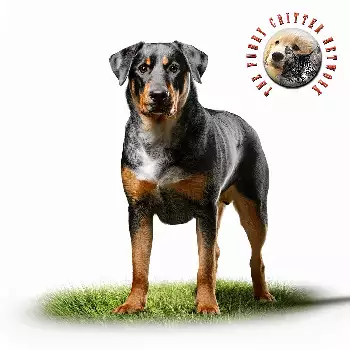
The Beauce Shepherd is a large, well-muscled dog that carries its mass without appearing heavy or coarse. Stand one next to a German Shepherd and the comparison becomes obvious - both are athletic herding breeds with intelligent expressions - but the Beauceron is distinctly French in its construction, carrying more substance and a somewhat more rectangular profile. Males stand between 25.5 and 27.5 inches at the withers and weigh between 70 and 110 pounds. Females are slightly smaller but still solidly built, with the same impression of depth and endurance. The overall silhouette is of a dog balanced between elegance and power - neither coursing hound thin nor livestock guardian massive.
The head is proportional and refined without being narrow. The muzzle and skull are roughly equal in length, meeting at a moderate stop. The eyes are dark and oval-shaped, conveying a watchful, confident expression rather than softness or timidity. There is a quality of assessment in the Beauceron's gaze - this is a dog that is always paying attention, reading its environment and the people in it. The ears may be left natural - in which case they hang flat against the head - or cropped, a practice still seen in France and some European countries but rare in North America. Natural ears lie close and do not detract from the overall impression of alertness.
The neck is strong and carried with assurance, flowing into well-laid shoulders that allow for the long, ground-covering stride this breed was built to maintain over hours of work. The chest is deep, reaching the elbow, and the body has a moderate tuck-up at the flank. The back is level and firm. The loins are short and well-muscled. Nothing about the construction should suggest weakness or excess - this is a dog whose proportions were refined over generations of demanding physical work, not for the show ring.
The coat is one of the defining features. It is short, lying flat and firm against the body, and is supported by a dense, woolly undercoat that provides genuine insulation in cold and wet conditions. The French standard notes that this dog slept outside and worked in all weather, and the coat reflects that heritage. The outer coat has a slightly harsh feel and does not wave or curl. In the harlequin pattern, gray and black patches are overlaid on a base with tan markings - each harlequin dog is unique in how the patterning falls. The harlequin should show more black than gray, and white is not permitted.
The color must be black and tan or harlequin. The black and tan pattern is the more common of the two. Tan markings appear above each eye as small spots, on the cheeks and muzzle, on the chest, on the lower legs, and sometimes under the tail. In a well-marked dog, these points are clear and evenly placed. The lower leg markings are the most prominent, giving the breed the Bas Rouge appearance that is almost as famous as the breed itself. The tan is described in French breed documentation as rouge ecureuil - squirrel red - a warm russet rather than a pale yellow tan.
The tail is long and carried low with a slight J-curve at the tip. It should not curl over the back. In motion, the Beauceron moves with a long, elastic trot that covers ground efficiently, the kind of pace that a working dog can sustain for hours without tiring. Judges at working dog competitions look for this fluid movement as a sign of sound construction. The rear dewclaws - double on each hind leg - are a breed requirement and immediately distinguish this dog from similar breeds. They are set close to the leg and are fully formed, not vestigial. Their presence is considered a signature of authentic French herding lineage and a dog shown or bred without them does not meet the standard.
Affectionate With Family
★★★★★
The Beauce Shepherd forms a fierce bond with its people and is deeply devoted to the household it considers its own. Their attachment runs quietly deep - not showy, but absolutely unwavering.
Good With Young Children
★★★☆☆
This breed is patient and protective with children it has been raised around, but its size, energy, and herding instincts make it better suited to families with older kids who understand how to interact respectfully with a large, working dog.
Good With Other Dogs
★★★☆☆
With proper socialization from an early age, the Beauce Shepherd can coexist well with other dogs. Without it, their dominant personality may cause friction, particularly with same-sex dogs.
Shedding Level
★★★☆☆
The short double coat sheds at a moderate rate year-round with a heavier shed in warmer months. Regular brushing keeps loose hair under control.
Coat Grooming Frequency
★★☆☆☆
Weekly brushing and the occasional bath are generally all this breed needs. The short, weather-resistant coat is designed for field work and does not demand much fuss.
Drooling Level
★☆☆☆☆
The Beauce Shepherd is a clean, dry-mouthed dog and drooling is rarely an issue.
Coat Type
★★☆☆☆
The coat is short and lies flat with a dense, woolly undercoat that thickens in cold weather. It is firm to the touch and offers genuine protection in all conditions.
Openness To Strangers
★★☆☆☆
Natural suspicion of unfamiliar people is built into this breed. They are not hostile, but they are watchful and will not warm to strangers without clear signals from their owner.
Playfulness Level
★★★★☆
Beneath the serious working-dog exterior is a dog with a genuine capacity for play, particularly in the company of people they trust. They can be silly and enthusiastic when the mood calls for it.
Watchdog/Protective Nature
★★★★★
Guard and protection work is central to this breed's heritage. They take their role as family guardian seriously and will act on that instinct when they believe their people are threatened.
Adaptability Level
★★★☆☆
This breed does best in homes with space and purpose. They can adapt to varied environments but require enough room and activity to stay mentally and physically satisfied.
Trainability Level
★★★★★
Exceptionally trainable in the hands of someone with experience and consistency. The Beauce Shepherd is used in military, police, and sport work because of its ability to learn and reliably execute complex tasks.