Bavarian Blood Tracker

Bavarian Mountain Hound

Quick Facts

🐕 Breed Group
Scent Hound (FCI Group 6, Section 2)
📏 Size Category
Medium
📏 Height
Males: 18.5-20.5 inches, Females: 17-19 inches
⚖️ Weight
Males: 44-55 pounds, Females: 37-48 pounds
⏱️ Life Expectancy
12-15 years
🧣 Coat Type
Short, dense, close-lying, moderately harsh
🎨 Coat Colors
Deep red, deer red, reddish brown, tan, brindle, fawn, all with darker mask
😀 Temperament
Calm, devoted, reserved with strangers, persistent, courageous
🏃 Exercise Needs
High
🎓 Training Difficulty
Moderate - requires patience and consistency
👶 Good with Children
Yes, with proper socialization
🐾 Good with Other Pets
Conditional - high prey drive with small animals

Other Names & Breed Recognition

Bavarian Blood Tracker is an English translation of the functional description embedded in the breed's German name, Bayerischer Gebirgsschweisshund. The word Schweisshund translates directly as "sweat hound" or "blood hound" in the traditional German hunting vocabulary, where Schweiss refers not to perspiration but to the blood trail left by wounded game. English-speaking hunters and breed enthusiasts adopted "blood tracker" as a shorthand that captures the breed's defining purpose: following the scent of blood and tissue left behind by injured deer, boar, and other hoofed game through difficult mountain terrain. The name distinguishes this dog from general-purpose hounds by pointing directly to its specialized role in the post-shot recovery of wounded animals.

The breed is more commonly known in English as the Bavarian Mountain Hound or Bavarian Mountain Scent Hound, the latter being the name used by the American Kennel Club in its Foundation Stock Service. In continental Europe, the German name Bayerischer Gebirgsschweisshund remains standard, and breed clubs across Austria, Hungary, the Czech Republic, and Scandinavia use their own language translations that preserve the "blood-tracking mountain hound" meaning. The variation in English names reflects the challenge of translating a compound German word that carries centuries of hunting tradition into a concise breed label. Bavarian Blood Tracker is perhaps the most literal and descriptive of the English alternatives, though it has never gained official status with any major kennel club.

The breed holds formal recognition from the Federation Cynologique Internationale, which accepted it in 1959 under Group 6 (Scent Hounds and Related Breeds), Section 2 (Leash Hounds). The FCI standard, maintained by the German parent club, serves as the reference document for breed assessment worldwide. The United Kennel Club in the United States recognized the breed in 1996 under the Scenthound Group, making it one of the first registries in North America to formally accept the breed. The American Kennel Club followed in 2016 by admitting the Bavarian Mountain Scent Hound to its Foundation Stock Service, a program that records purebred populations not yet eligible for full registration and conformation competition. The Kennel Club in the United Kingdom also recognizes the breed within its Hound Group.

Despite its growing international recognition, the Bavarian Blood Tracker remains a rare breed outside central Europe. In Germany and Austria, where the tradition of Nachsuche (the methodical search for wounded game) is both a legal obligation and a deeply respected hunting discipline, the breed maintains a stable working population managed by dedicated breed clubs. Elsewhere, numbers are small and the breed is still largely unknown to the general public. Most Bavarian Blood Trackers outside Europe are owned by serious hunters, wildlife managers, or breed preservation enthusiasts rather than casual pet owners, and this working-dog identity shapes nearly every aspect of the breed's culture and management.

Bavarian Blood Tracker Organizations & Standards

The Club fur Bayerische Gebirgsschweisshunde, founded in Munich in 1912, serves as the breed's parent organization in Germany and the custodian of its FCI standard. This club has maintained strict breeding oversight for over a century, requiring working performance testing before any dog can be used for breeding. The emphasis on proven tracking ability over conformation appearance alone sets the breed's governance apart from many other kennel club structures. Prospective breeding dogs must demonstrate their cold-nose tracking skills in formal field trials that simulate real wounded-game recovery scenarios before they receive breeding approval. This performance-first philosophy has kept the Bavarian Blood Tracker firmly grounded in its working purpose.

The FCI standard describes the breed as a balanced, light-framed, very mobile and muscular medium-sized dog. The body should be slightly longer than tall, with the topline rising slightly from the withers toward the hindquarters. Height at the withers is specified as 47 to 52 centimeters for males and 44 to 48 centimeters for females, with no deviation permitted in either sex. The standard calls for a calm, balanced temperament, with devotion to the owner and reserve toward strangers. It explicitly requires that the dog be sound, self-assured, and biddable, neither shy nor aggressive. These behavioral requirements carry equal weight to physical conformation in breed assessment.

In North America, the Bavarian Mountain Scent Hound Society of America was established in 2017 to serve as the breed's advocate within the AKC system. The society works to educate prospective owners about the breed's working requirements, promote health testing, and develop a community of responsible breeders and owners. Because the breed is still in the AKC's Foundation Stock Service rather than fully recognized, it cannot yet compete in regular AKC conformation events but may participate in companion events and certain performance activities. The UKC, which recognized the breed two decades earlier, allows full conformation and performance competition.

Breed clubs across Europe operate under the umbrella of the FCI standard but often add their own national requirements for breeding approval. In Austria, Germany, and several other countries, breeding stock must pass working tests that evaluate the dog's ability to follow an aged blood trail over varied terrain. These tests are not optional extras but mandatory prerequisites, ensuring that every generation maintains the scenting ability and temperament that define the breed. Health screening requirements vary by country and club but increasingly include hip evaluation and, where available, genetic testing for conditions identified in the breed population. The overall governance structure prioritizes function, health, and temperament in roughly that order, with conformation beauty being a consideration but never the primary selection criterion.

Kennel Club Recognition

  • American Kennel Club (AKC): Recognized in 2016, Foundation Stock Service (Hound Group designation)
  • United Kennel Club (UKC): Recognized in 1996, Scenthound Group
  • FCI: Recognized in 1959, Group 6 - Scent Hounds and Related Breeds
  • The Kennel Club (UK): Recognized, Hound

Bavarian Blood Tracker Physical Description

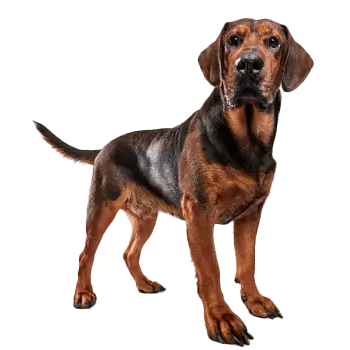
The Bavarian Blood Tracker presents an athletic, well-proportioned silhouette that communicates endurance and agility rather than bulk or raw power. This is a medium-sized dog standing between 17 and 20.5 inches at the withers, with males generally at the upper end of the range and females smaller. Weight is proportionate to height, typically falling between 37 and 55 pounds depending on sex and build. The overall impression should be of a dog light enough to navigate steep, broken mountain terrain for hours at a time yet substantial enough to handle the physical demands of working through dense underbrush, rocky slopes, and uneven ground.

The head is one of the breed's most distinctive features, appearing strong and elongated with a relatively broad skull that is slightly domed when viewed from above. The stop between skull and muzzle is well defined, and the nosebridge is straight or carries a very slight convex curve. The muzzle is broad with solid jaws and tight lips that fully cover the mouth without excessive flews. The nose is large with well-opened nostrils, colored black or dark red, reflecting the extraordinary olfactory apparatus that drives this breed's working capability. Dark, expressive eyes convey intelligence and calm attentiveness. The ears are set high, moderately long, and broader at the base, hanging flat against the head with rounded tips.

The body is slightly longer than tall, with the topline rising subtly from the withers to the hindquarters, a structural feature that provides the rear-drive leverage needed for climbing steep terrain. The chest is well developed, long, moderately wide, and well let down, providing ample lung capacity for sustained physical effort. The loin is short, broad, and muscular. The tail is set high, of medium length, and carried level or slightly downward. It should not curl over the back. The limbs are straight and well-angulated, with strong bone and well-muscled thighs that power the breed's characteristic light, springy, ground-covering gait. Feet are oval-shaped with tight, well-arched toes and tough pads suited to rough terrain.

The coat is short, dense, and glossy, lying very flat against the body with a moderately harsh texture that provides practical weather resistance. Hair is finer on the head and ears and somewhat coarser and longer on the abdomen, legs, and tail. Color ranges across shades of deep red, deer red, reddish brown, tan, reddish grey, and brindle, frequently with a darker mask on the face and darker coloring along the ears. A small white patch on the chest is permitted. The coat's coloring historically served as natural camouflage during woodland tracking work. Black coats with red markings (black and tan pattern) are a disqualifying fault under the FCI standard, as are flesh-colored noses and kinked tails.

Affectionate With Family
The Bavarian Blood Tracker forms an exceptionally tight bond with its owner and immediate family members. This breed was historically handled by a single forester or gamekeeper, and that one-person devotion carries into the home environment. The dog wants to be near its people at all times and will follow household members from room to room throughout the day. It shows affection in a steady, quiet manner rather than through boisterous displays, pressing against its owner's leg or resting its head in a lap. That unwavering attachment means the breed does not tolerate long stretches of isolation well and can develop anxiety or destructive behavior if left alone for extended periods.
Good With Young Children
The Bavarian Blood Tracker has the patience and steady temperament to coexist well with children who understand how to interact respectfully with a dog. The breed is not snappy or reactive under normal circumstances, and its calm indoor demeanor means it is unlikely to bowl over a small child through sheer energy. However, this is a working hound that values its personal space and can become uncomfortable with the unpredictable grabbing and loud noises that come with very young children. Families with toddlers should always supervise interactions and teach children appropriate handling. Older children who can participate in training exercises and outdoor activities will find a willing and gentle companion in this breed.
Good With Other Dogs
The Bavarian Blood Tracker was developed to work independently alongside a single handler rather than as part of a pack, which influences its social dynamics with other dogs. It is generally tolerant and can live peacefully with another dog in the household, particularly if raised together from a young age. Same-sex aggression is not a significant breed trait, but the dog does not actively seek out canine companionship the way pack hounds do. Early socialization is important because the breed can be reserved or indifferent toward unfamiliar dogs. In multi-dog households, the Bavarian Blood Tracker typically bonds more strongly with its human family than with its canine housemates.
Shedding Level
The short, dense coat of the Bavarian Blood Tracker sheds moderately throughout the year with heavier shedding during seasonal coat changes in spring and autumn. The hair is short enough that individual shed hairs do not create the large tufts associated with double-coated spitz breeds, but the density of the coat means a noticeable amount of hair will accumulate on furniture and clothing without regular brushing. During peak shedding periods, daily brushing with a rubber curry brush or hound glove significantly reduces the amount of loose hair around the home. The coat does not mat or tangle, so shedding management is straightforward compared to longer-coated breeds.
Coat Grooming Frequency
Grooming the Bavarian Blood Tracker is a low-maintenance affair that suits owners who prefer a wash-and-wear dog. The close-lying coat stays relatively clean and does not pick up burrs or debris as readily as longer-coated hunting breeds. A weekly once-over with a rubber brush or grooming mitt removes dead hair and distributes natural skin oils that keep the coat glossy. Bathing is needed only when the dog gets genuinely dirty, which in a working dog used for tracking can happen regularly during hunting season. The ears require more attention than the coat itself, as the hanging ear leather can trap moisture and should be checked and cleaned weekly to prevent infections.
Drooling Level
The Bavarian Blood Tracker is not a heavy drooler under normal circumstances. The breed standard calls for lips that fully cover the mouth without excessive flews, which keeps drool contained better than in breeds with loose, pendulous lip structure. Some drooling may occur around mealtimes or after drinking water, and individual dogs with slightly looser lip conformation may produce more saliva than others. Compared to other scent hound breeds that can leave wet trails across the house, the Bavarian Blood Tracker is a relatively tidy companion. Owners should not expect the dry mouth of a terrier, but significant slobber is not characteristic of the breed.
Coat Type
The coat of the Bavarian Blood Tracker is short, dense, and glossy, lying very flat against the body with a slightly harsh texture that provides weather resistance during outdoor work. Hair is finer on the head and ears and somewhat coarser and longer on the abdomen, legs, and tail. This coat evolved to protect the dog while working through dense brush and rough terrain in the Bavarian Alps without collecting excessive debris. The flat-lying structure sheds water reasonably well, though the coat is not truly waterproof in the way a retriever's coat might be. Coat color ranges across various shades of red, tan, fawn, and brindle, typically with a darker mask on the face.
Openness To Strangers
Reserve with unfamiliar people is deeply embedded in the Bavarian Blood Tracker's temperament and reflects the breed's working heritage alongside a single handler in remote settings. The dog is not aggressive toward strangers but maintains a watchful distance until it has assessed the situation and received cues from its owner. This reserved nature means the breed does not rush to greet visitors at the door with tail-wagging enthusiasm. Socialization from puppyhood helps ensure that natural wariness does not tip into timidity or fear-based reactivity. The breed standard explicitly describes the ideal temperament as calm, self-assured, and reserved with strangers, distinguishing appropriate aloofness from shyness or nervousness.
Playfulness Level
The Bavarian Blood Tracker enjoys play but expresses it differently than high-drive sporting or herding breeds. It will happily engage in scent-based games, tug sessions, and moderate fetch, but it does not demand constant interactive play or entertainment. The breed's play style tends toward focused bursts of activity followed by periods of rest, reflecting the stamina-over-speed approach it brings to tracking work. Puzzle toys and scent games hold its attention far longer than repetitive ball throwing. Puppies and young adults show more sustained playfulness, while mature dogs settle into a calm household presence that comes alive primarily during outdoor exercise and scent work.
Watchdog/Protective Nature
The Bavarian Blood Tracker will alert its household to unfamiliar sounds and visitors with a deep, hound-like bark, but it is not an aggressively protective breed. Its natural reserve with strangers means it notices and reacts to changes in the environment, making it a reasonable alarm dog. However, the breed was never developed for guarding or protection work, and it lacks the territorial intensity of dedicated guard breeds. Once the owner acknowledges a visitor, the Bavarian Blood Tracker typically accepts the situation calmly. It will not confront an intruder with physical aggression but will make its presence and displeasure known vocally.
Adaptability Level
The Bavarian Blood Tracker is a breed that thrives in environments where it has space to move and access to outdoor terrain that satisfies its tracking instincts. It does not adapt well to apartment living or sedentary households where exercise opportunities are limited. The breed requires a committed owner who can provide structured physical activity daily, ideally including off-leash time in secure areas where it can use its nose. Changes in routine or living situation should be introduced gradually, as the breed's deep bond with its handler means disruptions to established patterns can cause stress. Rural or suburban homes with access to open land represent the most suitable living arrangement.
Trainability Level
The Bavarian Blood Tracker is intelligent and willing to work but brings a hound's independent thinking to training sessions. It learns commands and patterns quickly when motivated by food rewards, praise, or the opportunity to use its nose. Harsh corrections are counterproductive and can damage the bond between handler and dog, leading to avoidance behavior rather than compliance. The breed responds best to patient, consistent training that incorporates scent work and tracking exercises alongside basic obedience. Recall is the most challenging skill to develop because a scent trail can override verbal commands when the dog is in full tracking mode. Early and ongoing training establishes the handler-dog partnership that the breed needs to function well in any setting.

Bavarian Blood Tracker History & Development

The story of the Bavarian Blood Tracker begins with the ancient tradition of Nachsuche in German-speaking hunting culture, the disciplined practice of tracking and recovering wounded game after a shot. For centuries, German hunters relied on various types of Bracken (tracking hounds) to follow the blood trails of deer, boar, and chamois through the forests and mountains of central Europe. By the 18th century, a specialized type of tracking dog had emerged in the lowlands: the Hanoverian Scenthound (Hannoverscher Schweisshund), a large, heavy-boned hound bred from the ancient Bracken lines. While effective in flat and gently rolling terrain, the Hanoverian's substantial build made it less suited to the steep, rocky, densely forested slopes of the Bavarian and Austrian Alps.

The need for a lighter, more agile tracking hound that could work effectively in mountain terrain drove the development of the Bavarian Blood Tracker in the mid-to-late 19th century. Baron Karg-Bebenburg of Reichenhall is credited with initiating the deliberate crossbreeding program around 1870, mating Hanoverian Scenthounds with smaller, more nimble red mountain scenthounds (Rote Gebirgsschweisshunde) from the Tyrolean and Bavarian Alps. The goal was to produce a dog that retained the Hanoverian's exceptional cold-nose tracking ability while gaining the lighter frame, greater agility, and surefootedness necessary for sustained work on steep mountain slopes. The resulting offspring proved well suited to alpine conditions and quickly gained favor among professional foresters and gamekeepers across southern Germany and Austria.

The breed's formal organization took shape in 1912 with the founding of the Club fur Bayerische Gebirgsschweisshunde in Munich. The club established breeding guidelines that prioritized working ability over appearance, a philosophy that has defined the breed's development ever since. Unlike many breeds that transitioned from working function to show ring appearance over the course of the 20th century, the Bavarian Blood Tracker has remained firmly tethered to its original purpose. Breeding approval in the German system requires dogs to demonstrate proven tracking ability in structured field tests, ensuring that each generation maintains the scenting talent and temperament for which the breed was created.

Throughout the 20th century, the breed spread slowly beyond its Bavarian homeland into Austria, Hungary, the Czech Republic, and Scandinavia, always moving along networks of serious hunters and wildlife managers rather than through pet markets. The breed reached North America in small numbers during the late 20th century, gaining UKC recognition in 1996 and AKC Foundation Stock Service registration in 2016. Despite growing international interest, the Bavarian Blood Tracker remains uncommon outside central Europe, and the breed's guardians have largely resisted pressure to popularize it as a companion animal. The working community regards this restraint as essential to preserving the breed's exceptional scenting ability, stable temperament, and physical soundness.

Bavarian Blood Tracker Temperament & Personality

The Bavarian Blood Tracker's temperament is built on a foundation of calm confidence and deep attachment to a single handler or family unit. This is not a demonstratively exuberant dog. Its affection runs deep but is expressed through steady presence rather than jumping, licking, or frantic tail wagging. The breed was shaped by generations of working alongside a single forester or gamekeeper in remote mountain settings, and that heritage produces a dog that bonds intensely with its people while maintaining a watchful reserve around anyone outside the trusted circle. First-time visitors to a household with a Bavarian Blood Tracker may find the dog politely indifferent or quietly observant, warming up gradually over repeated encounters.

On the trail, the breed's personality transforms from calm household companion to focused, persistent tracker. The switch between domestic tranquility and working intensity is one of the breed's most remarkable characteristics. A Bavarian Blood Tracker following a blood trail becomes single-minded in its concentration, filtering out distractions that would sidetrack a less specialized hound. This intensity is not aggressive or frantic but methodical and determined, reflecting centuries of selection for dogs that work patiently on old, faint scent trails rather than chasing fresh quarry at high speed. The breed's cold-nose ability, its capacity to follow trails that may be many hours old, requires exactly this kind of focused patience.

Within the home, the breed is quiet, clean, and unobtrusive when its exercise and companionship needs are met. The Bavarian Blood Tracker does not bark excessively, does not demand constant attention, and generally settles calmly on a favored spot when indoor activity is low. However, this composed demeanor depends entirely on adequate physical and mental stimulation. A bored, under-exercised Bavarian Blood Tracker can become restless, vocal, and destructive. The breed's intelligence requires engagement, and without constructive outlets, it will find its own entertainment, often in ways the owner would not choose.

The breed's sensitivity and handler-dependence mean that it responds poorly to harsh treatment, inconsistent handling, or chaotic household environments. Raised voices, physical corrections, or unpredictable routines create anxiety rather than compliance in this breed. The ideal owner provides calm, confident leadership, a structured daily routine, and ample opportunity for the dog to use its nose in some capacity, whether through formal tracking work, scent games, or long walks through varied terrain. In return, the Bavarian Blood Tracker offers a loyalty and companionship that handlers describe as unlike any other breed, a quiet, unwavering partnership that deepens over years of shared work and daily life.

Bavarian Blood Tracker Family Life & Living Requirements

The Bavarian Blood Tracker was not developed as a family companion, and its transition into domestic life requires owners who understand and accommodate its working heritage. The breed can function well in a family setting, but the environment must provide sufficient space, exercise, and mental engagement to prevent the behavioral problems that arise when a high-drive scent hound is under-stimulated. A house with a securely fenced yard in a rural or suburban area represents the most suitable living arrangement. Apartment living is not recommended for this breed under any circumstances, as the confinement and limited exercise opportunities conflict fundamentally with its physical and psychological needs.

Families with children will find the Bavarian Blood Tracker a patient and tolerant companion, provided the children are old enough to interact respectfully with a dog that values its personal space. The breed's calm indoor temperament means it coexists peacefully with school-age children who understand boundaries. Very young children who grab, climb on, or startle the dog may find the relationship more challenging, not because the breed is aggressive but because it may withdraw or become anxious in response to unpredictable handling. Supervision during interactions between the dog and young children is always appropriate, as with any breed.

The breed's strong prey drive is the most significant consideration for multi-pet households. Centuries of selection for tracking wounded game have produced a dog with a keen instinct to follow and pursue animal scents. Cats, rabbits, and other small household animals may trigger this prey drive, especially if the dog was not raised alongside them from puppyhood. Even dogs raised with cats from a young age may chase an unfamiliar cat outdoors. Other dogs in the household are generally accepted, particularly if introductions are handled gradually and the Bavarian Blood Tracker has adequate individual attention from its owner.

The breed's deep attachment to its owner means that long periods of isolation are poorly tolerated. A Bavarian Blood Tracker left alone for a full workday without prior exercise and enrichment may develop separation anxiety that manifests as destructive behavior, excessive barking, or attempts to escape the yard. The breed does best in households where at least one family member is home for significant portions of the day or where the dog can accompany its owner to work. Doggy daycare or a midday visit from a dog walker can help bridge the gap for owners with standard work schedules, but the breed's preference is always for direct contact with its primary handler.

Bavarian Blood Tracker Training & Exercise Needs

Training the Bavarian Blood Tracker requires patience, consistency, and an appreciation for the breed's independent thinking. This is an intelligent dog that learns quickly but evaluates commands through the lens of its own assessment of the situation. Blind obedience is not in the breed's nature, nor would it be desirable in a working tracking dog that must make decisions in the field about how to follow a scent trail across challenging terrain. The handler who approaches training as a partnership rather than a hierarchy will achieve the best results. Positive reinforcement through food rewards, praise, and the opportunity to engage in scent work creates a motivated learner. Harsh corrections, raised voices, or physical punishment damage the handler-dog bond and produce avoidance or shutdown rather than compliance.

Basic obedience should begin in puppyhood, with socialization to varied environments, people, and animals running alongside foundational commands. Recall is the single most important and most challenging skill to develop in this breed. When the Bavarian Blood Tracker locks onto a scent trail, its concentration narrows to the exclusion of nearly everything else, including verbal commands from the handler. Building a reliable recall requires starting in low-distraction environments with high-value rewards and gradually increasing the complexity of the training scenario over months of consistent practice. Even well-trained adults may not be reliably off-leash in uncontrolled environments where wildlife scent is present, and many experienced owners accept this reality and manage their dogs accordingly.

Exercise requirements are substantial and non-negotiable. The breed needs a minimum of one to two hours of physical activity daily, with longer sessions on weekends or days off. Simple leash walks around the neighborhood provide basic physical output but do not satisfy the breed's mental stimulation needs. Ideal exercise combines physical movement with scent engagement: long hikes through woods and fields, structured tracking exercises, search-and-rescue training drills, or organized scent work courses. The breed excels in trailing and tracking competitions and takes naturally to search-and-rescue training, both of which channel its working instincts into constructive activities.

Mental stimulation is as important as physical exercise for preventing behavioral problems. Puzzle feeders, scent detection games hidden around the house or yard, and training sessions that introduce new skills or challenges keep the breed's active mind engaged. Without adequate mental outlets, the Bavarian Blood Tracker may redirect its tracking drive toward inappropriate targets, following scent trails out of the yard, obsessively tracking wildlife through fences, or developing compulsive behaviors. The breed's owners consistently report that a tired Bavarian Blood Tracker is a well-behaved one, and that the investment in daily exercise and enrichment pays dividends in household harmony.

Bavarian Blood Tracker Health Concerns

The Bavarian Blood Tracker is generally regarded as a robust, healthy breed with fewer inherited health problems than many purebred dogs of comparable size. This relative soundness reflects the breed's working-dog management philosophy, which has historically prioritized physical function and performance over aesthetic traits that can inadvertently introduce structural weaknesses. Breeding stock in Germany and other countries with established breed clubs must pass working tests and, increasingly, health screenings before receiving breeding approval. However, no breed is entirely free of health concerns, and prospective owners should be aware of the conditions that have been documented in the breed population.

Hip dysplasia represents the most commonly reported orthopedic issue in the breed. This developmental condition involves malformation of the hip joint that produces abnormal wear, pain, and progressive arthritis. Because the Bavarian Blood Tracker is an active breed that relies on sound locomotion for its tracking work, hip dysplasia can have a significant impact on quality of life and working ability. Radiographic screening of breeding stock through established evaluation protocols helps identify affected and at-risk dogs, allowing breeders to make informed decisions about which matings to pursue. Elbow dysplasia, involving similar developmental abnormalities in the front limb joints, has also been documented and warrants screening in breeding animals.

Idiopathic epilepsy has been identified as a concern in certain bloodlines, particularly in populations where the gene pool has been constrained by restrictive breeding programs or limited founder stock. Affected dogs typically develop seizures between one and five years of age, with episodes ranging from mild focal events to generalized tonic-clonic seizures. The condition is manageable with anticonvulsant medication in many cases, but it requires lifelong veterinary monitoring and medication compliance. Breeders who maintain detailed records of seizure history across generations can make meaningful progress in reducing the prevalence of this condition through careful line selection.

Progressive retinal atrophy and entropion represent the most commonly reported eye conditions in the breed. PRA causes gradual deterioration of the retina leading to progressive vision loss, while entropion involves inward rolling of the eyelid that causes corneal irritation. DNA testing for PRA markers, where available, allows identification of carriers before breeding. Entropion is typically correctable through minor surgical intervention. The breed's hanging ear conformation also predisposes it to chronic ear infections, which while not a genetic disorder per se, require ongoing preventive management to avoid permanent damage. Regular veterinary checkups, appropriate health screening of breeding stock, and attentive daily care form the foundation of health management for this breed.

Common Health Issues

  • Hip dysplasia - The most commonly reported orthopedic condition in the breed, hip dysplasia involves abnormal development of the hip joint that leads to pain, lameness, and progressive arthritis. Screening through radiographic evaluation is recommended before breeding to reduce incidence in future generations.
  • Elbow dysplasia - Improper development of the elbow joint components can cause forelimb lameness, joint pain, and degenerative joint disease. The condition has a hereditary component and may require surgical intervention in severe cases to restore comfortable mobility.
  • Idiopathic epilepsy - Seizure activity with no identifiable underlying cause has been documented in certain bloodlines of this breed, likely linked to limited genetic diversity in some breeding populations. Affected dogs typically develop seizures between one and five years of age and may require lifelong anticonvulsant medication.
  • Progressive retinal atrophy - A group of inherited degenerative eye diseases causing gradual loss of photoreceptor cells in the retina. Early signs include difficulty seeing in low light, progressing to significant or complete vision loss. DNA testing can identify carriers and help breeders make informed mating decisions.
  • Entropion - An eyelid conformational defect where the lid margin rolls inward, causing the lashes to irritate the corneal surface. The resulting friction produces chronic tearing, squinting, and potential corneal ulceration if left untreated. Surgical correction resolves the condition in most cases.
  • Ear infections (otitis externa) - The breed's hanging ear leather restricts air circulation within the ear canal, creating a warm, moist environment favorable to bacterial and yeast overgrowth. Regular ear inspection and cleaning help prevent chronic infections that can lead to permanent hearing damage if neglected.

Preventive Care & Health Monitoring

  • Hip and elbow radiographic screening before breeding - Both hips and elbows should be evaluated through standardized radiographic protocols. Results should be registered with an appropriate database such as OFA or a national kennel club scheme to contribute to breed-wide health data.
  • Ophthalmologic examination - Annual eye examinations by a board-certified veterinary ophthalmologist help detect early signs of progressive retinal atrophy and other inherited eye conditions before clinical symptoms become apparent.
  • Weekly ear cleaning and inspection - Check ears weekly for redness, odor, or excessive wax buildup. Clean gently with a veterinarian-approved solution to maintain a dry, healthy ear canal and prevent recurring infections common in drop-eared breeds.
  • Seizure history review in breeding lines - Prospective puppy buyers should request documentation of seizure history in the dam and sire's lineage. Responsible breeders maintain records of epilepsy occurrence across generations and avoid repeating combinations that have produced affected offspring.
  • Weight management and joint support - Maintaining lean body condition throughout the dog's life reduces mechanical stress on hips and elbows. Controlled exercise during the growth period between four and fourteen months helps prevent joint damage before skeletal maturity is reached.
  • DNA testing for progressive retinal atrophy where available - Genetic testing identifies carriers and affected dogs before they are used in breeding programs. Responsible breeders test breeding stock and share results openly to help reduce the prevalence of PRA in the breed population.

Bavarian Blood Tracker Grooming & Maintenance

The Bavarian Blood Tracker's grooming needs are refreshingly straightforward compared to many breeds, reflecting its practical working-dog origins. The short, dense, flat-lying coat was designed by function rather than fashion, developed to protect the dog during long hours of tracking through brush and rough terrain while shedding debris and drying quickly. Maintaining this coat in good condition requires minimal effort: a weekly session with a rubber curry brush or hound grooming mitt removes dead hair, stimulates circulation, and distributes the natural oils that give the coat its characteristic gloss. During seasonal shedding periods in spring and autumn, increasing brushing to several times per week helps manage the uptick in loose hair.

Bathing should be infrequent, performed only when the dog has gotten genuinely dirty or developed an odor that brushing alone cannot resolve. Over-bathing strips the coat of its natural oils and can lead to dry, flaky skin. When a bath is necessary, a mild dog shampoo followed by thorough rinsing and drying is sufficient. Working dogs that spend time in water or mud during tracking may need more frequent bathing during hunting season, but even then, a quick rinse with plain water can often substitute for a full shampoo session. The coat dries quickly due to its short length and flat-lying texture.

Ear care demands more attention than coat care in this breed. The hanging ear leather creates a warm, enclosed environment within the ear canal that traps moisture and debris, promoting bacterial and yeast growth. Checking the ears weekly for redness, unusual odor, or excessive wax buildup should be part of the standard grooming routine. Cleaning with a veterinarian-recommended ear solution and cotton balls prevents the buildup that leads to chronic infections. Dogs that swim or work in wet conditions require ear checks after every exposure to moisture. Owners who notice head shaking, ear scratching, or foul odor from the ears should seek veterinary attention promptly before a minor issue becomes a painful chronic problem.

Nail trimming, dental care, and general inspection complete the grooming regimen. Nails should be trimmed every two to three weeks or as needed, keeping them short enough that they do not click on hard flooring. Dogs that spend significant time on rough outdoor surfaces may wear their nails down naturally and require less frequent trimming. Dental health benefits from regular brushing with a canine toothpaste several times per week, supplemented by appropriate dental chews. The weekly grooming session is an ideal time to run hands over the entire body checking for lumps, ticks, skin irritation, or other abnormalities that warrant veterinary attention. This hands-on routine reinforces the bond between handler and dog while catching potential health issues before they become serious.