Barbet

Barbet

Quick Facts

🐕 Breed Group
Sporting Group
📏 Size Category
Medium
📏 Height
Males: 21-25 inches, Females: 19-23 inches
⚖️ Weight
Males: 40-65 pounds, Females: 35-50 pounds
⏱️ Life Expectancy
12-15 years
🧣 Coat Type
Long, dense, curly or wavy single coat
🎨 Coat Colors
Black, brown, fawn, gray, white; solid or with white markings
😀 Temperament
Joyful, Loyal, Intelligent, Gentle, Playful, Adaptable
🏃 Exercise Needs
Moderate
🎓 Training Difficulty
Easy
👶 Good with Children
Excellent with proper socialization
🐾 Good with Other Pets
Excellent when socialized early

Other Names & Breed Recognition

The Barbet's name comes directly from the French word "barbe," meaning beard, which is a fair description of the thick, curly facial hair that gives the breed one of its most recognizable features. Pronounced "bar-BAY" in French - the final t is silent - the name has been in use for centuries and appears in French literature and records going back to the 16th century. In the days before breed standardization, the word barbet was used broadly in France as a generic term for any dog with a long, curly, or woolly coat, which is part of why the breed's early history is somewhat difficult to trace with precision. Over time, the specific working type we know today became the standard meaning of the name.

Historically, the Barbet went by regional names and informal descriptors across Europe. In Germany, the same type of dog was known as the Pudel - which eventually became the Poodle as that breed was refined into its own distinct type. In Italy, it was called the barbone. For a significant portion of the 18th and early 19th centuries, the names Barbet and Poodle were used interchangeably in France to describe what was essentially the same working water dog. The divergence into separate breeds happened gradually through selective breeding on both sides, and today's Poodle and Barbet are clearly different dogs despite their shared ancestry. The Barbet is also occasionally called the French Water Dog in English, which is a clean, descriptive alternative name that has some informal use among breeders and enthusiasts.

In France, the breed is classified under Group 8 by the Societe Centrale Canine (SCC), the French national kennel club, and by the Federation Cynologique Internationale (FCI) - grouped with retrievers, flushing dogs, and other water dogs. The FCI recognized the Barbet under Section 3, which covers water dogs specifically. The breed has been recognized by the FCI for decades, making its relatively recent recognition in North America somewhat surprising given its long European history.

The American Kennel Club officially recognized the Barbet in 2020, placing it in the Sporting Group. The Barbet Club of America, originally called the Barbet Fanciers Club of America when it was formed in 2009, was the organizing body that shepherded the breed toward full AKC recognition. The first Barbet was introduced to the US in 1994, and the breed was added to the AKC Foundation Stock Service in 2007, beginning a 13-year journey to full recognition. The United Kennel Club and the Canadian Kennel Club also recognize the breed. The Kennel Club in the United Kingdom began recording Barbets in the early 2000s, with the first two unrelated females arriving from France in 2007 - a small beginning for what is now a growing UK population.

Barbet Organizations & Standards

The Barbet Club of America (BCA) is the AKC parent club for the breed in the United States, with a membership focused on health testing, responsible breeding, and public education about a breed that most Americans are still encountering for the first time. The BCA maintains a breeder referral list, a health testing database, and educational resources about the Barbet's history, working ability, and care requirements. Given that the breed's total North American population remains in the hundreds - not thousands - the club's role in managing genetic diversity and breeding standards is significant. Working closely with Canadian breeders through a cooperative arrangement with Club Barbet Canada, the BCA participates in joint health survey programs aimed at building the breed's health data set over time.

The French parent club, which oversees the breed standard registered with the FCI, describes the Barbet as a medium-sized dog of rustic type and balanced proportions. The standard emphasizes a slightly rectangular profile when viewed from the side, with a substantial, broad head and long, sweeping tail. The overall impression should be one of sturdy functionality rather than refinement - this was always a working hunter, not a salon dog. The Barbet that wins in a conformation ring should also be physically capable of spending a day retrieving waterfowl from cold French marshes.

The breed standard specifies height at 21 to 24.5 inches for males and 19.5 to 23 inches for females, with weight typically ranging from 35 to 65 pounds depending on sex and frame. The coat is described as long, dense, and curly or wooly - a covering that begins at the top of the skull, sweeps across the beard and down through the body furnishings, and extends even to the tail. The coat must cover the dog fully; a sparse or thin coat is considered a fault. Colors accepted include solid black, brown, fawn, gray, and white, as well as parti-colored combinations with white markings on any of these base colors. A pied pattern where white is the primary color with shading is also accepted.

The CHIC program through the OFA has established specific health testing requirements for Barbets seeking CHIC numbers. The required tests are OFA hip evaluation (either standard OFA radiographic assessment or PennHIP), OFA elbow evaluation, annual CAER eye examination by a board-certified veterinary ophthalmologist, and a DNA test for progressive retinal atrophy. The BCA and Club Barbet Canada have jointly conducted health surveys aimed at documenting the breed's overall health picture and identifying emerging concerns as the population grows. Because the breed's coefficient of inbreeding has historically been high - a 2006 study found it at 12.4% among French Barbets - managing genetic diversity is an active priority in responsible breeding programs on both continents.

In France, Barbets can participate in the test d'aptitudes naturelles (TAN), a basic water-retrieving test that assesses whether dogs retain the working instincts the breed was built on. They are also permitted to participate in the brevet de chasse a l'eau (BCE), a more comprehensive hunting test covering both field and water work. In Germany, Barbets take part in field trials. These working evaluations are considered by many Barbet breeders to be as important as conformation assessment - a breed that loses its working ability in favor of coat and structure has lost something fundamental.

Kennel Club Recognition

  • American Kennel Club (AKC): Recognized in 2020, Sporting Group
  • United Kennel Club (UKC): Recognized, Gun Dog Group
  • Canadian Kennel Club (CKC): Recognized, Sporting Group
  • FCI: Recognized, Group 8
  • The Kennel Club (UK): Recognized, Gundog Group

Barbet Physical Description

The Barbet is a medium-sized dog with a build that is best described as slightly rectangular - body length modestly exceeding height at the withers. It is a sturdy, well-muscled dog under all that hair, with solid bone and a frame built for sustained physical work in water and rough terrain. The overall impression is of a rustic, functional dog with enough substance to do its job without being heavy or coarse. Think practical rather than elegant.

The head is substantial and broad, which is one of the Barbet's defining structural features. The skull is rounded and wide, with a pronounced stop. The muzzle is about the same length as the skull and is broad and strong, with a well-developed, prominent nose. Tight, fully pigmented lips cover the lower jaw without excess flew or pendulous skin. The bite is a scissors bite. The nose color corresponds to coat color - black in black and fawn dogs, brown in brown individuals.

The eyes are large, rounded, and set forward in the skull, giving the dog an open, expressive look. Eye color is dark brown, which contributes to the warm, intelligent expression that owners consistently comment on. The eyes should not be hidden under coat to the point where the dog cannot see; while the AKC standard does permit the facial coat to reach the bridge of the nose, the expression should remain visible and engaged. The ears are long and set low, level with the eyes, and covered in long curly hair that blends with the facial coat. When pulled forward, the ear leather reaches the nose tip or beyond. This low, pendulous ear is characteristic of the breed and is part of what gives it such a warm, slightly rumpled facial expression.

The neck is strong and well-arched, flowing smoothly into well-laid-back shoulders. The topline is level and firm from withers to the base of the tail. The chest is broad and deep with well-sprung ribs providing good lung room. The forechest is pronounced without being exaggerated. The loin is moderately short, broad, and strong. The abdomen is moderately tucked up - not tucked as sharply as a sighthound, but with a clean underline.

The tail is natural and uncropped, set high, and typically carried in a gentle upward curve when the dog is active. It is well covered with curly coat and has a broad, slightly bushy appearance. At rest the tail hangs lower. The tail is one of the breed's expressive features - a working Barbet locks its tail in that upward curve when it is on bird and the whole rear end wags in excitement.

Forequarters are well-angulated with straight, well-boned legs and compact, round feet with thick pads. The webbing between the toes is well-developed, which serves the breed's water work directly. Hindquarters are broad and well-muscled, with good angulation that provides the drive needed for swimming. The rear legs are parallel when viewed from behind.

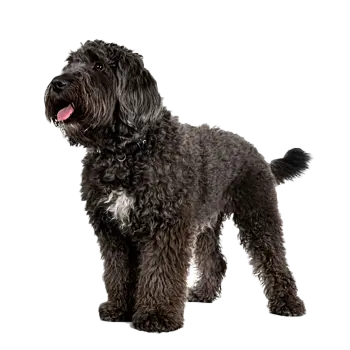
The coat is this breed's most discussed feature, and rightfully so. It is long, dense, and curly to wooly throughout - not just on the body but on the head, face, legs, and tail. There is no undercoat in the traditional double-coat sense; the Barbet has hair rather than fur, which is why shedding is minimal. The texture ranges from loose, large curls to tighter, more compact curls depending on the individual and breeding influence. Dogs with more Poodle influence in their recent pedigrees tend to have tighter, smaller curls; older-type Barbets have looser, larger waves. Both are acceptable under the standard.

Colors include solid black, brown in all shades from dark chocolate to liver, gray, fawn ranging from cream to deep gold, and white. Solid colors with white markings on the chest and feet are common and accepted. Parti-coloring with significant white patches against a darker base is also seen. The face is characteristically covered in coat, with a distinctive beard at the muzzle and a fall of hair across the forehead.

Movement in a sound Barbet should be effortless and ground-covering. At a trot the dog extends well in front and drives strongly from the rear, with a level topline and clean footfall. It should not appear stilted, choppy, or paddling - all of which suggest structural problems. The coat in motion tends to sway and bounce, which gives the moving Barbet a distinctive visual impression that experienced observers find easy to identify at a distance.

Sexual dimorphism in the Barbet is moderate. Males are noticeably larger than females in both height and weight, and broader through the head and chest. A correct male should read clearly as masculine without coarseness; a correct female should be distinctly feminine without appearing slight. Both sexes should share the same structural balance, working expression, and characteristic curly coat. The breed's size range is genuine - some individuals run toward the smaller end of the standard and some toward the larger, and both are correct as long as the proportions are right and the build reflects the functional working dog the breed was designed to be.

Affectionate With Family
The Barbet is famously devoted to its people and prefers to be in the same room at all times. This is a breed that follows you from room to room and is most settled when its household is gathered together.
Good With Young Children
Gentle, patient, and playful - the Barbet's combination of medium size, soft temperament, and genuine joy in social interaction makes it an excellent fit with children of most ages.
Good With Other Dogs
The Barbet Club of America describes the breed as a 'good mixer.' Well-socialized Barbets typically enjoy the company of other dogs and integrate into multi-dog households without difficulty.
Shedding Level
The Barbet has hair rather than fur, meaning it sheds minimally in the traditional sense. Old hair tends to tangle into the coat rather than falling out, which is why regular grooming is essential.
Coat Grooming Frequency
The dense curly coat requires thorough combing several times a week to prevent matting. This is not a wash-and-go breed. Regular maintenance is the real ownership cost here.
Drooling Level
A dry-mouthed breed with no meaningful drooling tendency. The beard picks up water when drinking, but there is no slobber situation.
Coat Type
The dense, curly, all-over coat is high maintenance without regular attention. It does not shed heavily but mats readily if ignored, and must be brushed to the skin rather than just the surface.
Openness To Strangers
The Barbet is a genuinely social dog that tends to greet new people warmly after a brief assessment. It may bark an alert but settles quickly when the situation reads as safe.
Playfulness Level
This breed has a well-documented goofy, clownish streak. Barbets love to play, initiate games, and entertain their people. The playfulness is genuine and persists well into adulthood.
Watchdog/Protective Nature
The Barbet is friendly by nature and not a reliable guard dog. It will bark to alert you to something unusual but is far more likely to want to make friends with an intruder than deter one.
Adaptability Level
Adapts well to different living situations as long as its exercise needs are met and it has company. It can handle varying climates, though the dense coat provides good cold-weather insulation.
Trainability Level
Highly trainable, eager to please, and genuinely enjoys learning. The Barbet is not the stubborn independent thinker that some sporting dogs can be - it wants to get it right and cooperates willingly.

Barbet History & Development

The Barbet's history is long, imprecisely documented, and genuinely fascinating for anyone who enjoys tracing dog breeds back through the eras that shaped them. References to a curly-coated French water dog appear in records and artwork from as early as the 14th century, and by the 16th century the barbet was a well-established fixture in French hunting culture, specifically valued by hunters working waterfowl in the country's marshes, wetlands, and coastal estuaries. The breed's nickname, "muddy as a barbet," became a popular French expression in the 19th century - a tribute to its enthusiasm for exactly the kind of filthy, wet, thorough work its coat was built for.

For the better part of several centuries, the Barbet served as something close to a universal working water dog across much of western Europe. It was used to locate and flush game birds from thick marsh vegetation, then retrieve fallen birds from cold, often rough water. The webbed feet and dense, insulating coat were functional adaptations to this work, not breed club creations. The dog that could hunt wet terrain all day in northern French autumn weather was exactly the dog breeders selected.

The Barbet's role in the development of other breeds is significant and well-documented. The Poodle, the Bichon Frise, the Briard, and to some degree the Portuguese Water Dog and the Newfoundland are all thought to carry Barbet ancestry. For much of the 18th century, the names Barbet and Poodle were functionally interchangeable in France, describing what was considered the same dog type. The divergence into clearly separate breeds happened as the Poodle was increasingly refined toward the aristocratic salon companion role, while the Barbet continued primarily as a working marsh hunter.

The first written breed standard for the Barbet was developed in 1894. The 20th century, however, was difficult. Both World Wars devastated French dog breeding programs, and the Barbet's population collapsed along with those of many other European breeds. By the early postwar period, the breed was genuinely close to extinction. Dedicated French breeders in the 1970s began the work of revival, registering 307 Barbets in France between 1975 and 2001. Outcrossing to the Standard Poodle was used to rebuild numbers, which is why the modern Barbet is somewhat taller than the historical type and why some individuals carry tighter, more Poodle-like curls than others.

The breed's small global population - estimated at well under 1,000 dogs worldwide as of the early 2020s - means that genetic diversity remains an active management concern. A 2013 study found the coefficient of inbreeding in the French Barbet population at 9.1%, significantly elevated compared to most breeds. This is a direct consequence of rebuilding a population from very few individuals, and breeders on both continents take it seriously. The Barbet's arrival in the United States in 1994 and eventual AKC recognition in 2020 have added North American breeding lines that contribute new genetic material to the global population, which is a meaningful development for the breed's long-term health.

Today the Barbet is gaining recognition among sporting dog enthusiasts and family dog seekers alike, appreciated for both its working ability and its adaptable companion temperament. It remains genuinely rare - there are estimated to be approximately 600 or fewer dogs worldwide outside France - which means finding a puppy often involves significant wait times and working with one of a small number of dedicated breeders. That scarcity is also why every responsibly bred litter carries real weight in the breed's future.

Barbet Temperament & Personality

If you ask a Barbet owner what their dog is like, you will almost certainly hear the word "joyful" somewhere in the first 30 seconds. This is one of those breeds that genuinely seems happy to be alive, and it broadcasts that happiness freely. The Barbet is playful, socially oriented, gentle, and consistently warm with the people it knows. It has a documented goofy streak - owners describe it as clownish, which is meant affectionately and is accurate. This is not a dignified, serious breed. It will make you laugh.

The Barbet bonds closely with its family and does not like being left alone for extended periods. It is a companion dog at heart even though it was built as a hunting dog, and the centuries it spent working alongside human hunters rather than independently have given it a deep orientation toward cooperation and proximity. Separation anxiety can be a genuine issue in Barbets that are left alone regularly for long stretches. The breed does best in households where it has consistent company, whether human or canine.

With children, the Barbet is genuinely excellent - not just tolerant but actively engaged. It matches children's energy level with its own playfulness, is gentle enough not to be rough, and is patient enough to handle the imperfect social interactions of young kids without overreacting. The Barbet Club of America's FAQ notes that the breed is suitable across age ranges, from young children to the elderly, which speaks to its genuine social flexibility. Supervision is still sensible with very young toddlers simply because of size, but the Barbet's temperament with children is one of its genuine strengths.

With other dogs, the breed earns its reputation as a good mixer. Properly socialized Barbets get along with other dogs across a range of sizes and temperaments, and multi-dog households with Barbets typically report smooth integration. With cats and small animals, early introduction and socialization matter - the breed does have a sporting dog's prey instinct, and a Barbet raised from puppyhood with a cat will treat that cat as family, while one introduced to cats as an adult needs supervised introductions and time.

With strangers, the Barbet occupies the friendly middle ground of the social spectrum. It is not the pushover that some sporting breeds are, but it is also not reserved or suspicious. A Barbet will typically bark to alert you to an unfamiliar person at the door, assess the situation briefly, and then warm up readily once it gets normal social cues. This makes it a decent alarm dog but a poor deterrent - its instinct when a stranger proves friendly is to immediately try to become their new best friend.

The Barbet's intelligence is of the cooperative, trainable variety. It problem-solves well and learns quickly, but its primary motivation is to work with its handler rather than around them. This makes it significantly easier to train than some other sporting breeds that apply their intelligence to independent action. When a Barbet does not get enough mental stimulation, the problem behaviors that emerge tend toward excessive vocalization, attention-seeking, and mild destructiveness - the behaviors of a social animal that needs engagement rather than the behavior of a dog with a frustrated working drive.

One thing that surprises people who know sporting breeds is how settled the Barbet can be indoors once its exercise needs have been met. This is not a breed that paces the house, stares out windows obsessively, or demands constant play. It can be a remarkably easy companion to live with from a day-to-day management standpoint, which contributes to its growing popularity as a family dog alongside its working sporting home. The key phrase is "once its needs have been met" - skip the morning exercise session a few days in a row and you will start to see why that phrase matters.

Barbet Family Life & Living Requirements

The Barbet is one of the more adaptable sporting breeds when it comes to living situations. It can do well in a house with a yard, in a suburban home with nearby parks for exercise, or even in a city apartment if you are genuinely committed to meeting its daily activity needs. The breed does not have the explosive, all-day working drive of, say, a Field Spaniel or an Irish Setter. It needs daily exercise, but it is not going to vibrate out of its skin if it misses an hour of running.

A daily exercise budget of 45 to 60 minutes is typically adequate for an adult Barbet - ideally split into morning and evening sessions. What makes this breed particularly happy is variety: a swim in a lake or river, a hike on an interesting trail, a good fetch session in a park. The Barbet loves water with a passion that traces directly back to centuries of marsh hunting, and any opportunity to swim is a genuine highlight of its day. If you live near water and can offer regular swimming opportunities, this dog will thrive.

Indoors, the Barbet is a calm and easy companion once it has been exercised. It does not pace, does not obsessively seek stimulation, and is genuinely content to lie near you while you work or relax. This indoor settledness is one of the qualities that makes it a practical family dog - it brings the energy outside and turns it off reasonably well inside. You do need to earn that indoor calm with adequate daily exercise; a Barbet that has not been out will not simply settle on its own.

The coat management reality is worth being honest about. The dense, curly coat requires regular brushing - several times a week, to the skin - to prevent mats from developing. This is non-negotiable. A Barbet that goes without grooming for a few weeks will develop mats in the underarm areas, behind the ears, and around the collar, and those mats are uncomfortable and difficult to remove without professional help. If you are not genuinely willing to make regular grooming part of the weekly routine, this is not the right breed for you. Professional grooming every six to eight weeks supplements but does not replace home maintenance.

This breed sheds minimally in the traditional sense, which is a genuine advantage for households with allergies. Many people who react to other dog breeds find that they can live comfortably with a Barbet. That said, it is not truly hypoallergenic - no breed is - and prospective owners with serious dog allergies should spend time with an individual Barbet before committing.

Who this breed is not for: people who are away from home for long hours consistently, people who are unwilling to commit to regular grooming, and people looking for a guard dog. The Barbet's social needs, grooming requirements, and fundamentally friendly temperament are the three realities that eliminate it as a good fit for some households. For the right household - active, present, willing to groom, and looking for a genuinely cheerful companion - it is hard to beat.

Barbet Training & Exercise Needs

The Barbet is one of the easier sporting breeds to train, and that ease comes from a genuine desire to cooperate rather than a lack of intelligence. This dog wants to get things right with you. It watches your face, reads your body language, and adjusts its behavior in response to your feedback in real time. That attentiveness makes training sessions feel remarkably collaborative compared to breeds that require more persistent effort to hold focus.

Socialization during the critical period from 8 to 16 weeks is important with any breed, and the Barbet is no exception. The goal is to build a dog that is confident and comfortable across a range of situations - different environments, different people, different dogs, different sounds. The Barbet is naturally social and tends toward friendliness, so the socialization work is about reinforcing that confidence rather than overcoming a tendency toward wariness. Puppy classes and organized puppy socialization groups are highly recommended.

Basic obedience comes quickly with this breed. Sit, down, stay, come, and leash manners are typically established within a few weeks of consistent work. The Barbet's food motivation and social drive both serve as effective training tools. Positive reinforcement methods work extremely well here - the breed responds to both treat rewards and enthusiastic verbal and physical praise. Harsh corrections or punishment-based training is unnecessary and counterproductive with a dog this willing to please.

The Barbet's retrieving instinct is genuine and deep, and training that engages that instinct is particularly satisfying for the dog. Formal retrieving work, whether for hunting or as a sport, gives the Barbet a framework that aligns with its core purpose. Fetch games, though simpler, also engage that drive productively. Swimming combined with retrieving is the gold standard activity for this breed - it satisfies the water instinct, the retrieving instinct, and the need for vigorous physical exercise all at once.

For dog sports, the Barbet is genuinely competitive across multiple disciplines. Agility is a natural fit given the breed's athleticism and trainability. Obedience and rally work well with a breed this eager to cooperate. Tracking and nosework engage the hunting dog's scenting ability in a structured way. Dock diving is a sport where the Barbet's love of water and its jumping ability combine to produce a dog that is usually very enthusiastic about the whole enterprise. If there is a hunting tradition in the household, the Barbet remains a capable field dog and retriever of waterfowl.

One training consideration specific to this breed is its sensitivity to the emotional tone of training. The Barbet is not a breed that shrugs off frustration or impatience from its handler. When a session goes sideways because the handler is stressed or irritated, the Barbet picks that up and begins to shut down or become anxious. Keeping sessions positive, ending on success, and reading the dog's emotional state are skills that will pay dividends throughout this breed's training life.

Barbet Health Concerns

The Barbet is generally described as a healthy breed with a documented lifespan of 12 to 15 years, which is good for a dog of its size. The caveat that always accompanies health discussions of this breed is that its small global population limits the available data. Emerging concerns may not yet be fully visible simply because there are not enough dogs to generate statistically meaningful patterns. Responsible breeders treat this uncertainty as a reason for thorough health testing rather than as reassurance that problems do not exist.

The Barbet's elevated historical coefficient of inbreeding is a background health concern that responsible breeders work to address through diverse breeding pairings and careful management of the limited gene pool. The joint health survey conducted by the BCA and Club Barbet Canada is an ongoing effort to build the data set needed to track health trends as the breed grows.

Common Health Issues

  • Hip Dysplasia: Abnormal development of the hip joint causing pain and early arthritis. Present at low levels in the breed - OFA hip evaluation or PennHIP assessment is required for CHIC certification of breeding stock.
  • Progressive Retinal Atrophy - Prcd-PRA, : An inherited eye disease causing progressive retinal degeneration leading to blindness. DNA testing identifies clear, carrier, and affected dogs; required for CHIC certification.
  • Entropion: Rolling inward of the eyelid margin, causing the lashes to contact the eye surface and produce irritation and corneal damage. Detected through CAER eye examination - Inherited component documented in the breed.
  • Cataracts: Opacity of the lens causing vision impairment. Identified through annual CAER ophthalmologic examination - Included in routine eye health monitoring for breeding animals.
  • Epilepsy: Idiopathic seizure disorder occurring at documented low rates in the breed. Typically managed with lifelong anticonvulsant medication - Onset generally in young adult dogs.
  • Chronic Ear Infections: Particularly common due to the combination of heavy - Pendulous ears and the breed's love of swimming. Not an inherited condition but a predictable management challenge in this breed.

Preventive Care & Health Monitoring

  • OFA Hip and Elbow Evaluation: Required for CHIC certification - Radiographic assessment of breeding stock at 24 months or older identifies dysplasia before it is passed to offspring.
  • Annual CAER Eye Examination: Periodic examination by a board-certified veterinary ophthalmologist detects entropion - Cataracts, and other inherited ocular conditions in breeding animals.
  • prcd-PRA DNA Test: Required for CHIC certification - Identifies clear, carrier, and affected dogs before breeding decisions are made, preventing affected offspring from being produced.
  • Weekly Ear Maintenance: Clean and dry ears thoroughly after every swim or bath - Weekly inspection for redness, odor, or discharge catches infections early when they are easiest to treat.

Barbet Grooming & Maintenance

Owning a Barbet means making a genuine commitment to regular grooming. This is not a breed that tolerates benign neglect of its coat. The dense, curly hair does not shed in the conventional sense - instead, old and loose hair tangles into the living coat and forms mats if it is not brushed out regularly. Leave a Barbet unbrushed for two weeks and you will start finding small mats behind the ears, under the armpits, and at the elbows. Leave it for a month and those mats will be serious. At the extreme end of neglect, the coat can cord into a solid mass that requires a complete shave-down - uncomfortable for the dog and distressing for the owner.

The realistic grooming schedule for a Barbet in full coat is thorough combing and brushing three to four times a week. The key word is thorough - working through to the skin rather than gliding over the top of the curl. A long-toothed metal comb is your most important tool, followed by a slicker brush for surface work. Work section by section rather than trying to tackle the whole dog at once. The legs, armpits, and areas where the coat is densest deserve particular attention because those are the places where mats form first.

Many Barbet owners maintain their dogs in a shorter trim that reduces the brushing burden without abandoning the breed's characteristic curly look. A trim that keeps the coat at one to three inches still shows the Barbet's distinctive coat texture and facial features while cutting grooming time substantially. If you intend to show your dog in conformation events, a longer coat is expected; if you are keeping a pet and a hunting companion, a practical trim is entirely sensible.

Bathing every four to six weeks is appropriate for most dogs, more frequently for dogs that swim or spend significant time outdoors. The Barbet's love of water means many owners are managing a wet dog fairly regularly. After any swim, the coat should be rinsed with clean water and dried thoroughly - a damp undercoat sitting against the skin for extended periods is an invitation to skin problems and increases the rate of mat formation. A high-velocity dryer after bathing is genuinely useful for this breed, both for separating curls and for ensuring the coat dries completely.

Ear care is critical for this breed. After every swim and every bath, the ears should be dried carefully, and any moisture in the ear canal should be addressed with a drying ear solution if your veterinarian recommends one. Weekly ear checks are standard practice - look for redness, discharge, or odor that suggests a developing infection. Early ear infections caught at the first signs are simple to treat; infections that have been developing unnoticed for weeks require more aggressive intervention.

Nails should be trimmed every three to four weeks. Dental care through regular tooth brushing reduces tartar accumulation and helps prevent the periodontal disease that affects many dogs in middle age. These are unglamorous but important parts of any dog ownership routine, and the Barbet is no exception.