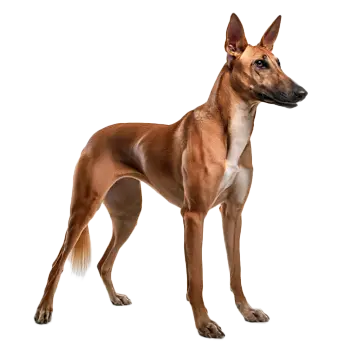
The Azawakh is one of the most visually extreme dogs in the world - tall, lean, and constructed with a precision that looks almost architectural. The coat is so short and fine that the musculature, the ribcage, and even the hip bones are visible in a well-conditioned dog, and this is not a sign of poor condition. It is the correct presentation. In the desert conditions the breed evolved in, carrying unnecessary body fat was a liability, and the standard explicitly values a dog that appears lean to the point that strikes many Western dog owners as thin.
The overall silhouette is tall and slightly over-square - the dog is taller at the withers than it is long from sternum to buttock. This is the opposite of most sighthound proportions, which tend toward length. The result is a dog that presents itself as upright and regal rather than stretched and fluid, though movement reveals the breed's full athleticism. The back is flat or very slightly arched, the loin short and dry, the belly deeply tucked.
The head is fine and chiseled, long and narrow, with a nearly flat skull, a barely perceptible stop, and a tapering muzzle that ends in a narrow nose. The bite is scissors. Eyes are large, almond-shaped, and range from dark brown to amber - the pale or amber eye is more common in this breed than in most sighthounds and is not a fault. The expression is intense and watchful, conveying the mixture of alertness and reserve that is central to the breed's character.
Ears are flat, pendant, and set high on the skull, lying close to the head. When the dog is alert they may raise slightly at the base but never become erect. The ears are fine in texture, matching the overall fineness of the breed's construction. The neck is long, lean, and well-muscled, carrying the head with an aristocratic elevation that is characteristic.
The chest is narrow and deep, with a distinct keel formation at the sternum - the breastbone protrudes perceptibly, a structural feature that is correct in the breed and often surprises people unfamiliar with it. The ribs are well-sprung but the chest remains narrow in its overall width. The belly tuck is dramatic - the underline rises sharply from the deep chest to a very high abdomen, creating the characteristic greyhound-type silhouette in extreme form.
Front legs are long, straight, and lean, with fine but strong bone. Feet are narrow and oval, with hard, well-arched toes. The hindquarters show moderate angulation in the stifle with well-developed muscle in the thigh - the Azawakh's propulsive power in the chase comes from those hindquarters. The hocks are well let down. Some Azawakh carry a natural dewclaw on the hindlegs, which is characteristic of the breed and not removed in countries where dewclaw removal is regulated.
The coat is the shortest of any sighthound breed. It lies flat and barely visible in some areas of the body - the flanks in particular may appear nearly hairless in some individuals, with very sparse, fine coat that is entirely correct. The belly and the inside of the thighs may be sparsely coated as well. This coat provides no insulation and the breed requires protection in cold weather.
The classic color is fawn in various shades from sand to dark fawn, with white markings: a white bib on the chest, white stockings on the feet, and often a white tail tip. The markings are characteristic and considered ideal in many countries, though not required. Brindle, black, blue, grizzle, and parti-color patterns are also recognized in various standards. The fawn-and-white combination with visible muscle and bone under a gleaming short coat is one of the most striking physical presentations in the dog world.
At speed, the Azawakh's movement transforms the static impression completely. The double-suspension gallop - where all four feet leave the ground twice per stride - produces the sighthound movement that is unlike any other gait in dogdom. At full extension the dog appears almost to fly, with a stride length that dramatically exceeds what the compact standing height would suggest. This movement is the physical expression of every anatomical feature: the length of leg, the depth of chest for cardiovascular capacity, the muscled hindquarters that drive the acceleration, and the lean build that reduces the weight that must be moved at each stride cycle.
Sexual dimorphism in the Azawakh is moderate and follows the expected sighthound pattern: males are taller and heavier, with more substance through the neck and chest, while females are more refined. Both sexes should present the same essential lean elegance - a female that appears heavy or a male that appears frail has departed from correct type in different directions.
Affectionate With Family
★★★★☆
Within its trusted family circle the Azawakh is deeply affectionate and physically close, often described as cat-like in the way it chooses contact on its own terms. This warmth is genuine but reserved for those who have earned it.
Good With Young Children
★★☆☆☆
The Azawakh's reserve, speed, and sensitivity make it poorly suited to households with very young children who cannot yet read or respect a dog's boundaries. Better matched to families with older children who understand this breed's nature.
Good With Other Dogs
★★★★☆
Generally comfortable and social with other dogs, particularly other sighthounds. The Azawakh is tribal in origin and was bred to live in groups, which contributes to its reasonable dog-dog sociability.
Shedding Level
★★☆☆☆
Light shedder due to the very short, fine coat. Hair deposit on furniture and clothing is minimal compared to double-coated breeds.
Coat Grooming Frequency
★☆☆☆☆
Essentially wash-and-go. The short single coat requires only occasional wiping down and infrequent bathing. There is no undercoat to manage.
Drooling Level
★☆☆☆☆
Dry-mouthed breed. Drooling is not a factor with the Azawakh.
Coat Type
★☆☆☆☆
Short, fine, single-layer coat that lies flat. The simplest coat type in dogdom. No grooming complexity whatsoever.
Openness To Strangers
★☆☆☆☆
Highly reserved with strangers is a defining breed characteristic. The Azawakh was developed to guard and will treat unfamiliar people as a potential threat until given reason to think otherwise. Socialization helps but does not eliminate this trait.
Playfulness Level
★★★☆☆
Playful in short bursts with trusted people and familiar dogs, but not perpetually playful in the way many breeds are. The Azawakh has a dignity about it that precludes the silliness of more exuberant breeds.
Watchdog/Protective Nature
★★★★★
This is a guarding breed as much as a hunting breed. The Azawakh takes protection of its family and territory seriously and backs that alertness with genuine physical capability. Not for households that want a passive alarm dog.
Adaptability Level
★★☆☆☆
Requires experienced owners, specific living conditions, and a stable environment to thrive. Not adaptable to very cold climates without specific management. Does not do well with frequent rehoming or environmental instability.
Trainability Level
★★☆☆☆
Independent, self-directed, and not particularly motivated to comply with instructions that do not make sense to it. Trainable with patience and the right approach, but not a breed that will please-train its way through an obedience course.