Australian Terrier

Australian Terrier

Quick Facts

🐕 Breed Group
Terrier Group
📏 Size Category
Small
📏 Height
Males: 10-11 inches, Females: 10-11 inches
⚖️ Weight
Males: 14-16 pounds, Females: 12-14 pounds
⏱️ Life Expectancy
11-15 years
🧣 Coat Type
Rough double coat, medium length
🎨 Coat Colors
Blue and tan, sandy, red
😀 Temperament
Spirited, Alert, Loyal, Tenacious, Curious, Affectionate
🏃 Exercise Needs
Moderate
🎓 Training Difficulty
Moderate
👶 Good with Children
Good with older children, supervision required with young children
🐾 Good with Other Pets
Requires careful introduction, high prey drive toward small animals

Other Names & Breed Recognition

The Australian Terrier is known simply as the Aussie Terrier in informal use, which creates the occasional confusion with the very different Australian Shepherd when abbreviations are used casually. In its home country of Australia it is simply called the Australian Terrier with no standard abbreviations in common use among breeders. The breed has no significant historical alternate names - it was developed with a consistent identity from its early days and never accumulated the layered naming history that older European breeds carry.

The breed holds the distinction of being the first Australian-bred dog to receive official recognition anywhere in the world. The Kennel Club in the United Kingdom recognized the Australian Terrier in 1933, acknowledging its development as a distinct breed in the Australian colonies. This recognition predated the breed's American registration and was a meaningful milestone for a country that had historically imported its dog breeds from Britain.

The AKC recognized the Australian Terrier in 1960, placing it in the Terrier Group where it remains. At the time of recognition it was already well-established in the United States through imports and a growing breeding community. The United Kennel Club and the Canadian Kennel Club both recognize the breed within their respective Terrier Group designations.

The FCI classifies the Australian Terrier in Group 3, Section 4, which covers small terriers. This international recognition covers the breed's standing in FCI-affiliated countries across Europe, South America, and Asia, though the breed remains uncommon outside of Australia, the United Kingdom, and North America.

The Australian Terrier Club of America serves as the breed's parent organization in the United States and is responsible for maintaining the breed standard, promoting health testing, and supporting conformation and earthdog events. The club maintains a breeder directory and health resources for owners and prospective buyers. In Australia, the Australian Terrier Club of New South Wales and state-level clubs serve similar functions.

The breed's recognition across multiple major registries reflects its status as a genuinely established breed with a consistent type, despite remaining a relatively low-population breed compared to more fashionable terriers. It does not appear in top-twenty breed popularity rankings but maintains a stable, dedicated following among terrier enthusiasts who value a dog with both functional history and manageable size.

Australian Terrier Organizations & Standards

The Australian Terrier Club of America is the AKC parent club for the breed and has been the primary organizational force for Australian Terriers in North America for decades. The club maintains the breed standard, coordinates health research efforts, supports regional breed clubs, and hosts national specialty shows where the breed's top specimens compete. The ATCA website is the most reliable starting point for prospective owners looking for health information, breeder referrals, and show schedules.

The AKC breed standard describes the Australian Terrier as a small, sturdy, medium-boned terrier of rather long, low build. Despite being one of the smaller terrier breeds, the standard emphasizes that this is a working terrier - not a toy or a purely decorative dog. The build should suggest both activity and agility. The standard specifically notes that the breed is low to the ground without being squat or exaggerated in length - a proportional, functional animal.

Height in the standard is approximately 10 to 11 inches at the withers, with a weight range of around 14 to 16 pounds for males and somewhat less for females. The body length is slightly greater than height at the withers. The head is long in proportion to the body, with a flat skull, a slight stop, and a strong muzzle that is well-filled under the eyes.

The coat standard is specific about texture: the outer coat is harsh, straight, and dense, approximately two to two and a half inches in length on the body. The undercoat is short and soft. A soft outer coat is a significant fault in the standard because the rough texture is part of the breed's weather-resistant working heritage. In show condition, the correct coat is achieved through hand-stripping - the manual removal of dead outer coat to encourage regrowth of hard-textured hair. Pet clips are acceptable for non-competing dogs but change the coat texture over time through repeated clipping.

The three accepted colors are blue and tan, solid sandy, and solid red. The blue and tan pattern places a blue, steel-blue, or silver-grey coat on the body with rich tan on the legs, feet, and facial furnishings. Sandy and red dogs should have a good, even distribution of color throughout. Topknot color should be lighter than the body color in blue and tan dogs. Dark eyes, a black nose, and correct tan on a well-structured blue and tan specimen produce the breed's characteristic expression.

The Australian Terrier Club of America participates in the AKC's CHIC health program. CHIC requirements for the breed include patella evaluation, ophthalmologist eye exam, and testing for diabetes mellitus susceptibility through health surveys. The club has conducted breed health surveys that track health conditions reported by owners across the population, which is an important supplement to individual testing programs given the breed's moderate size.

Kennel Club Recognition

  • American Kennel Club (AKC): Recognized in 1960, Terrier Group
  • United Kennel Club (UKC): Recognized, Terrier Group
  • Canadian Kennel Club (CKC): Recognized, Terrier Group
  • FCI: Recognized, Group 3
  • The Kennel Club (UK): Recognized, Terrier Group

Australian Terrier Physical Description

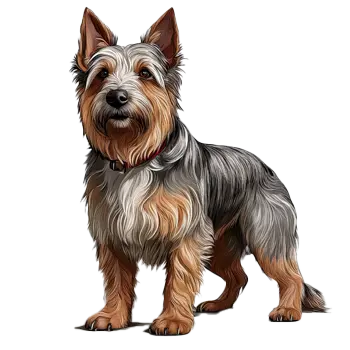
The Australian Terrier presents as a compact, low-set, and well-muscled terrier with a coat that gives it a slightly more substantial appearance than its actual modest weight. It is immediately identifiable by the combination of its characteristic topknot - a lighter-colored tuft of longer, softer hair on the top of the skull - the harsh, stand-off body coat, and the distinctive facial furnishings that frame the muzzle. Standing at 10 to 11 inches at the withers and weighing in the range of 14 to 16 pounds for males, it is small without being delicate.

The head is one of the breed's most important features. It is long relative to the body, with a flat skull that is slightly wider between the ears than at the stop. The muzzle is strong, equal in length to the skull, and well-filled under the eyes - not snipy or tapered toward the nose. The stop is moderate. The bite is scissors. Eyes are small, oval, and dark brown, set with a keen, intelligent expression that is characteristic of the breed. Light or round eyes are faults.

Ears are small, pointed, pricked, and set wide on the skull. They are carried erect and highly mobile, giving the dog its characteristic alertness. The ears should be clean-edged - free from long fringe or feathering on the inner surface. The topknot sits between the ears: a soft, fine-textured tuft that in blue and tan dogs is lighter in color than the body coat. This topknot is part of the breed's defined appearance and is maintained specifically in show dogs.

The neck is of medium length and slightly arched, flowing into well-sloped shoulders. The chest is moderately deep and well-filled without being barrel-shaped. The back is level and the body slightly longer than tall. This length-to-height proportion is functional, not exaggerated - the Aussie Terrier's slight elongation allows it to follow prey into tight spaces, which was a genuine working requirement when the breed was developed for rat and snake control in Australia.

Front legs are straight, strong, and well-boned for the size. Feet are small, round, and compact, with well-arched toes and thick, tough pads. The hindquarters are moderately angulated, broad, and well-muscled. The tail was traditionally docked to approximately two-fifths of its original length. In countries where docking is now prohibited, the natural tail is carried upright and slightly curved, adding to the dog's alert expression.

The coat is the breed's most distinctive physical feature. The outer coat is straight, harsh, and approximately two to two and a half inches in length on the body. It stands off the body rather than lying flat - running your hand through it, you feel the crisp, dry texture of a properly prepared working terrier coat. The undercoat is short, soft, and dense. This double-coat construction provides genuine weather resistance: the harsh outer coat sheds water and resists dirt while the soft undercoat insulates.

The blue and tan pattern is the most recognizable: a blue, silver-blue, or steel-grey body with rich tan on the muzzle, cheeks, ears, legs, feet, and beneath the tail. The topknot in this color is silver or a lighter blue than the body. Sandy dogs are an even warm tan or sand color throughout, with a slightly paler topknot. Red dogs carry a rich reddish-brown throughout. In all color patterns the coat should be well-groomed and the transition from body color to leg color sharp and well-defined rather than blurred.

Movement in the Australian Terrier is free and springy - a working terrier should move with purpose and energy, not a plodding or mincing gait. At the trot the legs track straight, the back remains level, and the head is carried with characteristic alertness. The combination of sound structure and good muscle tone produces a dog that looks as capable as its working history suggests it is.

Size in the breed is important to maintain correctly. An Australian Terrier that is too small becomes fragile and loses the working substance the standard requires. One that is too large loses the practical advantages that made the compact size valuable in its working role. The 10 to 11 inch, 14 to 16 pound range describes a dog that is small enough to be economical, practical, and manageable in a household, while retaining the physical capability to do what working terriers are asked to do.

The sexual dimorphism in this breed is modest. Males tend to carry a slightly broader head and heavier bone than females, but the size difference between the sexes is not dramatic. Both sexes should present the same alert expression, proper harsh coat, and athletic build that defines the breed. A female that looks weedy or a male that looks coarse has deviated from what the standard describes as correct.

Affectionate With Family
Australian Terriers form close bonds with their family and enjoy being in the middle of household activity. More openly affectionate than many terriers, they will settle in for contact without the fidgety independence some terrier breeds show.
Good With Young Children
Sturdy enough to handle normal child interaction and spirited enough to keep up with active kids. Very young children who handle dogs roughly can provoke a snap - the breed has terrier quickness and a low tolerance for harassment.
Good With Other Dogs
Gets along with dogs it knows and was raised with, but can be assertive and challenging with unfamiliar dogs, particularly of the same sex. The terrier tendency to stand its ground is present in this breed.
Shedding Level
Light to moderate shedder. The harsh outer coat does not release fur the way a soft-coated breed does, and regular grooming captures most of it before it reaches your furniture.
Coat Grooming Frequency
Weekly brushing keeps the coat in order, and occasional hand-stripping maintains the proper harsh texture for show dogs. Pet dogs can be clipped, which changes the coat texture over time but simplifies maintenance.
Drooling Level
Not a drooler. Dry-mouthed breed.
Coat Type
Rough, harsh-textured double coat that requires hand-stripping in show condition. Pet clips simplify care but change the coat character. Moderate maintenance overall.
Openness To Strangers
Alert and watchful with strangers, but not unfriendly. Will announce a visitor and assess before accepting them. Less aloof than some terrier breeds, but this is not a dog that bounces up to everyone.
Playfulness Level
Playful and energetic for its size, with the terrier enthusiasm for games that involve chasing and catching. Retains a puppy-level enjoyment of play well into middle age.
Watchdog/Protective Nature
Takes watchdog duties seriously and has the voice to announce what it finds. Will alert to anything approaching the property and can be a persistent barker if not managed.
Adaptability Level
One of the more adaptable terrier breeds. Manages well in smaller homes and urban environments provided daily exercise is maintained. Travels well once acclimated.
Trainability Level
Capable and reasonably cooperative when training is consistent and reward-based, but true terrier independence means this dog will occasionally decide the rules do not apply. Patience and consistency are required.

Australian Terrier History & Development

The Australian Terrier was developed in Australia during the 19th century from a collection of British terrier breeds brought by early settlers, and its history is inseparable from the practical needs of colonial life. Settlers arriving in Australia from the 1800s onward needed a dog that could handle vermin control in conditions radically different from anything a British terrier had been tested in - extreme heat, diverse terrain, and native fauna including venomous snakes that required a dog with both the speed to avoid a strike and the courage to attack without hesitation.

The founding stock is generally considered to include the Yorkshire Terrier, the Dandie Dinmont Terrier, the Skye Terrier, the Manchester Terrier, and possibly the Irish Terrier and the Cairn Terrier. Different contributors brought different qualities to the mix: the Yorkshire Terrier's coat and size, the Dandie Dinmont's topknot and tenacity, the Skye's body shape, and the Manchester's sleekness and rat-catching ability. No single cross produced the type - it was developed over several generations of selection for performance in Australian conditions.

The breed was exhibited at a dog show in Melbourne in 1868, one of the earliest documented appearances of what would become recognized as a distinct Australian type. By the 1890s the breed was being shown as the "Rough-Coated Terrier" and "Broken-Coated Terrier" before settling on the name Australian Terrier. The name reflected both the breed's country of development and a growing pride in Australian-bred dogs as distinct from their British imports.

The Kennel Club in the United Kingdom recognized the Australian Terrier in 1933, and the breed arrived in the United States with returning servicemen and expatriates from Australia and England. The AKC recognized the breed in 1960. By that time a small but dedicated American breeding community had established itself and the Australian Terrier Club of America was functioning as the breed's organizational home.

Throughout its history the Australian Terrier was valued for practical work: rat and mouse control in homes, farms, and mines; snake control in rural properties; and as a general all-purpose working companion on stations and properties across Australia. Its small size made it economical to keep and its terrier drive made it effective. The combination of genuine working ability and a size and temperament suitable for household life made it one of the more practical working terriers produced anywhere.

In the modern era the breed maintains a loyal following without achieving mass popularity. Breed numbers are modest compared to fashionable terriers like the West Highland White Terrier or the Scottish Terrier, and the Australian Terrier community tends to be serious about both type and health. The breed's working history informs its advocates' expectations: a soft, sluggish, or structurally unsound Australian Terrier is not what the breed was built to be, and responsible breeders hold the standard accordingly.

For prospective owners, the breed's history matters because it explains the temperament. Every characteristic that can be challenging in a household setting - the prey drive, the independence, the alertness and vocal nature, the willingness to stand its ground - is a characteristic that made the Australian Terrier useful and respected in the conditions it was developed for. Understanding the history is understanding the dog.

The breed today is at a stable and healthy population point - not so rare that genetic diversity is a serious concern, not so popular that commercial breeding has compromised average quality. It occupies a respected position among terrier enthusiasts who value working character in a small, manageable package.

Australian Terrier Temperament & Personality

The Australian Terrier has the terrier temperament in full, delivered in a package that is more compact and more openly affectionate than many in the group. It is curious, energetic, opinionated, and thoroughly convinced of its own importance - all characteristics that trace directly to the vermin-hunting and snake-killing work it was bred for. A terrier that hesitates, doubts itself, or defers unnecessarily to larger animals is not a useful terrier. The Australian Terrier does not hesitate, doubt, or defer.

With its family, the breed is genuinely warm and attached. Unlike some terrier breeds that maintain emotional independence even with people they know well, the Australian Terrier actively seeks contact and company. It wants to be in the room where the activity is, it will insert itself into whatever you are doing, and it will let you know when it feels its attention needs are not being met. This is not neurotic behavior - it is a well-socialized terrier that has figured out that people are the center of the action.

The prey drive is the most important behavioral characteristic for prospective owners to understand clearly. This is a breed developed to pursue and kill rodents and venomous snakes, and that drive is still very much present. Small animals - mice, rats, hamsters, guinea pigs, rabbits - are at genuine risk from an unsupervised Australian Terrier. Cats can coexist with Australian Terriers when the relationship is established from early puppyhood and the animals have grown up together, but introducing an adult Aussie Terrier to small animals requires caution and supervision indefinitely.

With other dogs, the Australian Terrier is generally manageable but carries the typical terrier tendency to stand its ground and challenge dogs that approach with too much assertiveness. It does not back down from dogs significantly larger than itself, which is a trait to manage on leash and in dog park settings. Dogs of the same sex can be a particular source of friction as the animal matures, and same-sex households with Australian Terriers require careful introduction and management.

Intelligence in this breed is practical and streetwise. These dogs learn quickly what produces the outcomes they want and are highly motivated by both food rewards and the opportunity to chase and catch. They are not a breed that sits passively waiting for direction - they will problem-solve actively, which means training needs to be consistent and the rules need to be clear enough that the dog does not find creative interpretations. A training approach that engages the dog's natural curiosity and drive works better than repetitive drills that the dog tunes out after the third repetition.

Barking is a trait that needs management from early puppyhood. Australian Terriers are vocal, alert dogs that will announce anything approaching the property, anything moving outside, and anything that triggers their keen interest. This is appropriate watchdog behavior up to a point. Without clear training about when to stop barking, it can become habitual and irritating in ways that create neighbor issues in close-living situations.

The breed is more compatible with an owner who has a sense of humor about terrier independence than with one who expects a highly obedient, always-compliant companion. The Australian Terrier will comply most of the time, genuinely wants to please its people most of the time, and is charming and entertaining most of the time. It is the exceptions to "most of the time" that require patience - and those exceptions are what make terrier people love terriers.

Australian Terrier Family Life & Living Requirements

The Australian Terrier is one of the more genuinely adaptable terrier breeds for family and household life. Its size makes it a practical choice for smaller homes and urban environments, and its affectionate temperament makes it more integrated into family life than many more independent terriers. The key is understanding what the dog is and managing the terrier characteristics honestly rather than expecting them to disappear with good intentions.

Space requirements are modest compared to herding and working breeds. An Australian Terrier in a city apartment with daily walks and regular off-leash time in a secure area is a satisfied dog. A house with a yard is a bonus, not a requirement. The critical factor is the yard's security - if there is a fence, the Aussie Terrier will find any weakness in it and go through, under, or over it given the motivation of something worth chasing on the other side. The fence needs to address the digging impulse specifically: either with a buried barrier or a concrete apron along the fence line.

Exercise needs are moderate and manageable. Two walks of moderate duration daily, plus some active play, meets the breed's physical needs without requiring the hour-plus commitments of high-energy working breeds. What the dog needs equally is mental engagement - the terrier brain that spent generations hunting and problem-solving in Australian conditions does not thrive on physical exercise alone. Puzzle toys, training sessions, earthdog trials for those interested in working their dog, and active fetch games all provide the mental component.

Children in the household work best when they are old enough to understand boundaries. Australian Terriers are sturdy enough for normal child play and energetic enough to enjoy it, but they have the quickness and low tolerance for harassment common to terrier breeds. A child who corners a dog, pulls it roughly, or does not respect clear signals that the dog wants space can provoke a defensive snap. Active supervision and teaching children how to interact with terriers specifically - not just dogs in general - makes the household safer for both.

Shedding is light to moderate and the coat's harsh texture means loose hair tends to collect in brushed sessions rather than distributing itself across all surfaces. The Australian Terrier is often listed as a lower-shedding choice for people sensitive to dog hair, though no dog is truly non-shedding. Regular brushing prevents the hair you do get from accumulating everywhere.

Who this breed is not right for: households with rabbits, guinea pigs, hamsters, or other small animals living in accessible areas; owners who want a quiet, stay-on-the-mat type companion; people who are not prepared to enforce consistent training with a dog that will test the rules; and anyone who wants a dog that can be left alone for extended periods without mental engagement, as boredom in a terrier produces behaviors that are impressive in their variety and unwelcome in their execution.

Australian Terrier Training & Exercise Needs

Training an Australian Terrier requires genuine patience, consistency, and the self-awareness to recognize when you are being outmaneuvered by a 14-pound dog. This breed is intelligent enough to learn what is wanted from it quickly, and independently-minded enough to decide whether it feels like complying in a given moment. The handler who finds that amusing and stays consistent wins. The handler who takes it personally and resorts to force or frustration creates a dog that is more difficult and less cooperative, not less.

Early socialization is essential and should start before the puppy leaves for its new home. Exposure to different people, dogs, surfaces, sounds, and environments during the first 16 weeks of life builds the confident, stable adult the breed is capable of producing. Socializing a terrier is particularly important because the independent, assertive character that makes them capable working dogs can become problematic fearfulness or reactivity in a dog that was not adequately exposed during the critical window. Puppy classes run by a trainer experienced with terrier temperament are a worthwhile investment.

Basic obedience with a terrier requires making compliance more rewarding than the dog's natural alternatives. High-value food rewards, play rewards, and short, engaging sessions work far better than long repetitive drills that invite the dog to disengage. Australian Terriers are food-motivated enough that reward-based training produces good results when applied consistently. The key word is consistently - a terrier that notices the rules are only enforced sometimes will calibrate its compliance accordingly.

Exercise quantity is moderate but the quality matters. Two brisk walks daily satisfying the physical component, supplemented by active games in a secure space. What varies from low-energy companion breeds is the mental load - the terrier brain needs work as well as the body. Earthdog trials are specifically designed for terrier-type dogs and provide the tunnel-and-prey activity that engages the Australian Terrier's deepest working instincts. They are not widely available in all areas but worth seeking out for a dog that needs more than standard exercise provides.

Leash training deserves specific attention because the prey drive that is central to this breed's character also produces a strong tendency to lunge at squirrels, mice, other small animals, and fast-moving objects. A dog that lunges on leash is unpleasant to walk and potentially dangerous in situations where the target is a cat or small dog. Solid leash manners built early save a great deal of management work later. Leash skills are easier to build than to fix.

Recall training should be considered a life-safety skill for this breed. An Australian Terrier that spots a rabbit or mouse and gets off leash in an open area will not respond to its name until the prey has been dealt with, regardless of how well-trained it is in other respects. The prey-chase sequence in this breed can override trained behavior momentarily, which means reliable recall needs to be built to a very high standard and the dog should always be in a secure area before going off leash.

Australian Terrier Health Concerns

The Australian Terrier is a generally hardy breed with a lifespan frequently extending into the 12 to 15 year range. Several health conditions are well-documented in the breed, and the Australian Terrier Club of America has conducted health surveys that provide real data on what affects the population rather than speculation.

Buyers should ask breeders directly about diabetes and Legg-Calve-Perthes history in their lines, as these are not currently covered by DNA tests and the best available information comes from the breeder's knowledge of their own pedigrees. A breeder who dismisses these health questions or claims their line has no issues without documentation is a red flag. The Australian Terrier community has been honest about the breed's elevated diabetes risk and buyers deserve that same honesty from the person selling them a puppy.

Common Health Issues

  • Diabetes Mellitus: Australian Terriers develop diabetes at an elevated rate compared to most breeds - Typically in middle to older age. The condition is insulin-dependent and manageable with daily injections and dietary management, but requires significant owner commitment.
  • Legg-Calve-Perthes Disease: Degeneration of the femoral head due to disrupted blood supply - Causing hip joint pain and lameness in young dogs typically under 18 months. Surgical treatment produces good outcomes when performed early.
  • Patellar Luxation: Slipping of the kneecap from its normal groove in the femur - Ranging from mild intermittent skipping to severe disability requiring surgery. CHIC-required patellar evaluation in breeding stock helps reduce severity in offspring.
  • Thyroid Conditions: Thyroid abnormalities have been reported in the breed and tracked through club health surveys. Hypothyroidism affects metabolism - Weight, and coat quality and is managed with daily medication.

Preventive Care & Health Monitoring

  • Patellar OFA Evaluation: Required for CHIC certification - Buyers should verify that both parents have current patellar evaluations and ask about grades in the pedigree.
  • Ophthalmologist Eye Exam - CAER, : Required for CHIC certification. Annual eye exams detect hereditary conditions before they become serious.
  • Diabetes Monitoring in Senior Dogs: Owners of Australian Terriers over seven years of age should monitor for increased thirst - Increased urination, and unexplained weight loss, as these are early indicators of diabetes. Annual blood work becomes increasingly valuable as the dog ages.
  • Dental Care: Given the breed's elevated metabolic health concerns - Keeping dental disease under control reduces systemic inflammation and supports overall health. Daily brushing or enzymatic dental chews should be part of the routine from puppyhood.

Australian Terrier Grooming & Maintenance

The Australian Terrier's grooming requirements fall into two distinct categories depending on whether you are maintaining a show dog or a pet. For pet owners, the coat is moderate and manageable. For show exhibitors, proper coat presentation through hand-stripping is a skilled technique that takes time to learn and time to execute.

Pet coat maintenance involves brushing twice a week with a slicker brush or pin brush to remove tangles and loose hair, with monthly baths to keep the coat clean. The rough outer coat does not mat easily under normal circumstances, but the areas behind the ears and in the leg furnishings can develop tangles in dogs that are not brushed regularly. Most pet owners opt for professional clipping two to four times per year to keep the coat at a manageable length. Clipping changes the coat texture over time - repeated clipping softens the outer coat, removing the harsh quality that makes a properly prepared show coat distinctive - but for a family pet this is an acceptable trade for lower maintenance.

Hand-stripping is the proper method for maintaining the breed's correct harsh coat texture. This technique involves pulling dead outer coat out by the roots rather than cutting it, encouraging new growth that comes in with the correct hard texture. Show dogs are stripped on a rolling schedule to keep the coat in peak condition. Hand-stripping is labor-intensive and requires learning proper technique - pulling incorrectly can be uncomfortable for the dog - but a dog maintained by stripping has a coat that functions as designed, with weather resistance and texture that clipped dogs lose over time.

Ear care involves keeping the inside of the ear flap clean and the hair inside the ear canal plucked to allow air circulation. The upright ears provide reasonably good ventilation, reducing chronic ear infection risk, but wax and debris should be cleared weekly. Nails need trimming every three to four weeks. The muzzle furnishings - the beard and whiskers that give the dog part of its characteristic expression - need combing out regularly and occasional trimming to keep them tidy. Dental care follows the standard recommendations: daily brushing is best, enzymatic chews are a practical alternative, and the breed's elevated diabetes risk makes maintaining overall metabolic health even more important than in other breeds.