Arabian Greyhound

Sloughi

Quick Facts

🐕 Breed Group
Hound Group
📏 Size Category
Large
📏 Height
Males: 24-29 inches, Females: 24-27 inches
⚖️ Weight
Males: 45-65 pounds, Females: 35-50 pounds
⏱️ Life Expectancy
12-15 years
🧣 Coat Type
Short, smooth single coat
🎨 Coat Colors
Sand, cream, fawn, brindle; with or without black overlay
😀 Temperament
Loyal, sensitive, aloof with strangers, devoted to family
🏃 Exercise Needs
High - needs daily opportunity to run at speed
🎓 Training Difficulty
Moderate - sensitive to harsh handling
👶 Good with Children
Better with older, calm children
🐾 Good with Other Pets
Good with other sighthounds; caution with small animals

Other Names & Breed Recognition

The name Arabian Greyhound captures something accurate about this breed - it is a greyhound-type sighthound from the Arabian and North African world. The comparison to the Greyhound is structural: both are built for speed over open ground, both carry the deep-chested, long-legged, lean-bodied silhouette of dogs shaped for pursuit rather than power. But the Arabian Greyhound has its own distinct origin, cultural history, and character that sets it apart from European sighthound breeds in important ways.

The formal breed name is Sloughi, pronounced approximately "SLOO-ghee." The breed originates in North Africa - primarily Morocco, Algeria, Tunisia, and Libya - and was developed by Berber and Bedouin nomadic tribes who prized it for hunting gazelle, hare, fox, and jackal across the Sahara and Atlas Mountain foothills. The name Sloughi is of Arabic or Berber origin, and the dog has been known by this name throughout North African history. The Arabian Greyhound label is an English-language descriptive name used primarily in Western breed literature, where the comparison to the Greyhound was the most familiar frame of reference for explaining what the breed looked like and how it moved.

Other alternate names for this breed include North African Sloughi, Sloughi Moghrebi (referencing the Maghreb region of North Africa), and occasionally Arabian Sighthound. The Sloughi should not be confused with the Saluki, which is a related but distinct breed from the Middle East and Fertile Crescent region. Both are ancient sighthounds from the broader Arabic-speaking world, and both carry similar elegant builds, but they have different geographic origins, slightly different conformation standards, and distinct genetic identities.

The FCI recognized the Sloughi in 1998. The AKC granted full recognition in 2016 within the Hound Group. The American Sloughi Association serves as the parent club in the United States. The breed remains rare outside North Africa and France, where North African immigration brought the dogs as well. Whether you encountered this dog as the Arabian Greyhound or by its formal name, you are looking at one of the world's genuinely ancient sighthound breeds - a dog with thousands of years of desert coursing behind it.

Arabian Greyhound Organizations & Standards

The breed's home organization is in Morocco, where the Sloughi has been bred and preserved for centuries within traditional Berber and North African culture. In the Western world, the primary parent club for the United States is the American Sloughi Association, which has advocated for the breed's recognition and maintains an ethical breeding code requiring health testing and responsible practices. The ASA signed its members to a code of ethics that includes requirements for PRA DNA testing and OFA CHIC registration.

The FCI standard for the Sloughi is precise about the breed's overall appearance - a lean, muscular, medium to large-sized sighthound with a smooth, short coat and a graceful but powerful build. The FCI places the breed in Group 10, Section 3, alongside short-haired sighthounds. The standard describes a slightly rectangular body with good depth of chest, a long narrow head, and dark, large, almond-shaped eyes that carry the characteristic melancholy expression the breed is known for. The tail is fine and curved at the tip when at rest.

The American Kennel Club recognized the Sloughi in 2016, making it one of the most recently recognized breeds in the AKC Hound Group. The AKC standard follows the FCI description closely, requiring the same lean build, smooth coat, and correct sighthound angulation. The United Kennel Club and The Kennel Club in the UK also recognize the breed.

Health testing requirements from the American Sloughi Association's CHIC program include DNA testing for progressive retinal atrophy (rcd1-PRA) - a condition for which a specific genetic test is available for this breed - and eye examinations by a board-certified veterinary ophthalmologist. The PRA DNA test identifies clear, carrier, and affected dogs, giving breeders the information needed to eliminate affected puppies from the breeding population entirely. The ASA's code of ethics requires breeding stock to have these tests completed and results disclosed before any breeding. The PRA DNA testing program has been highly successful - the disease is now rare in the breed as a result of responsible breeding practices.

The breed standard across FCI, AKC, and UKC registries emphasizes the Sloughi's unique combination of elegance and functional athleticism. Judges evaluating this breed are looking for a dog that could still do the work it was bred to do - not a stylized sighthound that has been bred toward extreme refinement. The deep chest, correct angulation, and elastic movement that allowed the Arabian Greyhound to outlast game across Saharan terrain are the same qualities that define a correct dog in the show ring today.

Kennel Club Recognition

  • American Kennel Club (AKC): Recognized in 2016, Hound Group
  • United Kennel Club (UKC): Recognized, Sighthound and Pariah Group
  • FCI: Recognized, Group 10 - Sighthounds
  • The Kennel Club (UK): Recognized, Hound Group

Arabian Greyhound Physical Description

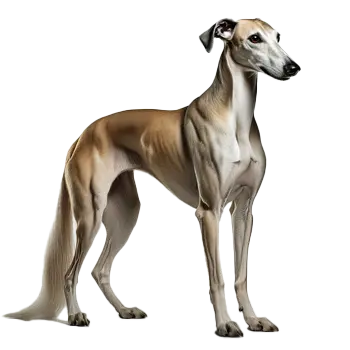
The Arabian Greyhound is one of those dogs that stops people in their tracks. The combination of the smooth desert coat, the lean athletic body, and the deep, soulful eyes creates an impression that is simultaneously ancient and striking. This is a dog that looks like it belongs in a painting - or in the desert landscape that shaped it.

The body is medium to large, slightly rectangular, and built entirely for speed and endurance over open terrain. Males stand 24 to 29 inches at the shoulder and weigh 45 to 65 pounds. Females are smaller and lighter at 24 to 27 inches and 35 to 50 pounds. Despite the size, the overall impression is one of elegant leanness rather than bulk - there is no extra weight on this dog. The chest is deep and narrow, the abdomen sharply tucked up, and the loin is short and muscular. The hindquarters carry the angulation and muscle mass needed for explosive acceleration and sustained pursuit gallop.

The coat is the first thing you notice and the last thing that needs attention. It is short, smooth, and tight against the body - a single-layer coat without undercoat that is perfectly adapted to the hot, arid conditions of the Sahara. Colors range from sand and cream through fawn and red fawn, with or without a black overlay. Brindle patterns are also recognized. White markings are generally not favored in the standard. The short coat allows the dog's musculature and structure to be clearly visible, which makes the Arabian Greyhound look both sculptural and functional at the same time.

The head is long and narrow, with a flat skull and almost no stop. The muzzle is elongated and fine. The eyes are one of the breed's most distinctive features - large, dark, and almond-shaped, with an expression that breed enthusiasts consistently describe as melancholic or soulful. The ears are pendant, set at skull level, and lie close to the head when at rest. In motion or when alert they may rise slightly at the base.

The tail is fine and slightly curved at the tip, reaching to the hock. It is carried low at rest and raises in a gentle curve during movement but is not carried over the back in the manner of Nordic or Spitz-type breeds. The feet are long and hare-like with well-arched toes - built for grip on loose sand rather than the compact pads suited to rocky terrain.

Movement is the final defining quality. The Arabian Greyhound moves with the effortless, elastic stride of a true coursing dog - a double-suspension gallop at speed that covers extraordinary ground per stride. At the trot the gait is smooth and ground-covering. When the dog is running flat out, the structural investment in the hindquarters and loin becomes immediately obvious.

The Arabian Greyhound in person is often described as more impressive than photographs convey. The photographs show the elegant proportions, the beautiful coat colors, and the soulful eyes. What photographs cannot capture is the quality of movement at speed - a coursing sighthound at full gallop is one of the most breathtaking sights in the dog world. The Arabian Greyhound at the gallop is that experience distilled - centuries of selective breeding for one function, expressed in a few seconds of open-ground pursuit. If you ever have the opportunity to watch one run freely in a large open space, take it. Few things in the dog world match the Arabian Greyhound at full speed - it is pure function expressed as grace, and it is exactly what thousands of years of desert selection produced.

Affectionate With Family
Deeply bonded to its own household and genuinely affectionate with the people it trusts. The Arabian Greyhound's warmth is reserved for its inner circle and is not given casually.
Good With Young Children
This breed can coexist well with calm, respectful older children but is not a natural playmate for rough or unpredictable toddlers. Its sensitive nature means it does better in quieter households.
Good With Other Dogs
Generally compatible with other sighthounds and dogs it has been raised with. The sight-hunting prey instinct makes careful introductions with small dogs and other small animals advisable.
Shedding Level
Minimal shedding from the short, smooth single coat. One of the lower-maintenance breeds in terms of coat care.
Coat Grooming Frequency
The smooth single coat requires almost no grooming. An occasional wipe-down and weekly brushing with a soft cloth or rubber curry is all that is typically needed.
Drooling Level
The Arabian Greyhound does not drool. The lean, clean-jawed build is suited to a desert running dog.
Coat Type
Short, smooth single coat in sand, cream, fawn, or brindle. This is a desert-adapted coat - not double and not water-resistant, but easy to maintain and visually elegant.
Openness To Strangers
Aloof with unfamiliar people - a consistent and characteristic trait across the breed. This is not shyness but a dignified reserve that softens only with time and familiarity.
Playfulness Level
Playful in short bursts with its own people, particularly in environments where it feels comfortable. The Arabian Greyhound's play is typically graceful and not rough-and-tumble.
Watchdog/Protective Nature
Alert to changes in its environment and will notify its family. Bred historically to guard desert camps as much as to hunt, the alert instinct is genuine though not aggressive.
Adaptability Level
Adapts well to calm household environments with consistent routines. Sensitive to stress, noise, and abrupt change - a settled, predictable home suits this breed best.
Trainability Level
Intelligent and willing but requires gentle, patient methods. Harsh training or forceful correction is counterproductive with this breed - positive reinforcement earns cooperation.

Arabian Greyhound History & Development

The name Arabian Greyhound points directly to this dog's origins - a greyhound-type sighthound from the Arabic-speaking world of North Africa and the broader Middle Eastern region. The Sloughi's history stretches back thousands of years, and depictions of sighthound-type dogs identifiably similar to the breed appear in North African rock art dating to the pre-Islamic period. These are among the oldest images of domesticated dogs hunting in the world.

The breed was developed and preserved by the Berber people of the Maghreb region - Morocco, Algeria, Tunisia, and Libya - and by Bedouin tribal communities across North Africa. For these nomadic peoples, the Sloughi was not simply a working tool but a prized companion, often allowed into tents and treated with a degree of care unusual in the broader treatment of dogs in the region. The dog hunted alongside its people, guarded their camps, and was gifted between tribes as a mark of trust and esteem.

The Arabian Greyhound label emerged in Western discourse when European explorers and colonists encountered this dog in North Africa and needed a frame of reference their audiences would understand. Calling it an Arabian Greyhound connected it to the familiar Greyhound while acknowledging its geographic origin. The name persisted in English-language breed literature for generations before the formal name Sloughi became more widely recognized in the West.

The breed reached France in significant numbers through North African immigration in the twentieth century, and French breeders were instrumental in seeking FCI recognition, which was granted in 1998. In the United States, dedicated enthusiasts worked through the American Sloughi Association to achieve AKC recognition, which came in 2016 - making the Sloughi one of the most recently formally recognized ancient breeds. Despite millennia of history, the breed is genuinely rare outside its North African homeland and France.

The Arabian Greyhound name carries a certain poetry - it evokes desert horizons, the Sahara at dusk, and a way of life built around speed and loyalty. For the Berber and Bedouin communities that developed this dog, those associations were literal and daily. For a Western reader, the name serves as a window into a long history most people know little about - and the dog behind the name is worth understanding on its own terms.

What the Arabian Greyhound name does well is establish the geography and the type immediately. Anyone who has seen a Greyhound understands the general build - the long legs, deep chest, tucked abdomen, and the design for speed. Adding Arabian locates that build in a specific cultural and geographic tradition that is quite different from the European Greyhound's history. Together, those two words deliver a reasonably accurate introduction to what the Sloughi is. The formal name is richer and more specific, but for a first encounter with this ancient breed, Arabian Greyhound does honest and genuinely useful work in connecting an unfamiliar breed to a recognizable reference point while fully honoring its geographic heritage.

Arabian Greyhound Temperament & Personality

The Arabian Greyhound is a dog that does not give itself away quickly. Strangers get reserve - polite distance, watchful eyes, no hostility but no welcome either. It takes time and repeated positive exposure for this breed to decide that a new person is trustworthy, and that process cannot be rushed. This is not shyness and it is not a problem to be trained away - it is the behavioral signature of a dog that was bred to be alert to unfamiliar people approaching a desert camp. That instinct remains.

With its own family the picture is entirely different. The Arabian Greyhound bonds deeply and affectionately with the people it trusts, and that bond is genuine and lasting. These dogs are physically demonstrative with their people - leaning against them, following them from room to room, and showing real distress when separated from their household for extended periods. The sensitivity that makes them aloof with strangers also makes them keenly attuned to the emotional state of the people they love.

Sensitivity is the word that comes up most often among Arabian Greyhound owners. This is a breed that reacts to stress, to raised voices, to tension in the household, and to inconsistency. Harsh training methods do not work and actively damage the relationship. Positive reinforcement, patient repetition, and a calm training environment produce a willing and capable student. The same dog that shuts down under pressure opens up entirely when the approach is gentle and consistent.

The sight-hunting prey drive is genuine and active. Off-leash freedom in an unsecured area is not safe for this breed - it will chase what moves and can be gone before its owner has time to call it back. Lure coursing and other organized activities that channel the prey drive safely are excellent outlets. The speed and athleticism of the Arabian Greyhound make it naturally suited to these activities and the mental satisfaction they provide is real.

At home, the Arabian Greyhound is calm and contained between exercise periods. This is not a breed that bounces off the walls inside - it tends toward graceful quietness indoors and conserves its energy for genuine running time. A dog that has had its daily sprint need met is one of the most peaceful housemates imaginable. One that has not may express its frustration with restlessness, but even then the expression is understated compared to most working breeds. The Arabian Greyhound handles frustration quietly, which can make it easier to miss when the dog's needs are not being met.

Owners who understand and accept the Arabian Greyhound's nature - the reserve, the sensitivity, the prey drive, and the deep family loyalty - describe it as one of the most rewarding breeds they have lived with. The relationship requires patience and respect but returns extraordinary devotion - the kind that comes from a dog that has genuinely and completely chosen you as its person and means it without reservation or condition.

Arabian Greyhound Family Life & Living Requirements

The Arabian Greyhound adapts to a wider range of living situations than most people expect from a large, athletic sighthound. This breed can live comfortably in an apartment or smaller home provided its daily running needs are genuinely met. Indoors it is calm, quiet, and undemanding. The catch is that those running needs are substantial and non-negotiable - a sighthound that cannot sprint regularly is not thriving.

A securely fenced yard is a significant asset. The fence needs to be high and solid - six feet minimum - because the Arabian Greyhound can jump, and a fence that is visually permeable invites the dog to test it when something interesting moves on the other side. An unfenced property or inadequate containment is not compatible with this breed's prey drive. Off-leash time must happen in a secured space.

This breed does well with older children who are calm and respectful around dogs. The sensitivity and aloof nature mean it does not recover quickly from rough handling or startling. Young children who move erratically and grab without warning are stressful for this breed and the combination is not ideal. In a household with older children who understand how to interact with a dog appropriately, the Arabian Greyhound is an affectionate and engaging companion.

Other sighthounds make ideal housemates for this breed - they share the same exercise habits, similar energy levels, and compatible social styles. The Arabian Greyhound introduced to small animals should be managed carefully given the prey drive; cats and small dogs may trigger the chase instinct depending on the individual dog and the introduction conditions.

Climate sensitivity is real for this single-coated, desert-adapted breed. Cold weather requires a coat for outdoor time, and the dog should have a warm place to sleep inside - a chill that a double-coated breed would shrug off can be uncomfortable for an Arabian Greyhound. Hot, dry weather is where the breed naturally excels. In summer heat that would bother many breeds, the Arabian Greyhound is in its element.

Overall, the Arabian Greyhound is a breed for a patient, attentive owner who values a dog's depth of character over its obedience to commands. It will not perform tricks on demand. It will, however, love its people with a quiet depth and genuine constancy that leaves a lasting and meaningful impression on everyone who has had the privilege of sharing a home with one.

Arabian Greyhound Training & Exercise Needs

Training an Arabian Greyhound requires patience, gentleness, and realistic expectations about what this type of dog is and is not motivated to do. This is not a breed that lives to please in the way a retriever does. The Arabian Greyhound is intelligent, perceptive, and capable of learning, but it learns on its own terms and will not perform for an owner who is harsh or impatient. The training relationship with this breed is one of mutual respect rather than compliance through pressure.

Positive reinforcement works. Food rewards, calm praise, and a quiet training environment are the foundation. Keep sessions short - the Arabian Greyhound's attention span for repetitive obedience work is limited, and sessions that drag on past the dog's interest threshold produce avoidance rather than learning. Variety in training activities and ending sessions before the dog disengages builds a positive association with training over time.

Socialization is critical for this breed and must begin early. The natural aloofness with strangers can develop into anxiety or fear-based behavior if puppies do not receive broad positive exposure to different people, environments, and situations during the socialization window. A well-socialized Arabian Greyhound is manageable and calm in public - dignified and reserved, but not reactive. An undersocialized one can be genuinely challenging to take anywhere.

Exercise requirements center on the ability to run at full speed. Daily access to a secure, large space where the dog can gallop freely is essential. Lure coursing is the ideal organized exercise - it provides the mental satisfaction of the chase in a safe, controlled environment and the Arabian Greyhound's speed and athleticism make it a natural at the sport. Leash walks satisfy part of the exercise need but cannot substitute for genuine free running at speed. A dog that can sprint daily is a different animal than one that only walks.

The recall is not reliable off-leash in unsecured areas, and no amount of training fully overrides a sighthound's instinct to pursue. Accept this as a breed characteristic and manage accordingly rather than assuming the prey drive can be trained away.

Owners who approach training with patience and genuine respect for the breed's nature find the Arabian Greyhound to be a capable and responsive student within appropriate boundaries. The dog that is trained with gentleness learns genuinely and willingly - it just does so at its own thoughtful pace and on its own terms.

Arabian Greyhound Health Concerns

The Arabian Greyhound - the Sloughi - is generally considered a healthy breed with a lifespan of 12 to 15 years. The American Sloughi Association describes the breed as robust, and the PRA DNA testing program has significantly reduced the prevalence of the most documented inherited disease in the breed.

The breed's generally clean health profile - a lifespan of 12 to 15 years with few documented hereditary conditions beyond the well-managed PRA - reflects the relative purity of its lineage and the effectiveness of the ASA's health testing requirements.

Common Health Issues

  • Progressive retinal atrophy rcd1-PRA - A specific inherited retinal degeneration caused by a PDE6B gene mutation unique to this breed. Visual impairment typically begins between ages 2-3 and progresses to blindness. A DNA test is available and has dramatically reduced disease prevalence in the breed.
  • Addison's disease - Autoimmune destruction of the adrenal cortex causing serious metabolic disruption. Symptoms can include weakness, vomiting, lethargy, and collapse during stress. Treatment involves lifelong hormone supplementation.
  • Symmetrical lupoid onychodystrophy (SLO) - An autoimmune condition causing painful inflammation and progressive loss of the toenails. Treatment involves anti-inflammatory and immune-modulating medication.
  • Anesthesia sensitivity - The breed's extremely low body fat percentage means standard barbiturate anesthetic doses can be life-threatening. All surgical and anesthetic procedures should be performed by practitioners familiar with sighthound protocols.
  • Autoimmune lupus - Systemic lupus erythematosus has been reported in the breed and can affect multiple organ systems.

Preventive Care & Health Monitoring

  • DNA test for rcd1-PRA (PDE6B gene mutation) - Required by the American Sloughi Association for all breeding stock; request test results for both parents before buying a puppy.
  • CAER eye examination by a board-certified veterinary ophthalmologist - Recommended for breeding stock.
  • OFA CHIC registration - The ASA participates in the CHIC program and breeders following the code of ethics should have CHIC-registered breeding dogs.
  • Sighthound anesthesia protocols - Ensure any veterinarian performing anesthetic procedures is aware of the breed's sensitivity and uses appropriate agents and monitoring.
  • Regular wellness exams including thyroid panels - As autoimmune conditions in the breed may affect multiple systems.

Arabian Greyhound Grooming & Maintenance

The Arabian Greyhound's short, smooth single coat is one of the lowest-maintenance coats in the dog world. The desert origin of this breed produced a coat that is self-cleaning, odor-resistant, and almost free of the grooming demands that owners of double-coated breeds deal with year-round. Weekly wiping down with a soft cloth or rubber grooming mitt removes dust, loose hair, and surface debris. Occasional brushing with a soft bristle brush is all the routine coat care this breed needs.

Shedding is minimal compared to double-coated breeds. There is no seasonal blow-out and no dense undercoat to manage. The short coat deposits a light amount of hair on furniture and clothing year-round, but nothing that requires intensive management.

Bathing should happen every few months or when the dog genuinely needs it. The coat dries within minutes after a bath. Over-bathing strips the skin of natural oils and is unnecessary for a coat that stays clean with minimal effort. A dog that has been on a muddy walk can often be cleaned with a towel and a quick wipe-down more effectively than a full bath.

The areas that do require regular attention are the ears, nails, and teeth. The pendant ears should be checked weekly for signs of irritation, wax buildup, or odor. Nails grow more quickly than their desert-worn counterparts would have - plan on trimming every two to three weeks for a dog that lives primarily indoors. Dental care is important for all breeds and daily brushing with a dog-safe toothpaste is the most effective at-home prevention for periodontal disease.

One grooming consideration specific to this breed is temperature sensitivity. The single coat without undercoat provides minimal insulation, and the Arabian Greyhound loses body heat quickly in cold or wet conditions. Drying the dog thoroughly after bathing or wet weather is important, and in winter a well-fitted dog coat for outdoor walks keeps the dog comfortable and prevents the chilling that makes sighthounds uncomfortable and prone to shivering. For most owners, this breed's minimal grooming needs are one of its practical advantages - more time for the run, less time at the brush.