Appenzell

Appenzeller Sennenhund

Quick Facts

🐕 Breed Group
Working Group
📏 Size Category
Medium
📏 Height
Males: 22-23 inches, Females: 20-22 inches
⚖️ Weight
Males: 55-70 lbs, Females: 48-55 lbs
⏱️ Life Expectancy
13-15 years
🧣 Coat Type
Short, dense double coat
🎨 Coat Colors
Tri-color: black or Havana brown with white and rust markings
😀 Temperament
Alert, energetic, loyal, reserved with strangers
🏃 Exercise Needs
High - 60+ minutes daily
🎓 Training Difficulty
Moderate - intelligent but independent
👶 Good with Children
Yes, with early socialization
🐾 Good with Other Pets
Good with supervision

Other Names & Breed Recognition

Appenzell is the shortened, informal name people use when referring to the Appenzeller Sennenhund, and it comes straight from the geography that shaped the breed. The Canton of Appenzell sits in the northeastern corner of Switzerland, tucked between rolling hills and the foothills of the Alpstein massif. For centuries, the hardworking herding dogs of that region carried the canton's name simply because that is where you found them. Calling one an Appenzell is like calling a person a New Yorker - the name tells you where the thing comes from, and in this case, that origin is deeply woven into the breed's identity.

The full formal name, Appenzeller Sennenhund, translates roughly to "herdsman's dog from Appenzell." The word Sennenhund refers specifically to the dogs kept by the Swiss alpine dairymen, the Sennen, who drove cattle to high mountain pastures each summer and returned before winter. These men depended on their dogs for herding, guarding the farm, and even pulling light carts. Over time, four distinct Sennenhund breeds developed across different Swiss cantons: the Bernese Mountain Dog, the Greater Swiss Mountain Dog, the Entlebucher Mountain Dog, and the Appenzell. Among dog people in the know, shortening the name to Appenzell is common and perfectly understood.

Outside of Switzerland and the small community of breed enthusiasts internationally, this dog may also be called the Appenzell Mountain Dog or the Appenzell Cattle Dog. Both names are in regular use and reflect different aspects of the breed's traditional work - the mountain context of its origins and its specific cattle-driving role. The American Kennel Club formally recognizes the breed under the full name Appenzeller Sennenhund, placing it in the Working Group after the breed received full recognition in 2020. The FCI classifies it in Group 2, Section 3 alongside the other Swiss mountain dog breeds.

People who discover this breed for the first time often find the full name a mouthful and reach for Appenzell almost immediately - which is not wrong. If you're standing next to someone at a dog show and say Appenzell, every dog person in earshot will know exactly which dog you mean. The name carries quiet authority, compressing a rich Swiss mountain tradition into four syllables.

Appenzell Organizations & Standards

The oldest authority on this breed is the Schweizerischer Klub fur Appenzeller Sennenhunde, commonly known as the Appenzeller Sennenhund Club of Switzerland. It was founded in 1906 largely through the efforts of Professor Albert Heim, a Swiss geologist and passionate advocate for preserving the country's native dog breeds. Heim was alarmed that modernization and the decline of traditional alpine farming were eroding the Appenzell population, and he devoted considerable effort to documenting the breed and lobbying for its formal recognition. The breed had already appeared at the 1898 International Dog Show in Zurich, which served as a catalyst for formal club formation. Heim authored the first complete breed standard in 1914, and that document - revised only in minor respects since - remains the foundational reference for the breed today.

In the United States, the Appenzeller Sennenhund Club of America (ASCA) serves as the AKC-affiliated parent club. The club maintains the breed standard for American purposes, supports health initiatives, and provides breeder referrals. Given that the Appenzell only received full AKC recognition in 2020 after years in the Foundation Stock Service, the American club is still a relatively young organization. That said, it has been active for over a decade in promoting the breed and maintaining the integrity of its breeding programs.

The FCI standard describes the Appenzeller Sennenhund as a medium-sized dog with a nearly square build - the length of the body should closely match the height at the withers. The standard emphasizes balance, muscularity, and agility above all. Height ranges from 50 to 58 cm at the withers (roughly 20 to 23 inches). The breed's characteristic curled tail - carried tightly over the back in a spiral - is one of its most distinctive and required features. Any deviation from the tri-color coat pattern, which must consist of black or Havana brown as the base with clearly defined rust and white markings, is considered a serious fault.

Responsible breeders, whether operating under Swiss club guidelines, the ASCA's standards, or FCI rules, are expected to screen breeding stock for hip dysplasia and elbow dysplasia through OFA evaluations or equivalent international testing. Eye health checks, particularly for progressive retinal atrophy (PRA), are also part of responsible breeding practice. Because the Appenzell remains rare internationally, maintaining genetic diversity alongside health testing is an ongoing concern for serious breeders. Anyone acquiring a puppy should ask to see health clearances for both parents before committing.

Kennel Club Recognition

  • American Kennel Club (AKC): Recognized in 2020, Working Group
  • United Kennel Club (UKC): Recognized, Guardian Dog Group
  • FCI: Recognized, Group 2 - Pinscher and Schnauzer

Appenzell Physical Description

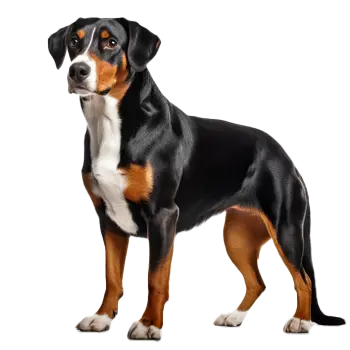
The first thing that stops people when they see an Appenzell is the coat. It is a striking tri-color pattern - a bold black or deep Havana brown base covered with precisely placed patches of rich rust and clean white. The rust typically appears above each eye in two small symmetrical dots (the classic "four eyes" markings), on the cheeks, along the chest, and on all four legs. The white marks the blaze on the face, the chest, and sometimes the tips of the feet. The standard calls for clearly defined, well-separated markings that give the dog a sharp, distinctive appearance. Even standing still, this dog looks like it means business.

The head is proportionate and moderately broad, with a slightly rounded skull that transitions into a clean, well-defined stop. The muzzle is fairly long and tapers to a black nose in black-based dogs or brown in Havana-based individuals. The eyes are small, dark, almond-shaped, and carry an expression that reads as alert and watchful rather than soft or dreamy. The ears are medium-sized and set high and wide on the skull - they fold forward when the dog is attentive, lying flat against the cheeks in a way that gives the face a compact, focused look.

The body is the body of a working dog: compact, muscular, and built close to square. The chest is broad and moderately deep. The back is firm and level, the croup only slightly sloped, and the hindquarters are well-muscled with good angulation. There is nothing exaggerated here - no excess bone, no dramatic angles. The overall impression is of a dog built exactly as hard as it needs to be for the work it was designed to do.

The tail is one of the Appenzell's signature features. In its natural state, it is tightly curled and carried over the back in a spiral that often lies flat against the back or along the side of the body. The curl is firm and characteristic - a straight or loosely held tail is considered a fault. When the dog is relaxed, the tail may drop, but the moment attention kicks in, it snaps back into position. It gives the breed a perky, confident silhouette that is immediately recognizable.

Height falls between 20 and 23 inches at the withers, with males on the taller end and females somewhat smaller. Weight ranges from 48 to 70 pounds depending on sex and build. Movement is where the athletic package really reveals itself - the Appenzell at a trot is smooth and ground-covering, with natural reach and drive that reflects generations of mountain work. Movement is where the athletic package really reveals itself - the Appenzell at a trot is smooth and ground-covering, with natural reach and drive that reflects generations of mountain work. There is nothing choppy or labored in a well-built specimen's gait; the dog covers ground efficiently without wasted motion, which is exactly what you would expect from an animal designed to travel over alpine terrain for hours at a stretch.

The double coat is short on the body's outer surface, thick and smooth rather than wiry. The undercoat is dense and may be grey, black, or brown, providing the insulation this dog needs for cold mountain mornings. The top coat is flat and shiny, which gives the tricolor markings a clean, vivid appearance that photographs beautifully and turns heads at dog events. The coat is weather-resistant - rain beads off it reasonably well - and easy to keep clean for a dog that spends significant time outdoors. Shedding occurs throughout the year with heavier seasonal blowouts in spring and fall.

Overall, the Appenzell presents as a dog that is balanced, confident, and purposeful in every aspect of its construction. Nothing about this breed is excessive or exaggerated. It was built to work and everything about it reflects that intent - from the grip of its compact feet on rough ground to the curl of its tail when it picks up something interesting on the wind.

Affectionate With Family
The Appenzell forms deeply devoted bonds with the people it lives with, seeking closeness and demonstrating loyalty through constant presence and attentiveness.
Good With Young Children
With proper early socialization, this breed is a patient and playful companion for children, though its herding instinct may cause it to nip at heels or attempt to herd smaller kids.
Good With Other Dogs
The Appenzell typically coexists with other dogs without issue when raised together, but its confident and territorial nature means introductions should be managed thoughtfully.
Shedding Level
The dense double coat sheds consistently throughout the year, with noticeably heavier seasonal blowouts in spring and fall that require increased brushing to manage.
Coat Grooming Frequency
Weekly brushing keeps this short coat tidy and free of loose hair, with no trimming or clipping required - a practical grooming routine for an active outdoor dog.
Drooling Level
Drooling is essentially a non-issue with this breed - the Appenzell has a clean, tight-lipped expression and does not slobber.
Coat Type
The coat is short, thick, and shiny on the outer layer with a dense undercoat in grey, brown, or black - weather-resistant and designed for alpine conditions.
Openness To Strangers
The Appenzell is a cautious breed with unfamiliar people - it prefers to size up a stranger at its own pace and will be far more welcoming once it has made its own assessment.
Playfulness Level
This breed has an enduring enthusiasm for games, fetch, and physical play that persists well into adulthood, making it an energetic and entertaining household companion.
Watchdog/Protective Nature
The Appenzell was bred for farm guarding and takes that responsibility seriously, delivering a loud, penetrating bark at the first sign of anything unusual on its territory.
Adaptability Level
Given sufficient daily exercise and mental engagement, the Appenzell can adjust to different living environments, though it is clearly happiest with space to move and a job to do.
Trainability Level
This is a quick-learning dog that thrives on challenge and responds exceptionally well to reward-based training - boredom is more of a problem than stubbornness.

Appenzell History & Development

The name Appenzell connects this dog to one of Switzerland's smallest cantons, a landlocked region that wraps around the base of the Alpstein mountains in the country's northeast. For centuries before anyone thought to write down breed standards or hold dog shows, the farmers and dairymen of Appenzell relied on their dogs the way a carpenter relies on good tools. The dogs herded cattle between valley farms and high summer pastures, guarded farmyards through the night, and pulled light carts when needed. They were indispensable, and they were everywhere in that region.

The first known written description of the breed dates to 1853, in a book by Friedrich von Tschudi called "The Animal World of the Alps." The dogs are described as loud, short-haired, multicolored herding dogs used throughout the Swiss mountain regions. The description fits the modern Appenzell precisely, suggesting that the breed had been stable in type for a long time before anyone formally documented it. These were farm-utility animals maintained by practical farmers who selected for working ability, not for show.

The transition from unnamed working dog to recognized breed happened in the late nineteenth century, driven by growing concern among Swiss naturalists that the country's native breeds might disappear as industrialization changed rural life. Professor Albert Heim was the central figure in this effort. He organized the first breed club in 1906 and pushed hard for a formal standard that would lock in the breed's characteristics. His 1914 standard established the key physical requirements - the square build, the tri-color coat, the curled tail - that define the breed today.

FCI recognition came much later, reflecting the breed's limited international profile compared to its cousin the Bernese Mountain Dog. In the United States, the Appenzell spent decades in the AKC's Foundation Stock Service before receiving full Working Group status in 2020. The name Appenzell shortened informally among the small community of American enthusiasts who imported and promoted the breed during those years. For them, saying Appenzell was both practical and affectionate - a badge of familiarity with a dog that most of their neighbors had never seen.

Today, the breed remains rare outside Switzerland and central Europe. Swiss breeders still maintain the tradition of working-dog functionality in their lines, and the Swiss club has historically been conservative about expansion to preserve genetic health. If you encounter an Appenzell in North America or the UK, you are almost certainly looking at a dog from imported European bloodlines, and the owner likely knows quite a lot about the breed's history.

Appenzell Temperament & Personality

The Appenzell was not bred to be decorative and does not pretend otherwise. This is a dog with a job in its DNA, and the behaviors that made it excellent at alpine farm work show up clearly in a pet household. The alertness that kept nighttime predators away from Swiss cattle means your Appenzell will notice everything that moves within its territory. The loud, penetrating bark that carried across mountain pastures means your neighbors will also notice. And the independent decision-making that helped a herding dog work unsupervised in a field means this is not a dog that will wait for your instruction before acting on something it has decided matters.

With its own people, the Appenzell is genuinely devoted - not in a clingy, anxious way, but in a watchful, present way. It tends to keep track of family members, positioning itself where it can monitor the household. It will not necessarily demand constant petting, but it wants to know where everyone is. This attentiveness makes it responsive and easy to read - a well-socialized Appenzell is an expressive dog whose body language is clear.

With strangers, expect caution rather than aggression. The Appenzell is not a dog that rushes up to greet unfamiliar people with its tail wagging. It prefers to assess first and warm up on its own schedule. Forcing an introduction - pushing a stranger to pet the dog before the dog has offered itself - is the surest way to make a bad impression. Let the dog approach in its own time and you will typically get a polite, curious response. Early and extensive socialization is not optional; it is necessary for a dog that defaults to wariness.

The herding instinct is real and specific. These dogs have a natural tendency to use their bodies and voice to move things - livestock, children, other pets. A young Appenzell given free rein with small children may attempt to herd them, which can mean nipping at heels or circling behind legs to push direction. This is not malicious behavior - it is job instinct - but it needs to be managed through training and supervision, especially with young children who may be knocked down or startled.

The energy level is genuine and consistent. An Appenzell that does not get enough physical and mental work becomes a problem dog - it will find things to do, and what it chooses usually involves barking, digging, or rearranging things you would prefer to remain where they are. An hour of real exercise daily is the floor, not the ceiling. Owners who match this energy level find the Appenzell one of the most rewarding working-dog companions available.

Appenzell Family Life & Living Requirements

The Appenzell is happiest in an active household where it has space to move, a family that includes it in daily activities, and ideally some form of work or structured sport. A house with a securely fenced yard is strongly preferred over apartment living - not because the dog cannot adapt, but because a yard gives it the ability to patrol, play, and decompress on its own terms throughout the day. The fence needs to be solid and tall; this breed can clear shorter obstacles with ease.

Families with older children who can participate in the dog's exercise needs and understand how to respect a cautious working breed will find the Appenzell a wonderful companion. With young children, supervision and management of the herding instinct are important. The dog is not dangerous, but its tendency to use body pressure and voice to redirect movement can startle or knock over toddlers. Teaching children how to interact calmly - not running past the dog repeatedly, not cornering it - is as important as training the dog itself.

This breed does reasonably well with other dogs when properly introduced and raised together. The Appenzell's bossy streak can occasionally surface in multi-dog households where it tries to organize other pets. Early socialization with dogs of various sizes and temperaments goes a long way toward producing an adult that coexists easily. With cats and small animals, the prey drive is moderate - manageable with early exposure but not zero.

The Appenzell is not suited for owners who want a low-demand dog. Novice owners or those with limited time for exercise and training will find this breed frustrating rather than fulfilling. The best Appenzell owners are people who enjoy being active with their dogs, have experience with smart independent breeds, and understand that consistent structure is what keeps a highly capable dog happy and appropriately directed.

As a breed that originated in alpine farming communities, the Appenzell has a deep connection to purposeful activity. Dogs that have a job - whether that job is herding, agility competition, regular trail hiking, or simply serving as an active family's adventure companion - settle better, bark less, and are generally easier to live with than dogs whose days consist of low-stimulation waiting. If you can give an Appenzell something meaningful to do with its considerable energy and intelligence, you will be rewarded with a devoted, manageable companion. If you cannot, expect the dog to create its own occupation, usually at your expense.

Appenzell Training & Exercise Needs

Training an Appenzell is genuinely enjoyable when you approach it correctly, and genuinely frustrating when you do not. The intelligence is real - this dog picks up new concepts quickly and retains what it learns. But intelligence in a working breed cuts both ways. A smart dog that is under-challenged will find its own outlets, and boredom is a bigger training problem with the Appenzell than stubbornness. Keep sessions short, varied, and rewarding, and this dog will engage fully. Drag the same exercise out past the point of the dog's interest and you will lose it to the environment.

Positive reinforcement is the right approach. The Appenzell responds to praise and food reward with enthusiasm and does not benefit from harsh corrections. Forceful training creates resistance and can damage the trust between dog and handler in ways that are difficult to repair. The breed's ancestors worked alongside farmers who directed them with voice and gesture - cooperative working is in the lineage. Use reward-based methods that build confidence and willingness.

Early socialization is essential. Expose a young Appenzell to different people, environments, sounds, vehicles, children, and other animals during the critical puppy window before 16 weeks of age. A dog that missed this window will spend its adult life managing situations that a well-socialized animal handles without thought. Puppy classes that include controlled exposure to other dogs and people are a good start, but they need to be supplemented with deliberate outings to new environments.

For exercise, think in terms of 60 to 90 minutes of genuine physical activity daily. Walking on leash counts but should not be the whole program. The Appenzell needs opportunities to run, jump, and think. Off-leash time in a secure area, fetch sessions, hiking on varied terrain, and organized dog sports like agility or herding trials all work well. This breed excels at agility and obedience competition because it is fast, athletic, and motivated - owners who pursue these sports typically find them as rewarding as the dog does.

Mental exercise matters as much as physical activity for this breed. Puzzle feeders, scent games, learning new commands, and any activity that requires the dog to problem-solve or follow a complex sequence of instructions burns mental energy that a physical walk cannot touch. A tired Appenzell brain produces a calmer, more settled dog than a physically tired one alone. Build mental work into the daily routine alongside the physical exercise and you will have a dog that is genuinely satisfied rather than just worn out.

Appenzell Health Concerns

The Appenzell is a genuinely robust breed. Centuries of selection for hard working ability in a demanding mountain environment did the breed real favors in terms of overall health. Lifespan runs 13 to 15 years, which is impressive for a dog of this size and activity level. That said, there are documented health concerns that responsible breeders test for and that owners should know.

The overall health picture for the Appenzell is encouraging. This is not a breed with a long list of serious hereditary conditions, and when breeders commit to OFA screening and responsible selection, the incidence of the known issues is manageable. The 13 to 15 year lifespan is a genuine reflection of the breed's vitality, not an aspirational number. Owners who keep their Appenzell at a lean, active weight and provide regular veterinary care can reasonably expect a long and healthy partnership with this breed.

Common Health Issues

  • Hip dysplasia - Abnormal development of the hip joint leading to cartilage wear, pain, and arthritis; OFA radiographic evaluation recommended for breeding stock.
  • Elbow dysplasia - Developmental conditions affecting elbow joint formation; can cause front-leg lameness and may require surgical management in severe cases.
  • Progressive retinal atrophy (PRA) - Degenerative retinal disease beginning with reduced night vision and progressing toward generalized vision loss; annual eye exams recommended.
  • Cataracts - Clouding of the eye lens that can impair vision; may be hereditary or develop with age; ophthalmology exams help identify early cases.
  • Gastric dilatation-volvulus (GDV/bloat) - Life-threatening stomach twisting seen in deep-chested breeds; feeding smaller multiple meals and restricting post-meal exercise reduce risk.
  • Epilepsy - Recurring seizure disorder documented in some lines; relatively uncommon in the breed but worth noting in breeding discussions.

Preventive Care & Health Monitoring

  • OFA hip and elbow radiographic evaluations for all breeding stock before any litter is produced. - OFA hip and elbow radiographic evaluations for all breeding stock before any litter is produced.
  • Annual ophthalmologist eye exams for breeding dogs to screen for PRA and cataracts. - Annual ophthalmologist eye exams for breeding dogs to screen for PRA and cataracts.
  • Restrict repetitive high-impact activities in puppies under 12 months to protect developing joints. - Restrict repetitive high-impact activities in puppies under 12 months to protect developing joints.
  • Feed two to three smaller meals daily and enforce a 30-minute rest period after eating to reduce GDV risk. - Feed two to three smaller meals daily and enforce a 30-minute rest period after eating to reduce GDV risk.
  • Annual veterinary wellness exams including physical examination and parasite screening. - Annual veterinary wellness exams including physical examination and parasite screening.

Appenzell Grooming & Maintenance

The Appenzell's short, dense double coat is one of the breed's practical advantages for owners who do not want to spend significant time on grooming. There is no trimming required, no clipping, no professional grooming appointments necessary to maintain the coat's function or appearance. Weekly brushing with a firm bristle brush or rubber grooming mitt removes loose hair during normal periods and keeps the coat looking healthy.

During seasonal coat blowouts - which happen most noticeably in spring and again in fall - the Appenzell sheds heavily as the undercoat releases. During these periods, daily brushing will dramatically reduce the amount of hair that ends up on furniture and floors. A deshedding tool or undercoat rake used gently during blowout periods speeds the process considerably. The coat does not mat or tangle under normal circumstances, so grooming remains straightforward year-round.

Bathing is infrequent for this breed - monthly at most and often less. The coat has natural water resistance and repels light dirt reasonably well. Routine bathing more than once a month is unnecessary and strips the natural oils that keep the coat healthy. A gentle dog shampoo and thorough rinse are all that is required when bathing is needed.

Nail trimming every three to four weeks keeps the nails at a comfortable working length. An active dog that covers hard ground regularly may wear its nails naturally, but checking monthly is good practice regardless. Ear cleaning should be part of the routine - the folded ears do not circulate air as freely as upright ears, and accumulated moisture can lead to infection if not addressed. Weekly ear checks and cleaning as needed prevent problems. Nail trimming every three to four weeks keeps the nails at a comfortable working length. An active dog that covers hard ground regularly may wear its nails naturally, but checking monthly is good practice regardless. Ear cleaning should be part of the routine - the folded ears do not circulate air as freely as upright ears, and accumulated moisture can lead to infection if not addressed. Weekly ear checks and cleaning as needed prevent problems.

Dental hygiene through regular tooth brushing or dental chews rounds out a complete care routine for this active, low-maintenance breed. One area where effort pays dividends is establishing a grooming routine early in the dog's life. An Appenzell puppy that learns to accept brushing, ear handling, nail trimming, and paw inspection from an early age will be a cooperative adult for all of these procedures. A dog that first encounters the nail clippers at age two will be considerably more difficult to manage. Five minutes of handling and examination a few times a week during puppyhood is an investment that pays off for the dog's entire life.