Ango Angari

Basenji

Quick Facts

🐕 Breed Group
Hound Group
📏 Size Category
Small to Medium
📏 Height
Males: 17 inches, Females: 16 inches
⚖️ Weight
Males: 24 lbs, Females: 22 lbs
⏱️ Life Expectancy
13-14 years
🧣 Coat Type
Short, fine, very dense
🎨 Coat Colors
Chestnut red, black, tricolor, brindle; all with white
😀 Temperament
Curious, independent, alert, affectionate with family
🏃 Exercise Needs
High
🎓 Training Difficulty
Difficult - sighthound independence
👶 Good with Children
Good with older, respectful children
🐾 Good with Other Pets
Better with dogs; small pets at risk from prey drive

Other Names & Breed Recognition

Ango Angari is one of the African regional names given to the dog known in the West as the Basenji. The name is used in parts of Central and West Africa and reflects the long history of this dog within indigenous communities long before any Western kennel club recorded its existence. For the communities that lived and worked with these dogs for generations, the Basenji was never a single uniform type with a single name - different villages, different regions, and different language groups had their own words for dogs that shared the same ancient lineage.

The name Basenji itself comes from the Lingala language and translates roughly as small wild thing from the bush, or in some interpretations, dog of the villagers. Western explorers and colonists encountered these dogs in Central Africa, particularly in the Congo basin, and brought them back to Europe beginning in the late 19th century, though early attempts to establish the breed in Europe failed due to disease. The successful introduction to the UK came in 1937, and AKC recognition followed in 1944.

Other African names and regional designations for the Basenji include Congo Dog, M'bwa wa mwitu (bush dog in Swahili), and Zande Dog after the Azande people of the Congo and Sudan border regions with whom the breed has a particularly long association. The Azande used these dogs for hunting - driving small game into nets and pursuing quarry through dense bush with remarkable silence. The barkless quality that strikes Western owners as remarkable was practically essential in this hunting context: a dog that yapped during the hunt was a poor hunting companion.

In the modern Western show and companion dog world, Basenji is the standard name. Ango Angari appears in historical and anthropological accounts of the breed's African origins and is part of the documented record of the breed's pre-Western existence. For owners interested in the breed's deep roots, these African names are worth knowing - they connect the dog you might be considering to a history that predates registries and breed standards by thousands of years.

The Basenji Club of America (BCOA) is the AKC parent club for the breed. The BCOA maintains an active health committee and coordinates with OFA on the breed's CHIC testing protocol. The breed has also attracted scientific interest as one of the most genetically primitive domestic dog breeds, with DNA studies consistently placing it among the first branches to diverge from the ancestral wolf-dog lineage.

Ango Angari Organizations & Standards

The Basenji Club of America (BCOA) is the AKC parent club for the Basenji and the primary body responsible for the breed standard and health testing framework in North America. The BCOA has an established health committee and participates in OFA's Canine Health Information Center (CHIC) program with a breed-specific required testing protocol. BCOA-endorsed CHIC requirements for Basenjis include Fanconi Syndrome DNA test through OFA, PRA-BJ1 (progressive retinal atrophy) DNA test, hip evaluation, thyroid testing, and eye examination by a veterinary ophthalmologist.

The FCI classifies the Basenji in Group 5, Section 6 (Primitive type), which is the most accurate classification from a biological standpoint. The primitive type designation reflects that Basenjis diverge less from ancestral dog behavior and structure than most breeds shaped by centuries of European selective breeding. The AKC places them in the Hound Group, reflecting their hunting function. The UKC groups them with Sighthounds and Pariahs - the pariah designation acknowledging the breed's free-ranging, village-dog origins.

The AKC breed standard for the Basenji describes a small, lightly built, short-backed dog, finely wrinkled of forehead, and with an alert, foxlike expression. The standard calls for a flat skull with little stop, almond-shaped eyes in dark hazel to dark brown, small, erect, hooded ears set well forward on the head, and a high-set tail that curls tightly over to either side of the spine. The neck is well arched and long. The body is short-coupled with level topline. The chest is deep and oval rather than deep and broad.

Height at the shoulder is 17 inches for males, 16 for females. Weight is 24 and 22 pounds respectively. The breed standard is specific about the wrinkled forehead, which appears particularly pronounced when the dog is alert or curious and gives it the thoughtful, quizzical expression characteristic of the breed. The feet are small, oval, and compact with thick pads.

The BCOA health statement, updated by ballot in 2017, provides specific guidance on the breed's most significant heritable conditions and recommends health testing protocols aligned with current DNA test availability. Given the significance of Fanconi Syndrome and PRA in the breed's health history, the BCOA health statement is essential reading for anyone considering acquiring a Basenji from a breeder.

Kennel Club Recognition

  • American Kennel Club (AKC): Recognized in 1944, Hound Group
  • United Kennel Club (UKC): Recognized, Sighthounds and Pariahs
  • Canadian Kennel Club (CKC): Recognized, Hounds
  • FCI: Recognized, Group 5 - Spitz and Primitive types
  • The Kennel Club (UK): Recognized, Hound

Ango Angari Physical Description

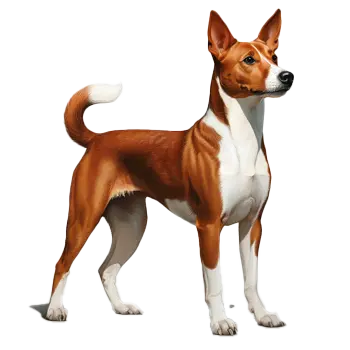
The Ango Angari - what we call the Basenji - is a small, finely built dog that carries itself with a dignity and assurance that makes it look larger than its 22 to 24 pounds. Standing 16 to 17 inches at the shoulder, it is compact and cleanly made, without the exaggerations or excess that characterizes many Western show breeds. Every part of the Basenji looks like it was designed to do a specific thing: the eyes to spot movement across a clearing, the ears to catch the faintest sound in the bush, the lithe body to change direction at speed without a moment's hesitation.

The head is the first thing you notice up close. The skull is flat - broader between the ears than between the eyes - and narrows slightly toward the muzzle. The wrinkled forehead is the breed's most distinctive facial feature, and the wrinkles intensify when the dog is alert or curious, giving the face an expression of focused intelligence that owners describe as almost human. The ears are small, erect, and set well forward on the skull, giving the face a wide-awake, forward-looking quality. The eyes are almond-shaped, dark hazel to dark brown, and slightly obliquely set, with a bright and penetrating gaze.

The neck is long and well arched, flowing into well-laid-back shoulders. The topline is level. The chest is deep and oval - not barrel-ribbed but with genuine depth reaching toward the elbows. The loin is short, giving the body a compact, square-ish appearance despite the relative length of the neck and legs. The tail is high-set and carried in a tight single or double curl over either hip, one of the breed's most recognizable features.

The coat is short, fine, and sleek with no undercoat, and it fits so closely to the body that the underlying muscle definition is clearly visible. The main color varieties are chestnut red with white, black with white, tricolor (black and chestnut with white), and brindle. All recognized varieties have white on the feet, chest, and tail tip. The white blaze, collar, and leg markings that appear in some individuals are correct markings in the standard.

The feet are small, oval, and compact, with deep pads and well-arched toes. The legs are fine-boned but strong. The overall impression is of a dog built for precision and speed rather than power - a sighthound-influenced body on a small, elegant frame.

Movement is distinctive: light, effortless, and swift, with a long reaching stride in front and strong drive behind. The Basenji at a run is a fluid thing - the acceleration from a standing start is immediate and the change of direction at speed is almost cat-like. This athleticism is part of the breed's daily reality, not a show-ring feature.

One feature that photos don't fully convey is the characteristic posture of alertness. When something catches the Basenji's attention, the whole body shifts - weight forward, head raised, eyes focused, ears pricked to maximum. The wrinkles on the forehead deepen. The tail may uncurl slightly from its resting position. The dog looks like a spring under tension, organized and ready, not agitated. It is one of the more striking behavioral expressions in any breed.

The gender difference in size is modest - one inch in height, two pounds in weight - but visible in type. Males tend toward a slightly more squared, muscular appearance; females are often more refined in overall outline. Both are unmistakably the same breed.

Affectionate With Family
The Ango Angari attaches deeply to its people, showing a warmth and expressiveness that surprises first-time owners expecting a more aloof primitive breed. Family members become their whole world.
Good With Young Children
Older children who understand that the Basenji is not a lap-and-cuddle toy on demand do fine with this breed. Toddlers and very young children who grab and overwhelm are a mismatch - the Basenji will find a way to exit the situation rather than tolerate it.
Good With Other Dogs
Basenjis raised with other dogs generally coexist well. Same-sex pairs can be more challenging. Their play style is physical and can look alarming to observers unfamiliar with the breed, but actual aggression toward other dogs is not a defining characteristic.
Shedding Level
The Basenji sheds minimally, and its grooming habits mean loose hair rarely accumulates in quantity. For people who find dog hair on furniture a dealbreaker, this is one of the breed's genuine practical advantages.
Coat Grooming Frequency
The Basenji essentially grooms itself in the manner of a cat. An occasional wipe-down and a weekly quick brush is typically all that is required. Bathing is needed rarely because the coat doesn't develop the dog odor characteristic of many other breeds.
Drooling Level
Not a drooler. This is a tidy, dry-mouthed breed with none of the jowl-related dampness associated with Mastiff or scent-hound type dogs.
Coat Type
Short, fine, and dense without any undercoat. The coat sits close to the body and showcases the muscular, defined lines underneath. It feels sleek to the touch and has a slight natural sheen.
Openness To Strangers
The Basenji is cautious with new people and takes time to assess before accepting anyone into its social circle. This is not aggression - it is the measured independence of a primitive breed that decides for itself who is trustworthy.
Playfulness Level
Quick, agile, and deeply mischievous, the Basenji plays with an inventiveness that keeps owners perpetually entertained and occasionally exasperated. They are problem-solvers by nature and will use that ability on anything in the household.
Watchdog/Protective Nature
The Basenji is observant and will alert to unusual presence, though it doesn't bark - any alarm is delivered in the form of the breed's distinctive yodel, growl, or other vocalizations. It is more observer than guardian.
Adaptability Level
Basenjis adapt reasonably well to different living situations provided their exercise and mental stimulation needs are met. Urban living works if the owner is committed to daily exercise and a secure environment.
Trainability Level
The Basenji understands exactly what you are asking. Whether it complies is a separate question entirely. Training requires creativity, variety, and the ability to make compliance seem like the Basenji's own idea.

Ango Angari History & Development

The story of Ango Angari - the Basenji - begins not in a kennel club registry but in the forests and villages of Central Africa, where dogs of this type have lived alongside human communities for longer than any Western breed record can document. Genetic research on domestic dog origins consistently places the Basenji among the most basal lineages - meaning its DNA diverged from the ancestral dog population earlier than most breeds. This is a genuinely ancient type of dog, not shaped by recent European selective breeding but by thousands of years of coevolution with its African environment and the people who shared it.

The Azande people of the Congo-Sudan border region and surrounding communities used these dogs as active hunting partners. The technique involved driving small game - guinea fowl, small antelopes, rats - into nets while the dogs worked ahead of the hunters in the dense undergrowth. The Basenji's silence was not a curiosity but a functional requirement: a barking dog would scatter the quarry before the trap could close. The breed's barkless quality - more accurately, the inability to produce a typical dog bark due to the unusual shape of its larynx - reflects real selection pressure over countless generations of working hunters.

Western awareness of the breed grew through 19th and early 20th century exploration and colonial accounts of Central Africa. Attempts to bring the dogs to Europe began in the 1890s, but early imports died from distemper and other diseases before they could establish a breeding population. The first successful European breeding establishment came in England in 1937, and the Basenji entered the show world rapidly from there. The American Kennel Club granted recognition in 1944, placing the breed in the Hound Group in recognition of its hunting heritage.

The name Basenji replaced the various African regional names - including Ango Angari and Congo Dog - as the breed became established in Western registries. The choice of name reflected the Lingala-speaking region of Congo where many of the imported foundation dogs originated. But the other names persist in historical records, in breed club literature about the breed's origins, and in the accounts of field researchers who documented the dogs in their original working context.

Periodic infusions of African-born dogs into Western breeding lines have been an important part of the breed's history, helping maintain genetic diversity in a breed with a relatively small founding population. Dogs brought from Zaire (now the Democratic Republic of Congo) in the 1980s and from additional African imports since then have broadened the gene pool and introduced physical characteristics - including the brindle color pattern - that weren't represented in the original Western foundation stock.

For anyone who encounters the name Ango Angari and wants to understand what it refers to, the short answer is: you're looking at one of the oldest domestic dog types still alive and recognizable, brought to the West in the 20th century, and known by many names across the African communities that lived with it long before any registry took notice.

Ango Angari Temperament & Personality

The Basenji is the dog that makes cat people say they finally found a dog they can live with, and that makes experienced dog people say they've never had anything quite like this before. Both observations are accurate. This is a breed that operates by its own rules, forms bonds on its own schedule, and maintains a behavioral complexity that keeps owners engaged and occasionally confounded for the duration of the dog's life.

The independence is not stubbornness in the conventional sense. The Basenji is not a dog that decides it doesn't want to comply with a command it understands. It is a dog that genuinely evaluates whether following a command makes sense given what it currently knows about the situation. This is the behavior of a hunting dog that made decisions in the field without human direction - the ability to think independently was selected for as rigorously as speed or nose. In a home environment, it produces a dog that is perpetually curious, problem-solving, and capable of getting into places and situations that more compliance-oriented breeds wouldn't think to attempt.

The affection with family is genuine and demonstrative - but on the Basenji's terms. These dogs choose their people carefully and love them wholeheartedly. The morning greeting from a Basenji that trusts you is warm and physical. The refusal to acknowledge you when you've done something it disapproves of is equally unmistakable. There is a clarity of communication in this breed that owners either find endearing or exhausting, depending on their expectations.

The prey drive is high and triggered by motion. A Basenji that sees a squirrel, a cat, or a small dog running will pursue it, and in that moment, recall training has limited influence. Off-leash time must occur in securely fenced areas. This is not a breed for off-leash hiking or unrestricted outdoor access, regardless of training. The sighthound-style chase response is deeply instinctive and operates faster than conscious decision-making.

With children, the Basenji does best with older kids who understand and respect the dog's boundaries. This is a small dog that will use its agility and independence to extract itself from situations it doesn't enjoy rather than enduring unwanted handling. Families with very young children who have not yet developed impulse control will find the relationship requires constant management. The dog is not aggressive toward children, but it will not tolerate being grabbed, squeezed, or overwhelmed.

Ango Angari Family Life & Living Requirements

The Basenji is adaptable enough to live in apartments and urban environments, provided the exercise requirement is genuinely met. These are athletic, high-energy dogs in small packages, and the daily walk that satisfies a Bulldog or a Basset is not enough for a Basenji. Serious daily exercise - at least an hour of genuine activity - combined with mental stimulation is the foundation of a harmonious household.

The containment requirement is absolute. Basenjis climb, jump, and problem-solve their way through most escape opportunities. A six-foot fence that is solid and smooth at the top is appropriate; anything with horizontal bars or lattice is an invitation to climb. The yard should be checked regularly for gaps at ground level. A Basenji that has escaped is difficult to catch - its speed and independent nature mean it will not simply return when called.

The breed's cat-like cleanliness and minimal odor make them pleasant indoor companions. They don't develop the heavy dog smell that requires frequent bathing in many breeds. They do, however, have the cat-like habit of grooming themselves and their housemates - other dogs, and sometimes tolerant human family members.

The Basenji is a one-heat-per-year breed, unlike most domestic dogs that cycle twice yearly. This ancient reproductive pattern is another marker of the breed's primitive origins. Breeders plan accordingly, and potential owners should understand that puppy availability follows a different seasonal pattern than most other breeds.

Multiple-dog households with Basenjis can work well, particularly when the dogs have been raised together. The breed's social nature means it generally enjoys company of its own kind. What it does not tolerate is being in a household where it is being bullied or dominated by larger, more assertive dogs. The Basenji is small but has no perception of its own smallness.

The Basenji's relationship to the home environment is more interactive than most breeds. This dog is not going to lie in the corner while you work. It will find something to do, and if that something isn't provided by you in the form of toys, training, or engagement, it will be provided by the dog in the form of counter-surfing, linen redistribution, and general investigation of household items. Owners who work from home or have flexible schedules do best with this breed. Basenjis left alone for long hours on a regular basis develop the separation-related behaviors that their intelligence and energy make particularly thorough.

Ango Angari Training & Exercise Needs

Training a Basenji is a creative exercise in partnership rather than command-and-comply obedience. The breed learns quickly - sometimes too quickly, learning in one or two repetitions what takes other breeds many sessions to absorb. The challenge is that it also quickly learns which rules apply when the owner is watching and which ones can be renegotiated when no one is looking.

Positive reinforcement with high-value food rewards is the most effective approach. Harsh corrections or repetitive drills produce a Basenji that checks out mentally - they simply remove themselves from a training relationship that isn't working for them. Variety, brevity, and genuine reward keep the Basenji's attention. Training sessions of five to ten minutes, multiple times daily, outperform long sessions with diminishing enthusiasm.

Basic manners - sit, down, stay, leash walking - are achievable. Reliable off-leash recall is difficult to achieve to the standard required for genuine safety, and most experienced Basenji owners are honest about this: the dog is trained on recall but not trusted off-leash in unfenced areas because the prey drive can override even well-established behavior. This is not a training failure; it is an honest assessment of the breed's hardwiring.

Exercise needs are genuinely high for the dog's size. An hour of vigorous activity daily is a minimum for most adult Basenjis. Lure coursing is an ideal outlet that combines the breed's speed and prey-drive energy in a safe, controlled setting. Fetch, agility, and fast-paced leashed walking also work well. A Basenji that doesn't get enough exercise becomes destructive in a creative and thorough way - these dogs don't just chew shoes, they systematically investigate every surface and container in the home for anything interesting.

The breed's intelligence also requires mental engagement beyond physical exercise. Puzzle feeders, nose work training, and novel environmental exploration keep the brain occupied in ways that a second daily walk alone cannot match. Owners who approach the Basenji as a project - an interesting partnership to develop rather than a pet to manage - consistently report the most satisfying relationships with this breed.

Adolescence in the Basenji, roughly 6 to 18 months, is when testing of household rules intensifies. Consistency during this period matters. Rules that are sometimes enforced and sometimes ignored get filed under optional, and a Basenji that has learned a rule is optional will treat it that way for years. Clear, consistent boundaries established early make the adult dog genuinely easier to live with.

Ango Angari Health Concerns

The Basenji is generally a healthy breed with a lifespan of 13 to 14 years - notably long for a pure-breed dog. Two genetic conditions have been the breed's primary health priorities for decades, and the availability of DNA tests for both has significantly improved breeders' ability to manage them.

Hip dysplasia occurs in a small percentage of Basenjis, though the rate is low compared to most breeds. The BCOA recommends hip evaluation for breeding stock. Monthly urine glucose strip testing, starting around age three, has been the traditional method for Fanconi monitoring in dogs without DNA test results, and remains useful for adopted dogs of unknown genetic status.

Common Health Issues

  • Fanconi Syndrome: A hereditary kidney tubule disorder in which essential electrolytes and nutrients are lost in urine rather than reabsorbed. DNA test available through OFA distinguishes clear - Carrier, and affected dogs. The Gonto Protocol manages affected dogs effectively when started early.
  • Progressive Retinal Atrophy - PRA-BJ1, : Genetic retinal degeneration causing progressive vision loss leading to blindness. DNA test for the PRA-BJ1 form is available through OFA and required for BCOA CHIC certification. Additional PRA forms in the breed require annual ophthalmologist examination.
  • Pyruvate Kinase Deficiency: Genetic condition affecting red blood cell metabolism - Causing hemolytic anemia and shortened lifespan in affected dogs. DNA test available.
  • Hip dysplasia: Occurs at a low rate in Basenjis but is documented - OFA or PennHip hip evaluation is recommended for breeding stock by the BCOA.
  • Hypothyroidism: Occurs in a small percentage of Basenjis - OFA thyroid testing from an approved laboratory is part of the BCOA health recommendations.

Preventive Care & Health Monitoring

  • Fanconi Syndrome DNA test through OFA - Required for BCOA CHIC certification; distinguishes clear, carrier, and affected status before clinical signs appear.
  • PRA-BJ1 DNA test through OFA - Required for BCOA CHIC certification; ophthalmologist examination also required because other PRA forms exist without a current DNA test.
  • Annual ophthalmologist eye examination (ACVO certified) - Required for BCOA CHIC certification; examines for retinal atrophy and other heritable ocular conditions.
  • Hip evaluation via OFA or PennHip - Required for BCOA CHIC certification.
  • Thyroid testing from an OFA-approved laboratory - Included in BCOA health recommendations.
  • Monthly urine glucose strip testing beginning around age 3 for dogs without a Fanconi DNA test result - To monitor for early onset of Fanconi Syndrome.

Ango Angari Grooming & Maintenance

The Basenji's grooming demands are about as close to zero as any breed gets. The short, fine coat requires no trimming, no professional grooming, and minimal brushing. A weekly wipe-down with a damp cloth or grooming mitt removes loose hair and keeps the coat gleaming. Basenjis groom themselves constantly in the manner of cats, licking their paws and using them to wash their faces, so the coat rarely develops the accumulated grime or odor typical of dogs that don't self-groom.

Bathing is needed only occasionally - every few months for most household dogs, or as needed after a particularly muddy adventure. The coat dries extremely quickly after bathing because there is no undercoat to trap moisture. The lack of the typical dog odor that so many breeds develop between baths is one of the Basenji's most appreciated practical qualities, especially for owners who prefer a tidy indoor environment.

Nails need regular trimming - every 2 to 3 weeks for most active dogs, less frequently for dogs that walk on pavement regularly and wear them down naturally. Ears should be checked weekly for wax accumulation or signs of infection. The Basenji's upright, open ear carriage allows for good air circulation and the breed does not have a high rate of ear infections, but regular inspection is still good practice.

Dental care is the area where most owners need to invest most consistently. Periodontal disease develops in most dogs without regular teeth brushing, and the Basenji is not exempt. Brushing several times a week, combined with dental chews or water additives, keeps plaque accumulation in check. Annual professional dental cleaning under anesthesia provides the thorough subgingival cleaning that home care cannot fully replace.

The overall grooming investment for the Basenji is genuinely minimal - the time saved on coat maintenance should be redirected into training and exercise, which is where this breed actually needs attention. For owners who want a clean, low-odor, easy-care coat, the Basenji delivers that. What it asks in return is engagement, not grooming effort.