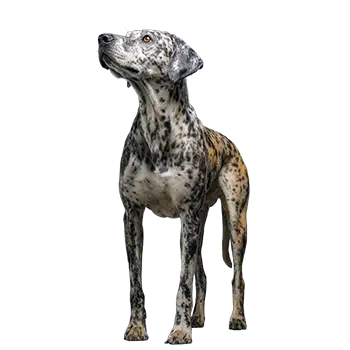
Stand an American Leopard Hound in front of you and the first thing you register is that this is a working dog - not a stylized version of one, but the real thing. The body is built for a specific job: tracking through rough terrain, navigating dense brush, and holding game at bay with athleticism and nerve. Nothing about the dog's construction is decorative. Every proportion serves the function.
The overall silhouette is that of a medium-to-large, balanced dog with a body that is only slightly longer than it is tall. Males stand 22 to 27 inches at the shoulder and weigh 45 to 75 pounds; females run somewhat smaller at 21 to 25 inches and 35 to 65 pounds. The dog looks capable without looking heavy. There is muscle throughout - through the hindquarters especially - but the frame is lean and the movement is efficient. A dog carrying unnecessary weight cannot duck and dodge through brush at speed, and this breed's characteristic hunting technique requires exactly that kind of nimble athleticism.
The head is broad and proportionate to the body's size. Viewed from the side, the muzzle is slightly shorter than the skull, and the two planes meet at a definite stop. The topline of the skull and the topline of the muzzle run in parallel planes - not dished, not roman-nosed. The muzzle itself is heavy and substantial, built to carry scent efficiently and to voice that distinctive bark without strain. The nose color varies with coat color: black on most dogs, brown or liver on dogs with brown or red pigmentation.
The eyes are round, wide-set, and carry an alert, engaged expression. Color ranges from yellow or brown in most dogs, but a dog can have one or two blue eyes, and this is acceptable under the UKC standard. Blue eyes on American Leopard Hounds are associated with the merle pattern but are not exclusively a merle trait - a dog can have a blue eye without being merle. This occasionally causes confusion for people trying to assess coat and pigmentation risks. The ears are set high on the head, taper to a point, and drop naturally to a short-to-medium length. They are not the long, pendulous ears of a Basset Hound - they are field-functional drop ears that stay relatively close to the head.
The neck is moderately long and muscular, flowing cleanly into well-laid-back shoulders. The topline is level and strong. The chest is deep enough to support good lung capacity for endurance work, but the dog is not barrel-chested. Ribs are well-sprung. The loin is moderately tucked, and the overall outline through the midsection shows the conditioning you would expect in a dog bred for sustained effort.
The tail is straight, set low on the croup, and may be any length - some working dogs are docked. Carriage when working is typically carried upward, though the standard does not specify a required tail carriage. Forequarters show good angulation with straight legs and round, compact cat-feet. Those feet deserve specific mention: the American Leopard Hound's paws are notably tougher and more durable than those of most other hound breeds, built to traverse rocky hillsides, creek beds, and logging roads without breakdown. Hindquarters are well-muscled with strong, fully extending hocks - the rear drive that propels this dog through difficult terrain.
The coat is the breed's most immediately variable feature. The outer layer is dense, close-fitting, and straight - stiff enough to offer some protection from briars and brush. Underneath sits a fine, wool-like undercoat that provides insulation across the temperature extremes this dog historically worked in. The coat sheds seasonally but is not heavy maintenance under normal circumstances. It dries quickly and sheds dirt well.
Color and pattern are where the American Leopard Hound becomes genuinely interesting. The breed comes in nine recognized colors: red, blue, black, yellow, brindle, grey, brown, tan, and saddle. Three pattern types occur: solid, brindle, and leopard (the merle-derived spotted pattern the breed is named for). White markings are acceptable as long as they cover less than one-third of the coat - any more than that is a disqualification under the UKC standard. Approximately 60 percent of registered American Leopard Hounds are solid-colored, meaning the iconic spotted appearance is actually the minority. The leopard pattern consists of irregular patches or spots of darker pigment over a lighter base - it looks striking, but it is also the pattern type that carries the double-merle breeding risk that breeders must manage carefully. Movement is smooth and effortless, with good front reach and strong rear drive. Legs track straight coming and going, and as speed increases the feet converge toward the center line in the efficient single-tracking movement typical of endurance hunting breeds.
Affectionate With Family
★★★★☆
The American Leopard Hound bonds closely with its household and shows genuine warmth, though it tends to express affection through presence and watchfulness rather than constant cuddling. They are devoted without being clingy.
Good With Young Children
★★★★★
This breed is notably protective of children and has a long history alongside families in rural America. Their patience with kids is genuinely documented - they tend to watch over the youngest household members with a calm, guardian-like attention.
Good With Other Dogs
★★★☆☆
American Leopard Hounds generally get along with other dogs, especially when raised together or socialized early. Some males can show same-sex tension, and pack dynamics should be introduced gradually.
Shedding Level
★★★☆☆
The short double coat sheds moderately and more noticeably during seasonal transitions. Weekly brushing keeps loose hair manageable - this is not a breed that fills your house with tumbleweeds.
Coat Grooming Frequency
★★☆☆☆
Beyond weekly brushing and occasional baths, this coat requires very little. It is a working dog coat - tough, weather-resistant, and genuinely low-maintenance.
Drooling Level
★☆☆☆☆
The American Leopard Hound has a dry mouth and is not a drooler. This is not a breed you'll hear slurping or find leaving wet patches on the couch.
Coat Type
★★☆☆☆
Short, dense, and straight on the outer layer with a fine wooly undercoat underneath - this is a practical field coat that sheds dirt and dries quickly. No trimming, stripping, or professional grooming required.
Openness To Strangers
★★★☆☆
Well-socialized American Leopard Hounds are neither aggressive nor effusive with strangers - they size people up before warming up. Poorly socialized dogs can be reserved or aloof, which is why early exposure matters.
Playfulness Level
★★★★☆
These are energetic, game-driven dogs who enjoy active play well into adulthood. Give them something to do and they are all in. Idle time is where they start looking for their own entertainment.
Watchdog/Protective Nature
★★★★☆
The American Leopard Hound is alert and will announce visitors - loudly. Their chop-mouth bark is distinctive and carries. They are protective of family and property without tipping into aggression.
Adaptability Level
★★☆☆☆
This is a working dog built for the field, and it shows. They adapt best to rural or suburban settings with significant outdoor space and daily exercise. Apartment life or inactive households are genuinely a poor match.
Trainability Level
★★★★★
For a hound, the American Leopard Hound's desire to please its handler is remarkable. They take direction well, respond to voice commands even while on track, and reward consistent, fair handling with fast results.