American Leopard Cur

American Leopard Hound

Quick Facts

🐕 Breed Group
Hound Group
📏 Size Category
Medium to Large
📏 Height
Males: 22-27 inches, Females: 21-25 inches
⚖️ Weight
Males: 45-70 pounds, Females: 35-55 pounds
⏱️ Life Expectancy
12-15 years
🧣 Coat Type
Short, dense double coat
🎨 Coat Colors
Yellow, black, brindle, red, blue, gray, mouse; solid or with merle pattern
😀 Temperament
Loyal, energetic, intelligent, protective
🏃 Exercise Needs
High
🎓 Training Difficulty
Moderate
👶 Good with Children
Yes
🐾 Good with Other Pets
With supervision

Other Names & Breed Recognition

The American Leopard Cur is not a separate breed from the American Leopard Hound - it is the same dog under its original registered name, a name that carried the breed through most of its documented modern history before a deliberate change in 2008. If you know this dog as the American Leopard Cur, you are using the name that appeared on breed registrations, club documents, and hunting records for nearly fifty years. That name is historically valid and remains widely recognized in working dog and hunting communities across the American South and Southwest.

The name change from American Leopard Cur to American Leopard Hound came in May 2008, when members of the breed club voted to adopt the new designation. The primary practical motivation was competitive eligibility: the Hound classification opened access to UKC coonhound events and other organized hunting competitions that the Cur designation had excluded the breed from entering. By calling the dog a hound rather than a cur, breeders could bring it into the organized field trial and bench competition world that validates working ability alongside conformation. The name Cur, despite its pejorative association in common English usage, had historically been used in the working dog community as a neutral descriptor for versatile American-type multipurpose dogs - other cur breeds include the Black Mouth Cur, the Catahoula Leopard Dog, and the Mountain Cur.

The word cur itself derives from older English and Nordic roots meaning a dog of mixed or uncertain origin used for working purposes. In the American hunting and farming tradition, cur breeds were the working dogs that settlers and pioneers relied on for treeing, stock work, and protection. The American Leopard Cur's assignment of this designation reflected its identity as a practical American working dog rather than a European import or a show-ring creation.

Other names that appear in historical and regional contexts include the Leopard Dog, the American Leopard, and simply the Leopard Cur. These names reference the breed's most visually striking characteristic - a coat that can carry a mottled or spotted pattern reminiscent of a leopard's markings, particularly in merle-patterned individuals. The UKC recognized the breed as the Leopard Cur in 1998 before adopting the updated American Leopard Hound name alongside the breed club's formal change. The AKC added the American Leopard Hound to its Foundation Stock Service and fully recognized it in the Hound Group in 2012.

American Leopard Cur Organizations & Standards

The breed that was registered and competed as the American Leopard Cur built its modern organizational foundation through the American Leopard Cur Breeders Association, which was established in 1960 by fanciers who recognized that the breed was declining and needed formal documentation and protection. The organization's founding is credited to J. Richard McDuffie, Leroy E. Smith, and A.W. Carter, who worked to locate remaining purebred examples and establish a registry. That registry became the foundation for what would eventually evolve into the breed's UKC recognition in 1998 and AKC recognition in 2012.

The UKC breed standard for the American Leopard Hound describes a medium to large, well-muscled dog with a dense double coat. The standard emphasizes athletic build and functional conformation suited to a full day of hunting work in varied terrain. The head is described as broad and slightly domed, with a medium-length muzzle and a well-defined stop. Ears are set high and taper to a slightly rounded tip, hanging to approximately the lower jaw. Eyes are round and set wide, with color varying from brown to yellow and including blue in dogs carrying the merle pattern. The topline is level from withers to hips, supported by a well-muscled back and strong, powerful hindquarters built for the sustained movement of a working field dog.

The breed standard accommodates a wide range of coat colors in recognition of the breed's varied working heritage. Yellow, black, brindle, red, blue, gray, and mouse (a neutral gray-brown) are all acceptable base colors, and white points or a white collar are common. The merle pattern produces a mottled coat that may also affect eye color, with blue eyes appearing in merle-patterned individuals. The standard explicitly notes that breeding two merle-patterned dogs together - a double-merle cross - is discouraged because it carries a documented risk of producing offspring with hearing and vision deficits. This is a health consideration that responsible breeders take seriously.

The American Kennel Club's full recognition in the Hound Group in 2012 brought the breed into AKC conformation showing, hunting tests, and tracking events. The AKC parent club and the UKC both maintain health and breeding guidance encouraging breeders to avoid double-merle breeding and to screen breeding stock for hip dysplasia. Because the breed is relatively rare outside of working dog communities in the South, genetic diversity and sound breeding practices are particularly important to the breed's long-term health.

Kennel Club Recognition

  • American Kennel Club (AKC): Recognized in 2012, Hound Group
  • United Kennel Club (UKC): Recognized, Scenthounds

American Leopard Cur Physical Description

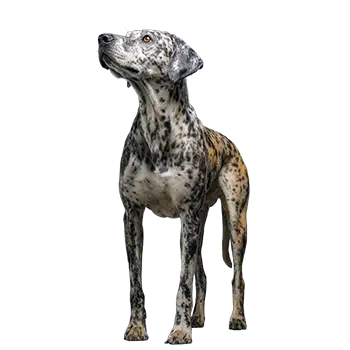
Stand an American Leopard Cur next to a typical hound breed and what strikes you first is how purposefully built this dog looks. There is nothing ornamental about its construction. Every dimension - the leg length, the depth of chest, the musculature of the hindquarters - communicates a dog designed to cover rough terrain all day and still have something left when the quarry goes up a tree. This is not a couch dog that happens to look athletic. It is an athlete whose working legacy is visible in every line of the body.

The head is broad and moderately domed, with a well-defined stop between the muzzle and the skull. The muzzle is of medium length, broad, and strong - built to hold prey without sustaining injury, which was a documented selection criterion in the breed's development. The nose is black or brown depending on coat color. Ears are set high on the skull, tapering from a broader base to a slightly rounded tip, and hang to approximately the lower jaw. They function as scent collectors in the field, helping stir and funnel ground scent toward the nose during tracking.

The eyes are one of the breed's most striking features. Round and wide-set, they come in shades of brown and yellow, and dogs carrying the merle gene often present with blue eyes or heterochromia - two eyes of different colors, or eyes that are partially blue and partially brown. The expression is attentive and intelligent, which matches the breed's actual disposition in the field and at home.

The body is built for endurance over speed. The chest is deep and well-sprung, providing lung capacity for sustained effort. The back is level and strong, supported by well-angulated rear legs with substantial muscling through the thighs. The feet are cat-footed - rounded, tight, and well-padded - which provides the grip and durability needed in rocky or uneven terrain. The tail is naturally long, carried up and slightly curved when the dog is engaged, and is sometimes docked short for working dogs to prevent injury in dense brush.

The double coat is one of the breed's most functional physical features. The outer coat is short and rough-textured, resisting burrs and debris during field work. The undercoat is fine and wool-like, providing insulation in cold conditions and moisture management in wet ones. The coat dries quickly and requires minimal maintenance. Colors range widely: yellow, black, brindle, red, blue, gray, and mouse are all documented in the breed, with approximately sixty percent of individuals presenting solid-colored or nearly solid with white points. Merle-patterned individuals show a mottled mixture of color over a lighter base, creating the leopard-like spotting that gave the breed its name.

Height ranges from 21 to 27 inches at the shoulder, with males typically toward the upper end of that range and females somewhat smaller. Weight follows proportionally, with males commonly between 45 and 70 pounds and females between 35 and 55 pounds. The size range reflects the breed's development from practical working stock rather than show-ring conformity - the emphasis was always on ability and structural soundness rather than strict dimensional consistency.

Movement is free, effortless, and ground-covering, with a gait that can shift from a ground-eating trot to a full run without the labored or choppy quality that structural faults produce. A correctly built American Leopard Cur moving at a working pace looks like an animal that could sustain that pace for hours, which is exactly what it was bred to do. Structural issues - straight shoulders, weak rear angulation, splayed feet - undermine that efficiency and are faults in both show and working evaluation contexts. The overall impression of the breed at its best is controlled power: a lean, athletic dog that looks ready without looking coiled, and calm without looking disengaged.

Affectionate With Family
The American Leopard Cur is known for forming deep bonds with its family, showing particular protectiveness and warmth toward children. This loyalty is a central characteristic documented by breed clubs and field hunters alike.
Good With Young Children
Historically praised as a gentle and protective dog around children, the breed tends to be watchful and patient with kids it knows well. High energy during play means supervision is wise with very young children.
Good With Other Dogs
Generally sociable with familiar dogs, though the breed's strong prey drive and hunting instincts mean introductions to new dogs benefit from proper management. Pack work in the field comes naturally to working-line dogs.
Shedding Level
The dense double coat sheds seasonally with moderate year-round hair loss. The short outer hairs tend to float and settle on furniture and clothing, making regular brushing a practical necessity.
Coat Grooming Frequency
Weekly brushing with a natural bristle brush or rubber curry keeps the coat manageable and removes loose hair before it migrates to upholstery. The coat is functionally low-maintenance and dries quickly after field work or baths.
Drooling Level
Not a significant drooler. The breed's conformation does not predispose it to excessive salivation, making it a tidy housemate in that respect.
Coat Type
A short, rough outer coat over a fine, woolly undercoat that insulates the dog in cold field conditions and sheds moisture effectively. The coat's texture and density suit the breed's all-terrain working heritage.
Openness To Strangers
Alert and initially reserved with strangers, the breed warms up readily once it determines there is no threat. Its protective instincts make it a reliable watchdog without the aggression that makes some working breeds difficult to manage socially.
Playfulness Level
Energetic and playful at home with its family, particularly enthusiastic about games that engage its tracking instincts. The breed's intelligence means it gets bored with repetitive, low-stimulation activities.
Watchdog/Protective Nature
A natural watchdog with a bark that carries. The breed is alert to disturbances and will announce them, but its fundamental character is loyal companion rather than aggressive guardian.
Adaptability Level
Well-suited to rural and suburban environments with adequate outdoor space and exercise, but less compatible with apartment living due to its high energy output and vocal tendencies when unstimulated.
Trainability Level
Unusually eager to please for a hound breed, which makes training more straightforward than with many dogs developed for independent field work. Positive reinforcement and early socialization produce reliably well-mannered adults.

American Leopard Cur History & Development

The American Leopard Cur is one of the oldest established tree dog breeds in the Americas, and the name itself reflects the breed's working-dog roots in early American settlement. The word cur, used in the breed's official name from its 1960 registration through 2008, was not a pejorative - it was the working dog community's straightforward descriptor for versatile, multipurpose American-type dogs that were bred for ability rather than appearance. In that context, being called a Cur was a mark of function, not a slight.

The breed's origins predate that 1960 formalization by centuries. The most widely accepted theory traces the American Leopard Cur's ancestry to hounds brought by Spanish conquistadors to Mexico, which were subsequently crossed with native dogs before settlers carried the resulting animals north into the United States. Records from eastern North Carolina in the early 1700s document dogs matching the breed's description being used for hunting and farm work, and from there the dogs spread westward through Tennessee, Kentucky, Texas, and Oklahoma as settlement expanded. A competing origin theory places the breed's development entirely in the American South, suggesting it emerged from crosses between European hound and herding breeds brought by English, Irish, French, and Scottish settlers.

Regardless of which origin story is more accurate - and the documentary record does not conclusively resolve the question - the American Leopard Cur was by the early twentieth century a recognized type of working dog in the southern United States, used for hunting bear, wild hog, bobcat, cougar, and raccoon and valued for its ability to work as a tree dog - tracking prey and holding it treed by bark until the hunter arrived. The breed's population declined significantly by the early 1950s as hunting practices changed and working dog breeding became less systematic in many areas.

The 1960 founding of the American Leopard Cur Breeders Association represented a deliberate rescue effort. The founders collected remaining purebred examples, established documentation and registration requirements, and worked to rebuild a consistent breed type from the animals they found. The UKC's recognition in 1998 validated that decades-long effort. The 2008 name change to American Leopard Hound - from Cur to Hound - was a strategic decision by the breed club to gain access to organized hound competitions and broaden the breed's competitive opportunities. The name Leopard Cur remains historically valid and is still used routinely by hunters and working dog fanciers who knew the breed under its original designation. For those people, the American Leopard Cur is simply the name they grew up with, and no registry change alters that.

The breed's coat pattern, and the name it inspired, deserve their own acknowledgment in the historical record. The mottled, spotted appearance that gave the dog its Leopard designation was not a selective target in the breed's working development - it emerged as a byproduct of the genetic mixing that produced this particular type of working dog. But the striking visual quality of a merle-patterned Leopard Cur, with its spotted coat and often-blue eyes, made an impression on the people who worked with them, and the name Leopard stuck across generations as a reliable identifier for this specific American working dog.

American Leopard Cur Temperament & Personality

The American Leopard Cur earned a reputation among early American settlers and working dog people that is unusual for a hunting breed: they called it gentle with children and loyal to a degree that made it a genuine household companion as well as a capable field dog. That dual character - tough and tenacious in the field, warm and attentive at home - is not contradictory. It reflects selective pressure from working families who needed dogs that could hunt hard during the day and be trusted around their kids at night.

The breed's intelligence is genuine and shows up in ways that matter to owners. These dogs read situations quickly, adapt to new tasks with less repetition than many working breeds, and form a clear picture of their household hierarchy early in life. That intelligence is a double edge. A well-engaged American Leopard Cur is a rewarding dog to work with. One that is bored, under-exercised, or understimulated will apply its problem-solving capacity to things you would prefer it ignored - fence integrity, cabinet latches, the contents of laundry baskets.

The prey drive in this breed is real and should be treated as such. The American Leopard Cur was developed specifically to track, pursue, and tree wild game, and that instinct does not turn off when the dog comes home. Small animals - cats, rabbits, guinea pigs - are at genuine risk unless the dog has been carefully conditioned to accept them from an early age. Even dogs with solid household manners around familiar small pets may respond to a neighborhood cat moving quickly across the yard in ways that are predictable from a breed-history perspective, even if inconvenient from a household management perspective.

With strangers, the typical American Leopard Cur is alert and initially watchful rather than immediately welcoming. The breed's protective character toward its family and especially toward children is well-documented, and that protectiveness extends to wariness about new people until the dog has determined they pose no threat. Proper socialization during puppyhood helps calibrate this response - a well-socialized American Leopard Cur that has met many different people and situations will be watchful rather than reactive, which is exactly where you want a dog of this character to land.

Vocality is a trait worth discussing honestly. This is a hound breed with a bark and bay that carried through woods and across ridges for hundreds of years - that vocal capacity does not diminish because you live in a suburb. A bored or lonely American Leopard Cur left outside for extended periods will use that voice, which creates friction with neighbors. Managing this means adequate exercise, mental stimulation, and not leaving the dog to entertain itself unsupervised in a yard for hours at a stretch. The breed's needs are not unreasonable, but they are non-negotiable if you want a dog that is pleasant to live with.

The American Leopard Cur's fundamental character - loyal, alert, capable, and genuinely attached to its family - is what made it a fixture on American farms and in hunting camps for centuries. That character is intact in well-bred individuals today. The adjustment required from owners is understanding that this is a working dog who happens to live with you, not a decorative companion who happens to have hunting blood. Meet the breed's needs honestly and the American Leopard Cur returns that investment with the kind of unambiguous loyalty that working dog people have relied on for generations.

American Leopard Cur Family Life & Living Requirements

The American Leopard Cur is most at home in a rural or suburban setting with real outdoor space, a secure fence, and an active family. This is not a breed that thrives in a small apartment with two short walks per day. The exercise requirements are genuinely high - this is a dog that historically worked all day in the field - and meeting them is not optional if you want a settled, manageable household companion. A yard where the dog can move freely is a baseline; regular active exercise beyond the yard is what actually burns the energy reserves that would otherwise fuel destructive behavior.

With children the American Leopard Cur has a reliable track record. The breed's historical characterization as particularly protective of children is not marketing - it comes from working families who depended on these dogs around their kids for generations. That said, the breed's size and energy level mean that play with very young children benefits from adult supervision. A dog that gets excited during a game of chase can knock a toddler down without any aggressive intent whatsoever.

The prey drive consideration that affects small animal cohabitation also affects cats and other household pets. Early introduction with careful management gives the best odds of peaceful coexistence, but no introduction eliminates the underlying instinct. Households with cats or small animals that the breed has not been raised alongside from puppyhood should proceed carefully and never assume peaceful behavior during supervised introductions translates to reliable safety when unsupervised.

Outdoor containment is a practical requirement. An American Leopard Cur that catches a scent worth following will follow it - through, over, or under whatever is between it and the trail. A secure fence of appropriate height and integrity, with attention to dig prevention at the base, is essential. This is not a breed you trust on a long line in an unfenced area and turn your attention away from. The hunting instinct and the stamina to pursue it are both intact and active.

Despite its working-dog requirements, the American Leopard Cur is also genuinely affectionate with the people it knows well. These are not standoffish dogs that tolerate their family's company from a distance. They want to be included, they notice when their people are home versus away, and they settle contentedly in close proximity to their household members at the end of an active day. That combination of working capability and genuine warmth is the quality that made the American Leopard Cur the farm and family dog it was for generations of American working households.

American Leopard Cur Training & Exercise Needs

Among hound breeds, the American Leopard Cur stands out for a characteristic that makes it considerably more trainable than many of its closest relatives: it is unusually eager to please its handler. Most hounds were developed for independent field work and can be politely indifferent to human direction when something more interesting is happening. The American Leopard Cur was shaped by selection that also valued handler cooperation, and that difference shows up clearly in training contexts. This dog pays attention to you and wants to work with you, which is not something you can say about all hounds.

Basic obedience comes relatively quickly with consistent positive reinforcement. The breed responds well to food rewards and to praise, particularly from a handler it trusts. Recall training is among the most important investments for this breed, given its tracking instinct, and it should begin early, be practiced consistently, and be reinforced reliably. A solid recall is the difference between a dog you can trust in the field and one that requires a leash at all times.

Exercise requirements are substantial. A daily minimum of one to two hours of vigorous activity - running, hiking, playing with purpose, or actual field work - is appropriate for an adult American Leopard Cur. Dogs with working backgrounds and breeding lines will need even more. Mental exercise matters alongside physical - tracking games, nose work, agility, and obedience training all provide mental engagement that a hound brain requires. A dog that gets daily physical exercise but no mental stimulation will still develop the restless, unfocused behavior that owners mistake for hyperactivity.

Socialization beginning in puppyhood shapes the adult dog's response to the world. A puppy that meets a variety of people, environments, sounds, and situations during its first four to six months develops a baseline confidence that serves it throughout its life. The American Leopard Cur's natural wariness with strangers is appropriate for a working dog but should not tip into reactive anxiety - and good early socialization is what keeps it calibrated correctly.

For active hunters, the American Leopard Cur is a natural working partner who requires relatively little formal hunting training because the instincts are already in place. Teaching the dog to work at a comfortable distance from the handler, to come off game when called, and to hold a tree without self-relieving tension through excessive movement are the practical field training refinements that turn a capable hunting dog into an efficient one. For companion owners who will not hunt the dog, channeling those instincts into nose work, tracking sports, and agility provides the mental and physical outlet the breed genuinely needs.

American Leopard Cur Health Concerns

The American Leopard Cur is among the hardier breeds in its size category, a quality that reflects centuries of selection for functional soundness rather than aesthetic conformation. Working dogs that broke down physically were not bred from, and the result is a gene pool with considerably fewer hereditary structural problems than many popular breeds. The typical American Leopard Cur lives 12 to 15 years with routine care, and serious illness before old age is not the norm.

Overall, the American Leopard Cur's health picture is more straightforward than many popular breeds. The breed's working heritage means it was not subjected to the extreme conformation changes that have created structural and systemic health problems in other breeds. Owners who buy from breeders who screen for hips, avoid double-merle breeding, and practice responsible selection are working with a gene pool that has real functional integrity behind it. Maintaining a healthy body weight throughout the dog's life is perhaps the single most impactful thing an owner can do to support long-term joint and metabolic health in a breed that can live into its mid-teens.

Common Health Issues

  • Congenital deafness associated with double-merle breeding - When two merle-patterned parents are bred together, offspring have significantly elevated risk of unilateral or bilateral deafness and eye abnormalities; responsible breeders avoid merle-to-merle crosses.
  • Hip dysplasia - Abnormal development of the hip joint that leads to loose joint laxity and progressive osteoarthritis; OFA hip evaluation is encouraged for breeding stock in this medium-to-large athletic breed.
  • Ear infections - The hanging ear conformation restricts airflow into the canal, making this breed prone to bacterial and yeast overgrowth, particularly in dogs with regular exposure to water or field conditions.

Preventive Care & Health Monitoring

  • BAER testing recommended for merle-patterned puppies to confirm hearing status before placement - And avoidance of merle-to-merle breeding to prevent congenital deafness and eye abnormalities in offspring.
  • OFA hip evaluation for breeding stock to reduce the incidence of hip dysplasia in future generations - Any dog showing lameness or abnormal gait warrants veterinary orthopedic assessment.
  • Regular ear inspection and cleaning with a veterinarian-recommended ear cleaner - Particularly following field work, swimming, or bathing, to prevent the chronic ear infections common in drop-eared breeds.
  • Annual veterinary wellness exams with parasite prevention appropriate for a dog with regular outdoor exposure in tick and heartworm-endemic regions of the United States. - Annual veterinary wellness exams with parasite prevention appropriate for a dog with regular outdoor exposure in tick and heartworm-endemic regions of the United States.

American Leopard Cur Grooming & Maintenance

The American Leopard Cur's coat is one of the easier coats to maintain among medium to large working breeds. Short, dense, and designed for field use, it does not mat, does not require trimming or clipping, and dries quickly after wet conditions. A weekly brushing session with a natural bristle brush or a rubber curry mitt removes loose hair, stimulates the skin, and distributes natural oils through the coat. During seasonal shedding - typically in spring and fall - brushing frequency can increase to several times per week to keep loose hair manageable.

Bathing is needed only periodically - every eight to twelve weeks under normal conditions, or when the dog returns from particularly muddy or aromatic field work. The breed has a moderate doggy smell that owners of working hounds generally accept as part of the package, but regular bathing with a quality dog shampoo keeps it from becoming offensive. Rinsing thoroughly after shampooing prevents residue buildup that can contribute to skin irritation.

Ear care is the most important routine maintenance item for this breed. The hanging ear conformation means that debris, moisture, and natural wax accumulation can build up in the canal without the airflow that would naturally keep it in check. Checking the ears weekly and cleaning them with a veterinarian-recommended ear cleaner - particularly after swimming, field work in wet conditions, or bathing - prevents the chronic ear infections that are among the most common veterinary complaints for dogs with this ear type. Nail trimming every three to four weeks keeps the feet comfortable and prevents the nail overgrowth that shifts gait and stresses joints over time. Dental care through regular brushing or appropriate dental chews addresses the periodontal disease that affects most dogs as they age.

For field dogs that work regularly in rough terrain, a post-outing inspection is a practical habit worth building. Check between the toes for embedded debris, burrs, or cuts. Inspect the ears for debris or signs of irritation. Look at the skin along the belly and flanks for ticks, which are an occupational hazard for dogs working in brushy or wooded areas. This inspection takes a few minutes and catches problems before they become significant. An American Leopard Cur in good condition, with a clean coat and healthy ears, reflects a modest but consistent investment of time rather than any elaborate grooming regimen.