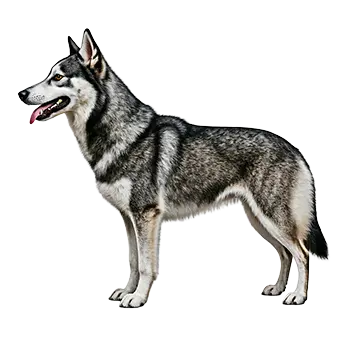
Standing next to an Alaskan Klee Kai for the first time, most people instinctively reach for the word "miniature Husky" even knowing they should not use it. The visual resemblance is strong - the upright ears, the masked face, the plush coat, the curled tail - but once you look carefully, the AKK has its own proportions and presence that distinguish it from both the Siberian Husky and the Alaskan Husky it descended from.
The AKK comes in three size varieties that differ only in height: toy (under 13 inches), miniature (13 to 15 inches), and standard (15 to 17 inches). Adult weights range from as little as 6 pounds for a toy female to 25 pounds for a large standard male. This is a genuinely small breed at the smaller end and a compact small-to-medium dog at the standard size. Within a litter, size can vary, and breeders cannot always predict exactly which variety a given puppy will reach at maturity.
The head is proportionate to the body - not massive or domed, but with a wedge-shaped skull that is wider between the ears and narrows toward the muzzle. The stop is moderate. The muzzle is of medium length and blunt at the end. The eyes are one of the breed's most striking features: almond-shaped, moderately sized, set obliquely in the skull, and variable in color. Brown, blue, green, and combinations are all accepted - a single dog can have two different-colored eyes (bi-eyed) or a split of color within one eye (parti-eyed). The expression is alert and keen.
The ears are firmly erect, triangular, well-furred inside and out, and set high on the skull. They are proportionally large relative to the head - a feature that contributes to the alert, watchful expression characteristic of the breed. The ears are one of the most expressive parts of an AKK: they move forward, back, and sideways in response to sound and mood in ways that experienced owners learn to read very well.
The neck is moderately arched and of medium length, flowing into a level topline. The body is compact and well-muscled, slightly longer than tall. The chest reaches to the elbow. The loin is short and firm. The overall impression should be one of balance and moderate substance - not cobby or heavy, but neither fragile or leggy. This is a dog built to move, not to pose.
The tail is full, well-furred, and carried over the back in a sickle or loosely curled position when the dog is alert. When relaxed, the tail may drop. The forequarters are well-muscled with straight legs, compact cat-feet, and thick pads. The hindquarters are moderately angulated and well-muscled through the thigh. Movement is fluid and light - the AKK moves with the quick, effortless quality of a dog that was built for extended activity at its size.
The double coat consists of a soft, dense undercoat topped by a straight, harsher outer coat of medium length. The coat is slightly longer at the ruff, tail, and back of the thighs. Color is always one of the three accepted combinations - black and white, gray and white, or red and white - with the contrasting facial mask pattern required by the standard. The mask creates the impression of goggles around the eyes and a distinct bar or stripe down the center of the muzzle. A dog without this contrasting facial pattern does not meet the breed standard. Sexual dimorphism is moderate - males tend toward the upper end of the size ranges and carry a more masculine expression; females are typically lighter and more refined.
The three size varieties - toy, miniature, and standard - are distinct enough that potential buyers should think carefully about which size suits their lifestyle. A toy AKK at six or eight pounds is a fragile animal in some respects, easily injured in rough play and requiring careful management around larger dogs and active children. A standard AKK at 20-25 pounds has much more physical robustness while still being genuinely small. All three varieties have the same temperament, coat requirements, and health considerations. The size choice is about physical management and lifestyle fit, not personality.
The overall visual impression of a well-built Alaskan Klee Kai is of concentrated energy and alertness in a compact package. These are not soft-looking dogs - the expression is keen and watchful, the body is muscled for its size, and the posture tends toward upright and attentive. Even at rest, an AKK looks like it is paying attention to something. This quality - the sense of a dog that is genuinely present and engaged with its environment - is one of the features that attracts people to the breed and one of the things that makes them simultaneously rewarding and demanding to live with.
Affectionate With Family
★★★★☆
Alaskan Klee Kais form deep bonds with their household and are genuinely affectionate with people they trust - often following their owners through the house and seeking contact on their own terms. That warmth is not extended to strangers.
Good With Young Children
★★☆☆☆
The AKK's nervous, reactive temperament can make it uncomfortable around the erratic energy of very young children. Older children who interact calmly and respectfully are a better match for this breed.
Good With Other Dogs
★★★☆☆
When properly socialized, most Alaskan Klee Kais do reasonably well with other dogs, particularly dogs they have been raised with. Their prey drive warrants caution around very small dogs and non-canine small animals.
Shedding Level
★★★★☆
Like their Husky relatives, AKKs blow their dense undercoat twice a year in a heavy seasonal shed. Between blow-outs there is ongoing moderate shedding that requires regular brushing to manage.
Coat Grooming Frequency
★★★☆☆
Weekly brushing handles routine maintenance, but the biannual coat blow requires daily attention and ideally a high-velocity dryer session to manage the undercoat efficiently. No professional trimming is required.
Drooling Level
★☆☆☆☆
The Alaskan Klee Kai is a clean, dry-mouthed breed. Drooling is not a feature of life with this dog under any normal circumstances.
Coat Type
★★★☆☆
A dense double coat with a soft, insulating undercoat and a harsher protective outer coat. The coat requires consistent maintenance during seasonal shedding but is manageable with regular brushing.
Openness To Strangers
★★☆☆☆
Wariness of strangers is well-documented and characteristic of this breed. AKKs are not aggressive with unfamiliar people, but they are not warm either - they observe, assess, and withhold approval until they have made their own decision.
Playfulness Level
★★★★☆
With family, AKKs are playful, active, and often silly. They have genuine energy and enjoy games, interactive play, and running - the playfulness of a small dog with the stamina of a working-dog descendant.
Watchdog/Protective Nature
★★★★☆
Alert and vocal, the Alaskan Klee Kai takes watchdog duty seriously. It will bark at anything it deems worth reporting and has the voice to make sure you know. This trait needs management in apartment settings.
Adaptability Level
★★★☆☆
The AKK's small size makes it physically adaptable to various living spaces, but its vocal nature, energy level, and sensitivity to environmental change require an owner who manages its needs consistently in any setting.
Trainability Level
★★★☆☆
Intelligent and capable of learning quickly, but with a stubborn, independent streak inherited from its spitz-type ancestors. Positive reinforcement works well; repetitive drilling produces a dog that finds something more interesting to do.