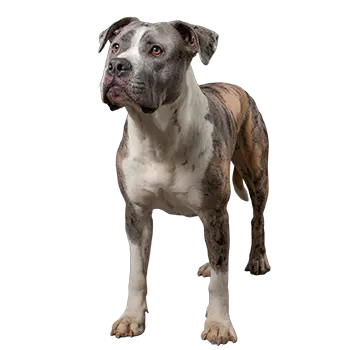
The first thing you notice about an Alapaha Blue Blood Bulldog is the head. It is broad, flat on top, and distinctly square - not the extreme, compressed skull of a French Bulldog, but a wide, purposeful structure that gives the face its characteristic authority. The muzzle is moderately short and broad, blunt at the end, and the jaws are strong and well-developed. The stop is well-defined without being abrupt. The lips are clean and relatively tight for a bulldog-derived breed, which contributes to the Alapaha's dry-mouth characteristic. The bite is either scissors or slightly undershot - the standard accepts some degree of undershot bite as characteristic of the bulldog heritage, though extreme underbites that affect function are not desirable.
The eyes are medium-sized, round, and set wide apart in the skull. Eye color can be brown, blue, or one of each - heterochromia (mismatched eye colors) is not uncommon in the breed, particularly in merle-patterned dogs. The expression is alert and steady, not soft or pleading. When an Alapaha is watching something, its eyes have a focused quality that mirrors its working heritage. The ears are drop ears that lie flat against the head - medium in size and set high on the skull. Rose ears, where the ear folds back to expose part of the inner ear, also appear in some individuals.
The neck is thick and heavily muscled, connecting a powerful head to equally powerful shoulders. There is very little dewlap. The body is compact and substantial - not long and rangy, but built with the density of a working dog that was expected to catch and hold livestock. The chest is broad and deep. The topline is level or very slightly higher at the rump than at the withers. The loin is short and muscular. The overall impression is one of athletic solidity rather than the chunky, low-to-the-ground look of show-line English Bulldogs.
Sexual dimorphism in this breed is notably pronounced. Males typically stand 22 to 25 inches and weigh 80 to 110 pounds; females are distinctly smaller at 18 to 22 inches and 60 to 85 pounds. The size difference is real enough that the experience of living with a male versus a female Alapaha can feel like two somewhat different dogs in terms of physical management. Both are athletic and capable, but a 110-pound male Alapaha is a serious physical commitment in ways that a 65-pound female is not.
The tail is set low and tapers to a point. It is carried low or in a slight upward curve, not curled over the back. Natural tails of varying lengths appear in the breed. The forequarters are straight-boned and heavily muscled, with feet that are round and compact with thick pads. The hindquarters are well-developed through the thigh, providing the drive needed for a dog built to pursue and hold livestock. The hocks are well let down and firm. The gait is purposeful and rolling - this dog does not prance, it moves with intention. When a physically sound Alapaha moves at a trot, the drive from the rear is substantial and the front reach is commensurate - a working gait that covers ground efficiently without the exaggerated, short-striding movement that characterizes over-angulated or poorly-proportioned dogs. Any hint of padding, waddling, or weakness in the hindquarters is a fault in a breed built to work.
The coat is the Alapaha's most practically convenient feature: short, stiff, and close-lying with no undercoat. It comes in white with color patches, with the patches appearing in merle, brindle, tri-color, or solid configurations. The merle gene produces the mottled, swirled color pattern that can create the blue or glass eyes sometimes seen in merle dogs. Double merle breeding (merle to merle) can produce severely health-compromised puppies, including blind and deaf offspring - this is a critical point for any buyer to understand when evaluating a breeder's practices.
Compared to the English Bulldog or French Bulldog, the Alapaha's physical structure is notably more moderate and functional. The muzzle, while shorter than that of a non-bulldog breed, is long enough to allow normal breathing without the respiratory compromise seen in extreme brachycephalic dogs. The legs are strong and straight, the chest is deep but not so barrel-shaped as to interfere with movement, and the overall proportions suggest a dog that can do real work for extended periods. This functional build is one of the reasons the breed's lifespan is longer than most of its bulldog relatives, and it is the direct result of breeders prioritizing working ability over appearance during the breed's development and recovery.
Affectionate With Family
★★★★☆
Within the household they claim as their own, Alapahas are devoted and warm, often shadow-following their people and seeking physical contact. That affection is tightly reserved for the inner circle and does not spill over to outsiders.
Good With Young Children
★★★☆☆
Alapahas raised with children from puppyhood typically treat them as part of the family unit they are guarding. Their size and strength recommend supervision around small children, and their tolerance for rough handling from strangers' kids is limited.
Good With Other Dogs
★★☆☆☆
Dominant and territorial by nature, Alapahas frequently challenge same-sex dogs and can be unpredictable with dogs they do not know. Multi-dog households require careful matching and management.
Shedding Level
★★★☆☆
The short, stiff coat sheds moderately year-round with seasonal upticks. Weekly brushing manages it well and the lack of a dense undercoat keeps shedding from being the production event it is in double-coated breeds.
Coat Grooming Frequency
★☆☆☆☆
The Alapaha's short, tight coat is genuinely low maintenance. A weekly pass with a rubber curry brush or hound glove keeps it clean and provides an opportunity to check the skin for early signs of irritation.
Drooling Level
★★☆☆☆
Unlike many bulldog-descended breeds, the Alapaha has a relatively dry mouth and is not a heavy drooler under normal circumstances. Some individuals drool more around food or during excitement.
Coat Type
★☆☆☆☆
A single-layer, short, stiff coat that lies flat against the body. There is no undercoat to manage or blow out seasonally, making this one of the lower-maintenance coat types among large working breeds.
Openness To Strangers
★★☆☆☆
The Alapaha is naturally reserved and suspicious of unfamiliar people - a core feature of a breed developed to protect property. Strangers entering the home should be introduced calmly and deliberately.
Playfulness Level
★★★☆☆
With family, Alapahas have a goofy, enthusiastic side that contrasts with their serious guardian exterior. They enjoy interactive play and can be surprisingly silly with people they trust.
Watchdog/Protective Nature
★★★★★
Guarding is not a personality add-on for this breed - it is the breed's foundational purpose. Alapahas are alert, territorial, and will physically intervene when they perceive a genuine threat to their household.
Adaptability Level
★★☆☆☆
Alapahas do best with a consistent home environment, a defined territory, and a stable routine. Frequent disruption, constant visitors, or chaotic households work against their territorial nature.
Trainability Level
★★★☆☆
Intelligent and capable, but with an independent streak that requires a consistent, confident handler. Alapahas respond well to positive reinforcement from someone they respect, and poorly to inconsistency or coercion.