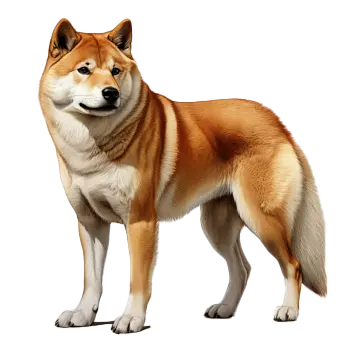
The Ainu Dog is a medium-sized spitz with the build of an animal designed to function in harsh, cold conditions over varied terrain. This is not a delicate or refined breed; it is compact, muscular, and dense, with the physical toughness that several thousand years of selection for survival and working ability in the mountains and forests of Hokkaido tends to produce. Every structural element reflects that function: the thick coat for cold tolerance, the strong bone for traction on snow and rocky ground, the deep chest for respiratory endurance, and the upright ears for 360-degree sound monitoring.
Males stand approximately 19.5 to 21.5 inches at the withers; females are slightly smaller at 18 to 20 inches. Weight ranges from 44 to 66 pounds for both sexes. The proportions are slightly longer than tall, giving the body a balanced, workmanlike appearance without the exaggerated length of some spitz breeds. The muscle mass is notable for the size - this is a dense, substantial animal whose weight feels greater than its height would suggest.
The head is wedge-shaped, broad and flat between the triangular, erect ears that are set forward and face directly ahead. The muzzle is strong and pointed but not needle-narrow, and the nose is dark. The eyes are small relative to the head, dark brown, and slightly triangular in set - a feature that the breed shares with other Asian spitz types and contributes to the characteristic alert, piercing expression. Many Ainu Dogs have black or blue-black spots or patches on the tongue, a pigmentation pattern also seen in Chow Chows and Shar Peis that has led to speculation about ancient shared ancestry.
The neck is thick and muscular, set into well-laid-back shoulders that allow efficient movement. The chest is deep, the ribs well-sprung, and the back short and straight with a muscular, slightly arched loin. The hindquarters are powerful and angulated, providing the drive this breed needs for sustained movement in difficult terrain. The tail is set high, thick at the base, and carried curled tightly over the back or in a sickle curve - the classic spitz tail position that aids heat retention in cold weather.
The coat is the breed's most visually distinctive feature after the overall build. The outer coat is coarse and straight, providing a weather-resistant surface layer that sheds rain and snow. The undercoat is dense and soft, providing the insulating layer that allows this breed to remain comfortable in temperatures that would stress most other dogs. The combination produces a coat that feels substantial and protective, and that requires regular attention to remain in good condition. Colors include sesame, brindle, red, black and tan, black, and white - a range that produces considerable visual variety within the breed.
Movement should be light-footed and efficient despite the dense build. This is a breed that was bred for endurance over varied mountain terrain, not for the formal trotting gaits of show-ring-oriented breeds. Sound, balanced, energetic movement that covers ground without wasted motion reflects structural correctness.
The overall picture is of a dog that has not been dramatically altered from its functional original by selective breeding for appearance. The Ainu Dog looks like a working dog because it is one, and every physical characteristic from the dense coat to the powerful hindquarters to the alert, forward-set ears reflects a specific adaptation to its original environment and work. This is a breed that looks exactly like what it is and nothing more - which is one of its most genuinely honest qualities, and one that the long history of the Ainu Dog makes entirely appropriate.
Affectionate With Family
★★★★☆
The Ainu Dog is loyal and deeply bonded to the people it considers its own. Affection is genuine but not demonstrative in the way of more overtly social breeds; this dog shows its attachment through presence, attentiveness, and an evident preference for being near its family.
Good With Young Children
★★★☆☆
Raised alongside children and properly socialized, the Ainu Dog can be a good family companion. Young children who do not yet understand how to interact calmly with a strong, independent working dog require attentive supervision.
Good With Other Dogs
★★☆☆☆
Dog-dog interactions require management. Same-sex tension is possible, and this breed's working-dog independence means it does not automatically defer or defer gracefully in every encounter. Early socialization is important but does not eliminate all risk.
Shedding Level
★★★★☆
The thick double coat blows heavily twice a year, producing substantial shedding over several weeks. Between seasonal shedding periods, the coat sheds at a moderate, steady rate. This is a high-shedding breed and owners should expect dog hair as a feature of life with it.
Coat Grooming Frequency
★★★☆☆
Weekly brushing throughout the year keeps the coat in good condition, and daily brushing during shedding seasons manages the volume of loose hair. The coat does not require trimming or professional grooming under normal circumstances.
Drooling Level
★☆☆☆☆
The Ainu Dog does not drool. This is a clean, dry-mouthed breed whose maintenance challenges are related to coat and exercise rather than mess.
Coat Type
★★★★☆
The double coat consists of a dense, soft undercoat and a coarse, straight outer coat that provides remarkable cold-weather protection. Accepted colors include sesame, brindle, red, black and tan, black, and white.
Openness To Strangers
★★☆☆☆
Reserve and wariness with unfamiliar people is characteristic of this breed. The Ainu Dog was a village guardian as well as a hunter, and it approaches strangers with watchful assessment rather than welcome. Early socialization tempers this but does not eliminate it.
Playfulness Level
★★★☆☆
The Ainu Dog has a playful side that surfaces reliably with people and animals it trusts. Its playfulness is energetic and athletic rather than gentle, and it brings full physical engagement to games that interest it.
Watchdog/Protective Nature
★★★★★
Bred to guard villages as well as hunt, this dog takes its protective function seriously and misses nothing. It will alert decisively to anything unusual and is physically capable of backing up that alert if it judges the situation requires it.
Adaptability Level
★★☆☆☆
The Ainu Dog is most comfortable in active homes with secure outdoor space and cold or temperate climates. Its dense coat makes heat stress a real concern in warm climates, and its exercise and mental stimulation needs are not easily met in urban environments without serious commitment.
Trainability Level
★★★☆☆
Intelligent and capable of high-level training performance, the Ainu Dog is also independent-minded in ways that require a consistent, experienced hand. Heavy-handed approaches are counterproductive; positive, firm guidance produces the best outcomes.