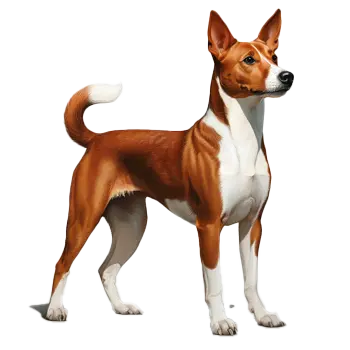
The first thing experienced dog people notice about a Basenji is the wrinkled forehead. The skin on the skull is folded in a way that produces an expression of perpetual inquisitive concern - slightly worried, slightly amused, constantly evaluating. Combined with the large, erect ears that face forward and rotate to follow sounds, and the dark, almond-shaped eyes set obliquely in the skull, the Basenji's face has an expressiveness that owners find endlessly entertaining. The breed communicates a great deal through its face, which makes it easy to anthropomorphize in ways that can occasionally mislead you about what the dog is actually communicating.
The body is well-balanced and lightly built, but compact rather than delicate. The back is short and level. The chest is deep with oval ribs - the oval cross-section rather than round is a breed characteristic that allows the Basenji to squeeze through dense undergrowth. The neck is of good length and well arched, carried high. The shoulders are well laid back. The hindquarters are strong and moderately angulated, capable of the powerful acceleration that makes a Basenji in full sprint a genuinely fast and agile animal.
The front legs are straight with fine, oval bone. The feet are small and narrow, with deep pads suited to varied terrain. The toes are well arched and close together. The tail is set high and tightly curled - lying flat on the back to one side or the other. The degree of curl varies among individuals, and a double curl is permissible in the standard.
The coat is short, fine, and close-lying. It has a slight sheen and feels almost silky to the touch despite its brevity. Colors recognized by the AKC standard include chestnut red with white, black with white, tricolor (black and chestnut with white), and brindle (black stripes on chestnut). White must appear on the feet, chest, and tail tip. White legs, a blaze, and a white collar are optional. The colors are clean and well-defined in a properly bred specimen, and the short coat's natural sheen makes those colors appear particularly vivid in good light - the chestnut red in particular can be striking on a well-conditioned dog moving in sunlight.
Males stand 17 inches at the shoulder and weigh approximately 24 pounds. Females stand 16 inches and weigh approximately 22 pounds. The breed's movement is characteristic: light-footed, swift, and easy, with a smooth stride and good reach and drive. In full sprint a Basenji is remarkably fast for its size, capable of changing direction with cat-like agility.
The overall impression should be of a compact, balanced, athletic small dog of obvious primitiveness - not refined in the way of toy breeds, not heavy in the way of working dogs, but something genuinely distinct from the mainstream of domestic dog types. The wrinkled forehead, tightly curled tail, and erect pricked ears combine to produce a silhouette that is completely unlike any other breed. Even someone with no prior knowledge of dogs recognizes immediately that there is something different about this animal - something older, less domesticated-looking, more watchful. That impression is accurate. The Basenji carries the physical signature of thousands of years of independent development in isolation from the breeds that shaped most Western dogs, and it shows in every proportion. The standard calls for a balanced, cleanly structured dog with nothing exaggerated and nothing weak - a working animal shaped entirely by function rather than fashion. Whatever variation exists in color or tail curl or precise head proportions, that fundamental quality of purposeful, unadorned functionality is the consistent thread running through every correctly built Basenji.
Affectionate With Family
★★★★☆
The African Barkless Dog bonds closely with its family and shows real warmth in familiar company, though it expresses that affection on its own terms in its distinctly cat-like fashion.
Good With Young Children
★★★☆☆
Generally good with older children who understand boundaries; young children who handle roughly may trigger the Basenji's sharp response to unwanted interaction.
Good With Other Dogs
★★★☆☆
Typically fine with dogs it knows well and has been raised with; its primitive independence can occasionally create friction with unfamiliar dogs.
Shedding Level
★☆☆☆☆
The short, fine coat sheds minimally and the breed grooms itself fastidiously - one of the most low-shedding dogs of any size.
Coat Grooming Frequency
★☆☆☆☆
Virtually no grooming required beyond occasional wiping down and nail trimming - the Basenji takes care of most coat maintenance itself.
Drooling Level
★☆☆☆☆
Clean and tidy to the point of fastidiousness - drooling is entirely nonexistent in this breed.
Coat Type
★☆☆☆☆
Short, fine, and close-lying - a practical, clean coat that contributes to the breed's cat-like maintenance profile.
Openness To Strangers
★★☆☆☆
Reserved and watchful with unfamiliar people - a primitive breed characteristic that requires socialization to prevent excessive suspicion from developing.
Playfulness Level
★★★★☆
Curious, mischievous, and highly interactive - the Basenji brings an almost playful irreverence to everything it does, particularly in the company of familiar people.
Watchdog/Protective Nature
★★★☆☆
Alert and aware of its environment but communicates through sound other than barking - owners learn to read the Basenji's unique yodel-growl warning signals.
Adaptability Level
★★★☆☆
Adapts to various living situations when given adequate exercise, but its need for activity and stimulation cannot be negotiated away regardless of environment.
Trainability Level
★★☆☆☆
Highly intelligent but powerfully independent - the Basenji understands what you want and evaluates whether compliance benefits it before responding.