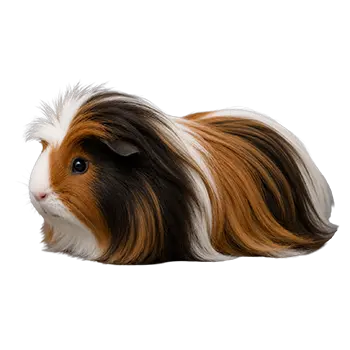

The Crested Sheltie Guinea Pig is a distinctive long-haired cavy variety that combines two well-known guinea pig coat traits: the flowing, swept-back coat of the Sheltie breed and the single forehead rosette, or crest, characteristic of Crested guinea pigs. This combination produces an animal that looks much like a standard Sheltie but is crowned with a neat whorl of fur centered on the forehead between the eyes and ears. The breed is sometimes referred to informally as the Crested Silkie in regions where the Sheltie breed itself is called the Silkie, reflecting the transatlantic naming divide between British and American cavy fanciers. In all cases, the same animal is being described: a long-coated guinea pig with hair flowing backward from the face and a single prominent crest on the head.
Within the cavy fancy, the Crested Sheltie occupies a niche position as a recognized but relatively uncommon variety. It is not universally recognized as a separate standardized breed by all cavy registries, and its competitive showing status varies between organizations and countries. Some national cavy clubs classify it under the broader long-haired or any-other-variety categories rather than granting it a standalone breed standard. Breeders who specialize in Crested Shelties maintain carefully managed breeding programs to produce animals that exhibit both the correct Sheltie coat flow and a well-formed, centrally positioned crest, as combining these two genetic traits consistently requires selective pairing across multiple generations.
The scientific name Cavia porcellus applies to all domesticated guinea pigs regardless of breed or coat type, as all recognized varieties are the same species descended from wild cavies native to the Andes region of South America. The Crested Sheltie is a product of selective breeding within the domesticated gene pool rather than a naturally occurring variety, developed by breeders who crossed Crested guinea pigs with Shelties to introduce the crest gene into the long-coated lineage. The breed's relative rarity compared to standard Shelties, American Cresteds, or smooth-coated varieties means that prospective owners may need to seek out specialist breeders or wait for available litters.