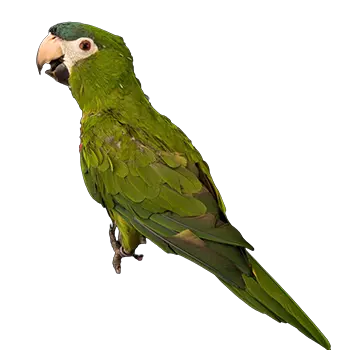

The Noble Macaw (Ara nobilis) is most commonly known in aviculture by its alternate name, Hahn's Macaw, honoring German zoologist Carl-Wilhelm Hahn who contributed to early ornithological studies. This smallest member of the true macaw genus Ara is also occasionally referred to as the Red-shouldered Macaw, a descriptive name referencing the red feathering on the underwing coverts visible during flight. In some literature, particularly older texts, the species may appear as the Noble Parrot or Dwarf Macaw, though these names are less commonly used today.
Taxonomically, the Noble Macaw belongs to the genus Ara within the family Psittacidae, making it a true macaw despite its diminutive size relative to species like Blue and Gold or Scarlet Macaws. The species is currently divided into two recognized subspecies based on geographic distribution and subtle morphological differences. The nominal subspecies Ara nobilis nobilis, known as the Noble Macaw proper, occurs in Guyana and parts of Brazil. The subspecies Ara nobilis cumanensis, commonly called Hahn's Macaw in the pet trade, is found in Venezuela, the Guianas, and northeastern Brazil, and is the subspecies most frequently kept as a companion bird.
The two subspecies are extremely similar in appearance, with Hahn's Macaw (A. n. cumanensis) being slightly smaller overall than the nominate subspecies, though the differences are subtle and difficult to distinguish without direct comparison or expert knowledge. In aviculture, the name "Hahn's Macaw" has become so widespread that it is often used for both subspecies interchangeably, and most captive-bred birds available in the pet trade represent the cumanensis subspecies or mixed ancestry. Some breeders and owners may not distinguish between the subspecies at all, referring to all Noble Macaws as Hahn's Macaws.
The scientific name Ara nobilis combines the genus name Ara (derived from indigenous South American languages for macaw) with the Latin adjective nobilis meaning "noble" or "distinguished," likely referencing the bird's dignified bearing despite its small stature. The species was first scientifically described by Carl Linnaeus in 1758, making it one of the earlier parrot species known to Western science. Historical natural history collections and illustrations from the 18th and 19th centuries document the species, and Noble Macaws have been kept as companion birds for well over a century, though they remained less common in aviculture than larger, more colorful macaw species until recent decades when their manageable size and engaging personalities gained recognition.
In modern aviculture and the companion bird community, "Hahn's Macaw" has become the standard common name, with "Noble Macaw" used primarily in scientific literature or by those making technical subspecies distinctions. This naming convention sometimes causes confusion among prospective owners unfamiliar with the synonymy between the names. Regardless of terminology, these mini-macaws have gained popularity as companion birds for people who love macaw personalities but cannot accommodate the space, noise, and care requirements of full-sized species.