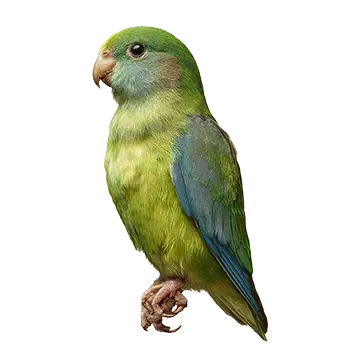
The Dusky Billed Parrotlet is a compact, sturdily built bird measuring approximately 4.5 to 5 inches in total length from the tip of its beak to the end of its short, squared tail. Adults typically weigh between 25 and 35 grams, making them among the smaller members of the Forpus genus. Despite their tiny stature, they have a substantial, rounded body shape with a broad chest, proportionately large head, and powerful legs that give them a particularly solid, capable appearance for birds of their size.
The plumage of the Dusky Billed Parrotlet is predominantly green, ranging from a bright medium green on the crown, face, and upperparts to a slightly yellower green on the underparts. The most diagnostic feature is the beak, which displays a characteristic dusky slate-gray or brownish-gray coloration distinctly different from the pale pink or horn-colored beaks typical of related species such as the Pacific Parrotlet. This beak coloration is present in both sexes and across subspecies, making it the most reliable visual identification marker in the field and in aviculture.
Sexual dimorphism is present but subtle compared to some other parrotlet species. Males of Forpus modestus display blue coloration on the rump, lower back, and secondary wing coverts, a feature shared by most male Forpus species. The blue is typically a medium cobalt to turquoise, most visible when the bird is in flight or when the wings are spread. Females lack the blue markings entirely, presenting as uniformly green across the body with slightly paler, more yellowish-green tones on the face and forehead. The eyes are dark brown in both sexes, and the feet and legs are gray.
The nominate subspecies Forpus modestus modestus tends toward a slightly deeper, more saturated green than Forpus modestus sclateri, which can appear marginally paler and more yellow-green, particularly on the underparts. Neither subspecies displays any red, orange, or other bold coloration, which contributes to the modest, understated appearance that inspired the scientific name. In good lighting conditions, the plumage has a gentle sheen, and fresh plumage after a molt shows particularly rich, uniform coloring.
Affection Level
★★★★☆
Dusky Billed Parrotlets form remarkably strong bonds with their primary caretakers despite their diminutive size. Hand-raised individuals actively seek out contact, enjoy head scratches, and will tuck themselves into collars or shirt pockets for warmth and closeness. Their devotion can be intense, and they express affection through mutual preening, soft vocalizations, and a persistent desire to remain close to their bonded person.
Sociability
★★★☆☆
These small parrots tend to be selective in their social bonds and can be wary or dismissive of strangers. With consistent early socialization, they can learn to tolerate and even enjoy interaction with multiple household members, but they typically choose a favorite person. When kept in pairs, they bond intensely to one another and may become less interested in human interaction, which is an important consideration for owners seeking a hands-on companion.
Vocalization
★★☆☆☆
The Dusky Billed Parrotlet is one of the quieter members of the parrot family, producing soft chattering, chirps, and contact calls throughout the day. Their volume rarely reaches levels that disturb neighbors, making them well-suited for apartment living. While they can learn a few words or short phrases, their talking ability is modest compared to larger psittacines. Their vocalizations are generally considered pleasant rather than intrusive.
Intelligence
★★★★☆
Despite their small stature, Dusky Billed Parrotlets are sharp, perceptive birds capable of learning tricks, solving foraging puzzles, and recognizing patterns in their daily routines. They demonstrate strong spatial memory and can navigate complex environments with confidence. Their intelligence manifests in their boldness toward much larger birds and their ability to assess and respond to social situations with surprising nuance.
Exercise Needs
★★★☆☆
Dusky Billed Parrotlets benefit from at least one to two hours of supervised out-of-cage time daily, during which they explore, climb, and exercise their flight muscles. They are active and agile birds that enjoy horizontal climbing structures, swings, and foraging toys. Without adequate physical outlet, these energetic little birds may develop feather-destructive behaviors or excessive territorial aggression, particularly in smaller enclosures.
Maintenance Level
★★★☆☆
Care demands for Dusky Billed Parrotlets are moderate. Daily food and water changes, regular spot-cleaning of the cage floor, and periodic full cage sanitization are standard requirements. Because they hull seeds and scatter food widely, their enclosures require more frequent tidying than might be expected from such a small bird. They also benefit from regular bathing or misting to maintain feather condition and overall health.
Trainability
★★★☆☆
Dusky Billed Parrotlets respond well to patient, consistent positive reinforcement training, though their independent streak can make sessions less predictable than with more eager-to-please species. They learn step-up commands, simple tricks, and target training with reasonable proficiency when sessions are kept short and rewarding. Their attention spans are brief, and heavy-handed approaches are counterproductive with a species that remembers negative experiences keenly.
Independence
★★★☆☆
Compared to many companion parrots, Dusky Billed Parrotlets show moderate independence and can occupy themselves with toys and foraging enrichment for reasonable stretches without becoming distressed. However, prolonged isolation consistently leads to behavioral deterioration. They strike a balance between being content to entertain themselves and still requiring meaningful daily interaction to remain psychologically healthy and well-adjusted.