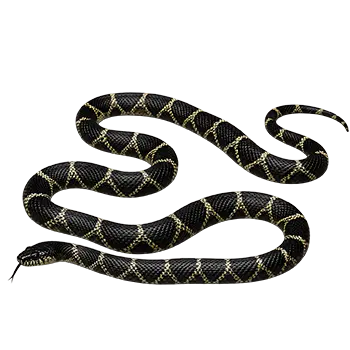

The Florida Kingsnake (Lampropeltis getula floridana) is a robust, non-venomous colubrid native to the Florida peninsula, where it inhabits a wide array of subtropical environments ranging from pine flatwoods and cypress swamps to hardwood hammocks and the transitional scrubland bordering the Everglades. The subspecies is distinguished from other members of the Eastern Kingsnake complex by its characteristically reduced banding pattern, with adults often displaying a yellowish or cream-colored ground tone overlaid with faded, diffuse crossbands or a nearly patternless brown-to-tan dorsum. This coloration reflects adaptation to the sandy soils and sun-bleached leaf litter of its peninsular range, where muted tones provide effective camouflage against a backdrop of palmettos and wiregrass.
European naturalists first encountered kingsnakes in the southeastern United States during the colonial era, but the formal taxonomic recognition of the Florida Kingsnake as a distinct subspecies came considerably later. The broader Eastern Kingsnake species, Lampropeltis getula, was described by Linnaeus in 1766 based on specimens from the Carolina colonies. However, it was not until the early twentieth century that herpetologists began to systematically differentiate the regional populations of this wide-ranging species. The Florida form was formally described and designated as the subspecies floridana, acknowledging the morphological and geographic distinctiveness of the peninsular population from its mainland relatives.
The scientific delineation of the Florida Kingsnake occurred during a period of intense herpetological activity in the southeastern United States. Researchers from institutions such as the University of Florida, the American Museum of Natural History, and the Academy of Natural Sciences in Philadelphia mounted extensive collecting expeditions throughout Florida during the early to mid-twentieth century. These efforts produced the specimen series that allowed taxonomists to characterize the subtle but consistent differences in scalation, color pattern, and body proportions that distinguish floridana from the nominate getula subspecies found further north and from the adjacent subspecies brooksi of southern Florida.
The Florida Kingsnake's taxonomic history has been complicated by ongoing debates about the species-level classification of the entire Lampropeltis getula complex. Molecular phylogenetic studies conducted in the early twenty-first century revealed that the traditional subspecies boundaries within the Eastern Kingsnake group do not always correspond to distinct evolutionary lineages. Some researchers have proposed elevating several former subspecies, including the Florida form, to full species status, while others advocate for a more conservative approach that retains the traditional subspecific designations pending further genetic sampling. This taxonomic fluidity reflects the genuine biological complexity of a group of snakes that diversified across the varied landscapes of the southeastern United States during the Pleistocene.