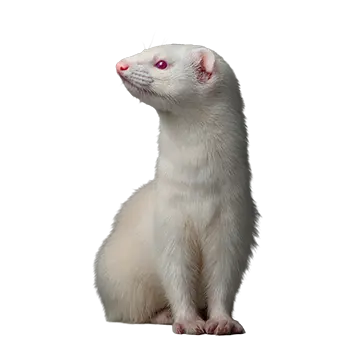

The domestic ferret, Mustela putorius furo, is descended from the European polecat, Mustela putorius, a small carnivorous mustelid native to western Eurasia and parts of North Africa. Domestication is believed to have occurred at least two thousand years ago, and possibly considerably earlier, making the ferret one of the oldest domesticated animals still widely kept today. The precise geographic origin of ferret domestication remains a subject of scholarly debate, with candidates including the Mediterranean basin, the Iberian Peninsula, and North Africa. What is clear is that humans recognized the polecat's exceptional value as a hunter of burrowing prey and selectively bred individuals for tameness, manageability, and willingness to work alongside people in confined underground spaces.
The earliest unambiguous written references to domesticated ferrets appear in classical Greek and Roman texts. Aristophanes mentioned a small animal used to hunt rabbits and drive vermin from their burrows, and Roman writers including Pliny the Elder and Strabo described the use of ferret-like animals to control rabbit populations in the Balearic Islands and across the Iberian Peninsula. These accounts suggest that by the late centuries of the pre-Christian era, ferrets were already established as working animals in the Mediterranean world, valued for their slender, flexible bodies and relentless predatory drive, which made them ideally suited to pursuing prey through narrow underground tunnels.
The transition from wild polecat to domestic ferret involved significant behavioral and physical changes driven by selective breeding over many generations. Domestic ferrets are substantially more tolerant of human handling than wild polecats, less aggressive toward people and other ferrets, and more adaptable to captive living conditions. Physical changes accompanied these behavioral shifts: domestic ferrets tend to have a wider range of coat colors and patterns than their wild ancestors, reduced adrenal gland reactivity, and subtle skeletal differences including a slightly shorter skull and modified dentition. These changes are consistent with the broader pattern of domestication syndrome observed across many species.
The albino variant — characterized by a complete absence of melanin pigmentation, resulting in a pure white or cream-colored coat and distinctive red or pink eyes — appears to have been among the earliest recognized color forms of the domestic ferret. The genetic mutation responsible for albinism occurs naturally in many mammalian species and would have appeared spontaneously in early domestic ferret populations. Historical evidence suggests that albino ferrets were not only tolerated but actively preferred by many early keepers, a preference that persisted across centuries and cultures and that played a significant role in shaping the trajectory of ferret breeding and husbandry.