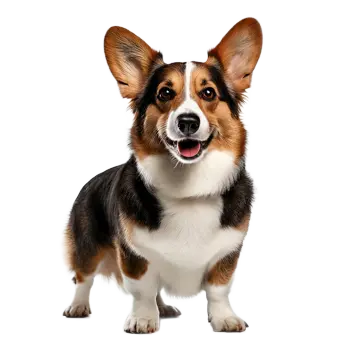

Origins & Development

The Cardigan Welsh Corgi is widely regarded as one of the oldest herding breeds in the British Isles, with a lineage that many breed historians trace back over three thousand years. The most commonly cited origin theory connects the breed to Celtic tribes who migrated from central Europe to the coastal hills of Cardiganshire in Wales around 1200 BCE, bringing with them small, low-set dogs belonging to the Teckel family of breeds. These early dogs are believed to share common ancestry with the Dachshund and Basset Hound, a connection reflected in the Cardigan's long body and short, sturdy legs.

In the rugged terrain of western Wales, these proto-Corgis proved invaluable to subsistence farmers. Their low stature allowed them to nip at the heels of cattle while ducking retaliatory kicks, and their surprising speed and agility made them effective at driving livestock across hilly pastures. Over centuries of selective breeding guided by practical necessity rather than aesthetic standards, the Cardigan developed the broad chest, powerful forequarters, and remarkably resilient constitution that define the breed today.

The name "Corgi" itself is a subject of etymological debate. The most popular interpretation derives it from the Welsh words "cor" (dwarf) and "gi" (dog), yielding "dwarf dog." An alternative theory suggests "cor" may instead relate to the Welsh word for "to watch over" or "to gather," making the name a functional descriptor rather than a physical one. Whatever its precise linguistic roots, the name has been associated with these small Welsh herding dogs for many centuries.

It is important to note that the Cardigan Welsh Corgi and the Pembroke Welsh Corgi, though superficially similar, are entirely distinct breeds with separate ancestral lines. The Cardigan is the older of the two, and its most visible distinguishing feature is its long, bushy tail, in contrast to the Pembroke's naturally bobbed or docked tail. The two breeds developed in neighboring but separate Welsh counties and were not interbred in any systematic way until the early twentieth century, a practice that was later discontinued as breed standards solidified.

Historical Roles

The Cardigan Welsh Corgi's primary historical role was as a cattle drover and general-purpose farm dog in the hills of Cardiganshire. Welsh farmers relied on common grazing land allocated by the Crown, and the Corgi's job was to drive cattle out to distant pastures while also chasing off trespassing livestock from neighboring farms. This dual function made the breed economically essential, as the amount of land a farmer could claim was often directly tied to how far his dog could drive and disperse cattle.

Beyond cattle work, Cardigans served as versatile homestead dogs. They guarded poultry from foxes, controlled vermin in barns and food stores, and served as alert watchdogs for isolated farmsteads. Their keen hearing and natural suspicion of strangers made them reliable sentries, while their moderate size meant they were economical to feed during lean seasons. Many farm families also valued them as loyal companions and household dogs, a role that foreshadowed their modern popularity as family pets.

The breed's working importance began to decline in the nineteenth century as changes in Welsh land law eliminated the old common grazing system. Enclosure acts divided open land into private holdings bounded by fences, reducing the need for a dog to drive and scatter cattle over open ground. As the Cardigan's economic role diminished, breed numbers fell, and the dogs that remained were kept primarily out of tradition and personal attachment rather than agricultural necessity.

Despite this decline, a handful of dedicated Welsh farmers and early breed enthusiasts preserved the Cardigan through the late 1800s and into the early twentieth century. Their efforts ensured that when organized dog breeding and showing gained popularity in Britain, there were still enough quality Cardigans to establish a viable breeding population and begin the breed's transition from working farm dog to recognized purebred.

Cultural Symbolism

In Welsh folklore, the Corgi occupies a charming and distinctive place. A beloved legend holds that Corgis were the preferred mounts of woodland fairies, and that the markings visible on many Corgis' coats, particularly the lighter patches around the shoulders and withers, are traces of the fairy saddle and harness. While this legend is most commonly associated with Corgis in general, the Cardigan's deeper roots in Welsh history make it a strong candidate as the original inspiration for these stories. The tale speaks to the almost mystical regard in which rural Welsh communities held their small herding dogs.

The Cardigan Welsh Corgi has also come to serve as an informal cultural emblem of Cardiganshire, now known as Ceredigion. In a region defined by pastoral farming, rugged coastline, and a fierce attachment to Welsh language and tradition, the Cardigan Corgi represents continuity with a way of life that stretches back centuries. Local heritage organizations and tourism boards have periodically featured the breed in materials promoting the region's identity, reinforcing the dog's symbolic link to the landscape that shaped it.

More broadly, the Corgi has become a recognizable symbol of Welsh culture worldwide, though the Pembroke variety has historically received more international attention due to its association with the British royal family. The Cardigan, by contrast, has retained a quieter, more understated cultural profile that many breed enthusiasts consider a point of pride. Cardigan owners often describe their dogs as the "thinking person's Corgi," appreciating the breed's slightly more reserved and independent temperament as a reflection of the self-reliant farming communities that created it.

Breed Clubs & Standards

The formal history of the Cardigan Welsh Corgi as a recognized breed begins in the late 1920s. Before that time, Cardigans and Pembrokes were often shown together under the single classification of "Welsh Corgi," a grouping that created considerable confusion and controversy among breeders who recognized the two types as fundamentally different. In 1926, the first breed club for Welsh Corgis was established in Britain, but it was not until 1934 that The Kennel Club in the United Kingdom officially recognized the Cardigan and Pembroke as separate breeds, a pivotal moment that allowed each variety to develop its own standard and show ring identity.

The Cardigan Welsh Corgi Association, the primary breed club in the UK, has played a central role in maintaining breed standards, organizing specialty shows, and promoting responsible breeding practices. The breed standard calls for a long, low-set dog with a deep chest, large erect ears, and a long tail carried low. Acceptable colors include all shades of brindle, blue merle, red, sable, and black with or without tan or brindle points, with white markings permitted on the legs, chest, neck, muzzle, and tail tip.

In the United States, the Cardigan Welsh Corgi Club of America (CWCCA) serves as the parent club recognized by the American Kennel Club. The AKC granted full recognition to the Cardigan in 1935, one year after the British separation. The CWCCA has been instrumental in supporting health research, maintaining a code of ethics for breeders, and educating the public about the differences between the Cardigan and Pembroke varieties. The club also sponsors national specialties and supports regional breed clubs across the country.

Internationally, the Fédération Cynologique Internationale (FCI) classifies the Cardigan Welsh Corgi in Group 1 (Sheepdogs and Cattle Dogs), reflecting its historical working function. Breed clubs exist in many countries, including Canada, Australia, Japan, and across Europe, each working to preserve the breed's health, temperament, and working heritage while adapting to local kennel club regulations and cultural expectations.

The Breed Today

The Cardigan Welsh Corgi remains considerably less common than its Pembroke cousin, a disparity that breed enthusiasts often view as a mixed blessing. Lower popularity has helped insulate the Cardigan from the overbreeding and puppy mill exploitation that can accompany sudden surges in demand, but it also means the breed faces a smaller genetic pool and less public recognition. In AKC registration statistics, the Cardigan typically ranks in the range of 60th to 70th most popular breed, compared to the Pembroke's consistent placement in the top fifteen.

Modern Cardigans are primarily kept as companion animals, but many owners and breeders actively pursue activities that channel the breed's working instincts. Herding trials, agility, rally obedience, and tracking are all popular outlets, and the Cardigan's intelligence and trainability make it a competitive participant in these venues. The breed has also found a niche in therapy and emotional support work, where its empathetic temperament and manageable size are valued assets.

Health-conscious breeding has become a major focus of the Cardigan community in recent decades. The breed is predisposed to certain conditions, including progressive retinal atrophy (PRA), degenerative myelopathy (DM), and intervertebral disc disease (IVDD) related to its elongated spine. Reputable breeders conduct genetic testing and screening for these conditions, and breed clubs actively fund research into canine genetics and orthopedic health. These efforts have helped improve overall breed health outcomes while maintaining the physical and temperamental qualities that define the Cardigan.

The rise of social media has given the Cardigan Welsh Corgi a new platform for visibility. While Pembrokes dominate the broader Corgi internet presence, dedicated Cardigan accounts and communities have cultivated enthusiastic followings. These online spaces serve as both breed promotion and education tools, helping prospective owners understand what makes the Cardigan distinct and connecting existing owners with resources and community support.

Notable Individuals

Throughout the breed's history, certain individual Cardigan Welsh Corgis have left a lasting mark on the development and public perception of the breed. In the early days of formal breeding, dogs from founding Welsh lines established the genetic and physical templates that breeders would refine over subsequent generations. These foundation dogs, bred by farmers in Cardiganshire who transitioned from practical stock work to the emerging world of pedigree breeding, bridged the gap between the breed's working past and its future as a recognized purebred.

In the show ring, a number of Cardigan Welsh Corgis have achieved distinction at the highest levels of competition. Success at prestigious events such as Crufts in the United Kingdom and the Westminster Kennel Club Dog Show in the United States has brought welcome attention to the breed. Each time a Cardigan earns a significant placement at a major all-breed event, it introduces the breed to a wider audience and sparks renewed interest among prospective owners and breeders alike.

Beyond the show ring, individual Cardigans have distinguished themselves in performance events and service roles. The breed's versatility has produced herding champions, agility titlists, and certified therapy dogs whose work in hospitals, schools, and assisted living facilities has demonstrated the Cardigan's gentle and perceptive nature. These working and service dogs carry forward the breed's tradition of purposeful partnership with humans, adapting ancient instincts to modern needs.

The collective impact of notable Cardigans, whether celebrated in competition, valued in service, or simply beloved as family companions, has been to steadily build the breed's reputation as a capable, intelligent, and deeply loyal dog. Each generation of exceptional individuals reinforces the qualities that have sustained the Cardigan Welsh Corgi through three millennia of history alongside the people of Wales and, increasingly, the world.

Always consult a qualified professional before making any health-related decisions. This content is provided for informational reference only and should not replace professional guidance specific to your animal.