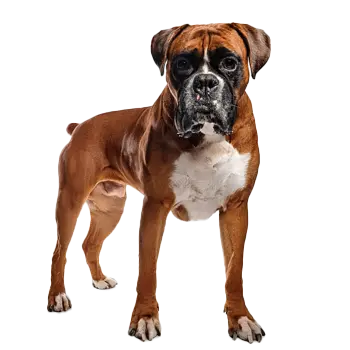

The Boxer descends from a line of European hunting dogs known collectively as the Bullenbeisser, or "bull biter," which were bred across Germany, Belgium, and the Low Countries for centuries. These powerful, broad-muzzled dogs were used by nobility to hunt large game such as wild boar, bear, and deer. Their task was to seize and hold prey until the hunter arrived, requiring immense jaw strength, courage, and athletic endurance. By the late 1800s, the decline of large-game hunting and changing societal structures left the Bullenbeisser without its traditional role, setting the stage for a new chapter in the breed's evolution.
In the latter half of the nineteenth century, German breeders began crossing the Bullenbeisser with smaller English Bulldogs imported to the continent. The goal was to produce a more compact, agile, and versatile working dog suited to modern life. The result was the breed we recognize today as the Boxer — a muscular yet refined dog with a distinctive square head, undershot jaw, and boundless energy. The name "Boxer" is believed to derive from the breed's tendency to stand on its hind legs and spar with its front paws during play, though some historians dispute this etymology.
By the 1890s, breed enthusiasts in Munich had begun to formalize the Boxer's characteristics. Georg Alt and his circle of dedicated breeders are often credited with establishing the foundational lines, using a brindle Bullenbeisser named Flora as one of the cornerstones of the breeding program. The careful selection for temperament, structure, and working ability during this formative period defined the breed's trajectory for generations to come.
The first Boxer breed standard was published in 1904 by the newly formed Boxer Klub in Munich, solidifying the physical and temperamental traits that breeders would strive toward. This standard emphasized balance, strength without coarseness, and a character that combined alertness with steady confidence. The early twentieth century saw rapid growth in Boxer popularity across Germany and into neighboring countries, as the breed proved itself adaptable to a wide range of roles.