
Origins & Development

The Beagle's roots stretch back centuries, with small scent hounds of similar type documented in ancient Greece and Roman-era Europe. While the exact lineage is debated among historians, it is widely accepted that the breed as we know it today emerged in England during the medieval period. Early references to "begle" or "begele" dogs appear in English literature as far back as the fifteenth century, describing compact hounds prized for their keen noses and tireless pursuit of rabbits and hares.

During the reign of Elizabeth I, miniature versions known as "Pocket Beagles" were fashionable among the aristocracy. These tiny hounds, small enough to be carried in saddlebags, were used more for amusement than serious hunting, though they still possessed the characteristic determination of the breed. By the eighteenth century, larger and more standardized Beagles had become the preferred choice for organized pack hunting across the English countryside.

The modern Beagle began to take recognizable shape in the 1830s when Reverend Phillip Honeywood established a pack in Essex that is often credited as the foundation of the contemporary breed. His hounds were selected for hunting ability rather than appearance, but subsequent breeders refined the Beagle's look while preserving its legendary scenting prowess. The breed arrived in the United States in the years following the Civil War, where American breeders further shaped the Beagle into the compact, well-proportioned dog recognized by kennel clubs today.

Throughout its development, the Beagle has remained remarkably true to its original purpose as a scent hound. Even as the breed transitioned from working hunter to household companion, its fundamental characteristics — the powerful nose, the melodious bay, and the sociable temperament — have endured largely unchanged. This continuity across centuries is a testament to the soundness of the breed's original design and the dedication of generations of breeders who valued function alongside form.

Historical Roles

The Beagle's primary historical role has always been as a rabbit and hare hunter. Hunted in packs, Beagles were ideally suited for sportsmen who followed on foot rather than horseback, making the breed accessible to hunters of modest means who could not afford to maintain horses and larger hounds. This democratic quality contributed to the Beagle's widespread popularity across social classes in both England and America, a characteristic that distinguishes it from many other hound breeds historically associated with the landed gentry.

Beyond recreational hunting, Beagles served practical roles in agricultural communities where rabbit populations could damage crops. Farmers relied on packs of Beagles to keep pest numbers manageable, and the dogs' cooperative pack mentality made them efficient and reliable workers. Their compact size allowed them to pursue quarry through dense brush and hedgerows that would impede larger hounds, and their stamina meant they could work for hours without flagging.

In the twentieth century, the Beagle's extraordinary nose found new applications far removed from the hunting field. The United States Department of Agriculture established the Beagle Brigade in 1984, deploying trained Beagles at airports and border crossings to detect prohibited agricultural products in passenger luggage. The breed was chosen for this role because its small, nonthreatening appearance puts travelers at ease, while its olfactory capabilities rival those of much larger detection dogs. The Beagle Brigade has intercepted tens of thousands of prohibited items and remains active at ports of entry across the country.

Beagles have also played a controversial but historically significant role in scientific research. Their docile temperament, uniform size, and genetic consistency made them a preferred breed for laboratory use throughout much of the twentieth century. While this aspect of the breed's history is uncomfortable, it has prompted important conversations about animal welfare and research ethics, and has led to strengthened protections for laboratory animals in many countries.

Cultural Symbolism

The Beagle occupies a distinctive place in cultural symbolism, often representing qualities of loyalty, persistence, and unpretentious companionship. Unlike breeds associated with wealth or status, the Beagle has historically been viewed as an everyman's dog — approachable, cheerful, and without airs. This perception has made the breed a symbol of democratic values and honest simplicity in both American and British culture.

In the American imagination, the Beagle is closely tied to rural life and the traditions of the countryside. The image of a Beagle baying on a scent trail through autumn woods is deeply embedded in the cultural landscape of the southern and midwestern United States, where the breed remains enormously popular among hunting enthusiasts. Beagle field trials, which test the dogs' hunting ability in competitive settings, have been a fixture of rural community life for well over a century and continue to draw passionate participants.

The breed's association with determination and single-minded focus has also given it metaphorical weight. To follow a lead "like a Beagle on a scent" is a common expression conveying dogged persistence, and the breed's name itself may derive from the Old French word "becguele," meaning "open throat" or "loudmouth" — a nod to the Beagle's famously vocal nature. This expressiveness, far from being seen as a flaw, has endeared the breed to generations of owners who appreciate a dog that communicates its emotions without reservation.

The Beagle's cultural resonance extends beyond English-speaking countries. In Japan, the breed enjoys significant popularity and has become associated with warmth and family harmony. Across Europe, Beagles are widely recognized and admired, their image appearing on everything from pub signs to postage stamps. This global recognition speaks to the breed's universal appeal — a dog whose charm transcends cultural boundaries.

Breed Clubs & Standards

The formal standardization of the Beagle began in earnest in the 1880s with the founding of breed-specific clubs on both sides of the Atlantic. The Beagle Club of England was established in 1890 and quickly set about codifying the ideal physical and temperamental characteristics of the breed. In the United States, the National Beagle Club of America was founded in 1888 and became the parent club recognized by the American Kennel Club, playing a central role in shaping the breed's development in North America.

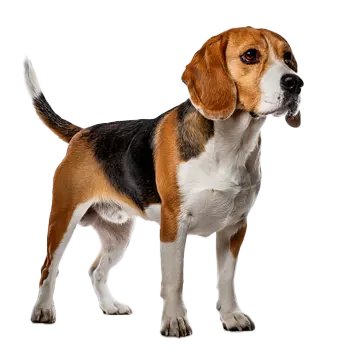
The AKC standard recognizes two Beagle varieties distinguished by height: those standing 13 inches and under at the shoulder, and those between 13 and 15 inches. Both varieties share the same essential characteristics — a sturdy, compact build, a broad skull with a moderate stop, large brown or hazel eyes conveying a gentle and pleading expression, and long, low-set ears that reach nearly to the tip of the nose when drawn forward. The standard calls for any true hound color, with the classic tricolor pattern of black, tan, and white being the most widely recognized.

Beyond conformation standards, Beagle clubs have been instrumental in preserving the breed's working heritage. The AKC and affiliated clubs sanction Beagle field trials and Small Pack Option tests that evaluate hunting instinct and cooperative pack behavior. These performance events ensure that the breed's legendary nose and hunting drive remain central to its identity, even as the vast majority of Beagles today live primarily as companion animals.

Breed clubs also serve as guardians of health and welfare within the Beagle community. The National Beagle Club of America supports health research, maintains databases of hereditary conditions, and promotes responsible breeding practices. Recommended health screenings for Beagles include hip evaluation, ophthalmologist examination, and testing for Musladin-Lueke Syndrome, a connective tissue disorder specific to the breed. These efforts reflect the broader commitment of breed clubs to ensuring that Beagles remain sound, healthy, and true to type for generations to come.

The Breed Today

The Beagle consistently ranks among the most popular dog breeds in the United States and enjoys strong followings in the United Kingdom, Australia, Canada, and many other countries. According to AKC registration statistics, the Beagle has maintained a position in the top ten most registered breeds for decades, a remarkable feat of sustained popularity that few breeds can match. This enduring appeal is driven by the Beagle's adaptability, manageable size, and genuinely affectionate nature.

Today's Beagle is primarily a family companion, and the breed excels in this role. Beagles are known for their patience with children, their sociability with other dogs, and their generally easygoing disposition. They adapt well to a variety of living situations, though their exercise needs and vocal tendencies are important considerations for prospective owners. The breed's compact size makes it suitable for both suburban homes and apartments, provided adequate physical and mental stimulation is provided.

The modern Beagle community is vibrant and diverse, encompassing show enthusiasts, field trailers, pet owners, and rescue advocates. Beagle-specific rescue organizations operate throughout the United States and Europe, rehoming dogs surrendered by owners, retired from laboratories, or rescued from puppy mills. These organizations have been particularly active in advocating for Beagles used in research, and high-profile rescue operations have brought national attention to the issue of laboratory animal welfare.

The breed has also found new roles in the contemporary world beyond traditional hunting and companionship. Beagles work as therapy dogs in hospitals and nursing homes, participate in canine sports such as agility and rally obedience, and continue to serve in detection roles with agricultural inspection agencies and law enforcement. Their versatility, combined with their endearing personality, ensures that the Beagle remains not just popular but genuinely relevant in modern life.

Notable Individuals

Perhaps the most famous Beagle in American political history is Him and Her, the pair of Beagles owned by President Lyndon B. Johnson. The dogs became fixtures of media coverage during the Johnson administration, though they also sparked controversy when the President was photographed lifting Him by his ears — an incident that drew sharp criticism from animal welfare advocates and prompted a national conversation about the proper handling of dogs. Despite the controversy, the Johnson Beagles helped cement the breed's association with the American presidency and public life.

In the world of competitive dog showing, a Beagle named Uno made history in 2008 by becoming the first Beagle to win Best in Show at the Westminster Kennel Club Dog Show. Uno's victory was met with an enthusiastic reception from the crowd at Madison Square Garden, and his joyful bay on the winner's podium became one of the most memorable moments in the show's long history. His win was widely celebrated as a triumph for a breed that, despite its enormous popularity as a pet, had long been overlooked in the highest levels of conformation competition.

The scientific community also counts a notable Beagle among its milestones. In 2005, a Beagle named Buddy became part of the first successful cloning of a dog, an achievement by South Korean researchers that advanced the understanding of mammalian cloning techniques. While the ethics of such research continue to be debated, the choice of a Beagle for this landmark experiment reflected the breed's longstanding role in scientific advancement.

Beagles have also distinguished themselves in detection and service work. Individual Beagle Brigade dogs have received commendations for exceptional service at U.S. ports of entry, and therapy Beagles have been recognized for their contributions to patient well-being in medical settings across the country. These individual achievements, taken together, illustrate the remarkable range of contexts in which Beagles have made their mark on human history and continue to do so today.

Always consult a qualified professional before making any health-related decisions. This content is provided for informational reference only and should not replace professional guidance specific to your animal.