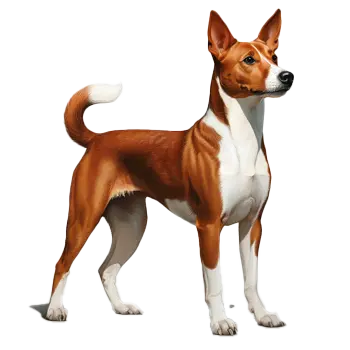

The Basenji is widely regarded as one of the oldest domesticated dog breeds in the world, with roots stretching back thousands of years to the river basins and dense forests of Central Africa. Archaeological evidence, including depictions on ancient Egyptian tombs and artifacts dating to roughly 3600 BCE, suggests that dogs closely resembling the modern Basenji were prized companions and hunting partners in the courts of the pharaohs. These likenesses show small, prick-eared dogs with tightly curled tails standing beside seated figures, indicating a long history of close human-canine relationships in the region.
The breed as it is known today descends primarily from dogs found among the Pygmy peoples of the Congo Basin, where they were selectively bred for their exceptional hunting ability in thick equatorial forest. These dogs were valued for their silence in the field — the Basenji does not bark in the conventional sense but instead produces a distinctive yodel-like vocalization known as a "barroo." This trait, along with their keen eyesight and remarkable agility, made them indispensable for driving small game into nets and tracking wounded quarry through dense undergrowth.
European explorers first encountered Basenjis in the Congo during the late nineteenth century, though early attempts to bring the dogs to England in the 1890s and again in the 1930s were met with heartbreaking losses due to distemper outbreaks. It was not until 1937 that a successful breeding pair was established in England by Olivia Burn, and shortly thereafter the breed began to gain a foothold in North America. The foundation stock for the American Basenji population arrived in the 1940s, and breeders worked carefully to maintain the distinctive traits that had been honed over millennia in Central Africa.
Genetic studies conducted in the early twenty-first century confirmed what breed enthusiasts had long suspected: the Basenji occupies a unique position on the canine family tree. DNA analysis places the breed among the most ancient and genetically divergent of all domestic dog breeds, closely related to other so-called "basal" breeds such as the Afghan Hound and the Saluki. This genetic heritage reflects thousands of years of relative isolation from the European and Asian breeding programs that shaped the majority of modern dog breeds.