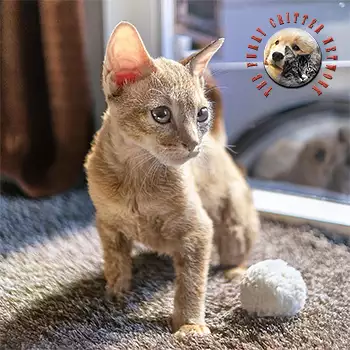

Origins & Early History

The German Rex holds the distinction of being the first documented rex-coated cat breed in the world, predating even the better-known Cornish Rex by several years. The breed's story begins in postwar East Berlin, where a curly-coated feral cat was discovered roaming the grounds of the Hufeland Hospital in the Buch district during the late 1940s. This cat, later named Lämmchen, meaning little lamb in German, caught the attention of Dr. Rose Scheuer-Karpin, a physician working at the hospital who recognized that the animal's unusual wavy coat was something genuinely novel rather than a sign of illness or malnutrition. Dr. Scheuer-Karpin took Lämmchen into her care around 1951 and began a careful breeding program, conducting crosses with straight-coated domestic cats that confirmed the rex gene was recessive and governed by a single autosomal locus. Lämmchen herself lived until 1964, producing multiple litters whose descendants formed the core of the German Rex gene pool.

The timing of the breed's emergence is significant in both feline genetics and Cold War history. Lämmchen was born and discovered in the Soviet occupation zone of Berlin, and the early breeding work took place in East Germany during a period of extreme political and economic upheaval. Resources were scarce, and the cat fancy was far from a priority for a society rebuilding from wartime devastation. Despite these challenges, Dr. Scheuer-Karpin maintained her breeding records with scientific rigor, providing a foundation of documentation that would prove invaluable to geneticists in later decades. In the 1950s and 1960s, breeders in West Germany and other European countries obtained German Rex cats or their descendants and began working to establish a stable population outside of East Berlin, though transporting cats across the inner German border required navigating bureaucratic obstacles that had nothing to do with animal husbandry.

The relationship between the German Rex and the Cornish Rex, which was independently discovered in Cornwall, England, in 1950, became a central question for feline geneticists. Initial speculation held that the two breeds might carry the same mutation, since both displayed similar curly coats caused by recessive genes. However, complementation tests conducted in the 1960s produced straight-coated kittens in the first generation when the two breeds were crossed, demonstrating conclusively that they carried mutations at different genetic loci. This result established the German Rex and Cornish Rex as genetically distinct breeds despite their superficial resemblance, and it remains a classic demonstration of allelism testing in genetics literature.

Formal breed recognition came gradually. The Federation Internationale Feline recognized the German Rex as a distinct breed with its own standard, but not all major registries followed suit. The Cat Fanciers' Association in the United States and some other organizations chose to group rex-coated breeds together or to focus recognition efforts on the Cornish Rex and Devon Rex, which had larger breeding populations and more active promotional campaigns. Throughout the latter decades of the twentieth century, a small but dedicated community of European breeders worked to maintain the German Rex's genetic integrity and to distinguish it clearly from other rex breeds, emphasizing the breed's more robust and rounded body type compared to the whippet-like silhouette of the Cornish Rex, as well as the particular texture of its coat, which tends to be slightly thicker and more plush.

Historical Roles

Unlike breeds with centuries of documented history in specific working roles, the German Rex emerged in a context where its primary significance was scientific rather than utilitarian. The breed's earliest contribution was to the field of feline genetics, where Lämmchen and her offspring served as living subjects for the study of coat inheritance patterns. Dr. Scheuer-Karpin's meticulous records provided some of the earliest systematic data on rex gene transmission in cats, contributing to a broader understanding of how spontaneous mutations arise and propagate in domestic animal populations.

In the immediate postwar years, cats in Berlin served the deeply practical role of controlling rodent populations in a city where infrastructure had been devastated by bombing. While there is no specific documentation of Lämmchen's mousing abilities, feral and semi-feral cats like her were valued by hospital staff and residents alike for keeping vermin in check. The Hufeland Hospital grounds, where Lämmchen was first observed, would have provided ample hunting territory in the overgrown and partially ruined landscape of postwar Buch.

As the breed became established among hobbyist breeders, the German Rex transitioned into a purely companion role. Its friendly and sociable temperament made it well suited to domestic life, and breeders noted that the breed's gentle disposition and tolerance for handling made it an excellent household pet. Unlike some more independent or reserved breeds, the German Rex actively sought human interaction, a trait that endeared it to families and individuals seeking a closely bonded feline companion.

The breed also played a quiet but meaningful role in the cultural life of the European cat fancy during the Cold War era. German Rex cats appearing at shows in both Eastern and Western Europe represented one of the few instances where a pedigree animal breed straddled the Iron Curtain, with breeding stock and genetic information passing between the two political blocs despite the broader atmosphere of division and suspicion.

Cultural Symbolism

The German Rex occupies a unique symbolic position among cat breeds, representing both scientific curiosity and resilient survival in the face of historical adversity. The breed's emergence from the rubble of postwar Berlin lends it a narrative arc that resonates with broader themes of renewal and recovery. For German cat fanciers in particular, the breed carries a sense of national heritage, a distinctly German contribution to the international cat fancy that predates most other rex varieties.

In the world of feline genetics, the German Rex serves as a textbook example of how spontaneous mutations can give rise to new breeds. The story of Lämmchen is recounted in genetics primers and breeding manuals as a clear illustration of autosomal recessive inheritance, and the complementation tests between German Rex and Cornish Rex remain a classic demonstration of allelism testing. This scientific legacy gives the breed a cultural significance that extends beyond the show ring and into the classroom and laboratory.

The breed also symbolizes the challenges facing rare and minority breeds in a cat fancy that tends to concentrate attention and resources on a relatively small number of popular varieties. German Rex enthusiasts often describe their breed as an underdog, overlooked by the mainstream but treasured by those who know it. This underdog status has fostered a strong sense of community among German Rex breeders, who view their work as a form of conservation rather than mere hobby breeding.

For many owners, the German Rex represents a connection to a specific moment in European history. The breed's East Berlin origins, the scientific curiosity of Dr. Scheuer-Karpin, and the difficulties of maintaining a breeding program across a divided continent all contribute to a narrative that is richer and more textured than the origin stories of many more popular breeds. This depth of historical context gives the German Rex a cultural weight that transcends its modest numbers.

Breed Clubs & Standards

The organizational landscape for the German Rex has always been smaller and more specialized than that of mainstream breeds. In Europe, the breed's primary institutional home is within the Federation Internationale Feline, which maintains a breed standard that distinguishes the German Rex from other rex-coated varieties. The FIFe standard describes a medium-sized cat with a rounded head, well-developed cheeks, and a strong chin, paired with a body that is muscular and compact rather than elongated or tubular. The coat is specified as short, silky, and evenly curled, with a plush texture that is distinct from the close-lying wave of the Cornish Rex.

Breed-specific clubs dedicated to the German Rex exist primarily in Germany, the Netherlands, and a handful of other European countries. These organizations coordinate breeding efforts, maintain pedigree records, and provide guidance to breeders on health testing and genetic diversity management. Given the breed's small population, these clubs play a particularly critical role in preventing excessive inbreeding and ensuring that the gene pool remains viable over the long term.

The breed's recognition status varies considerably across international registries. While FIFe recognizes the German Rex as a standalone breed, The International Cat Association groups it under a broader rex category, and the Cat Fanciers' Association does not currently recognize it as a separate breed at all. This fragmented recognition has practical consequences for breeders and exhibitors, as it limits the venues where German Rex cats can be shown competitively and reduces the breed's visibility to potential owners.

Efforts to achieve broader recognition have been ongoing for decades, with breed advocates compiling health data, standardizing type descriptions, and working to grow the breeding population to levels that registries consider sustainable. These efforts are complicated by the breed's small numbers and by the tendency of some registries to view rex breeds as variations on a single theme rather than as distinct breeds with separate genetic foundations and unique physical characteristics.

The Breed Today

The German Rex remains one of the rarest recognized cat breeds in the world, with active breeding populations concentrated primarily in Germany, the Netherlands, Finland, and a few other European countries. Annual registration numbers are modest compared to popular breeds, and finding a German Rex kitten often requires joining a waiting list or establishing a relationship with one of the breed's small number of active catteries. Despite these challenges, the breed has a devoted following whose enthusiasm compensates for what it lacks in numbers.

Modern German Rex breeders face the ongoing challenge of maintaining genetic diversity within a limited population. Outcrossing programs, in which German Rex cats are bred with approved domestic shorthair partners to introduce new genetic material, are a standard practice in many breeding programs. These outcrosses help to reduce the risk of inbreeding depression and to maintain the breed's overall health and vigor, though they require careful selection to ensure that the resulting offspring retain the characteristic rex coat and body type.

The breed has benefited from advances in genetic testing and veterinary medicine that allow breeders to screen for inherited conditions and to make more informed mating decisions. While the German Rex is generally considered a healthy and robust breed, its small gene pool makes proactive health management essential. Breed clubs and individual breeders collaborate to share health data and to track the prevalence of any emerging conditions within the population.

Interest in the German Rex has shown modest growth in recent years, driven in part by social media exposure and by a broader cultural trend toward valuing rare and heritage breeds. Younger cat enthusiasts, in particular, have been drawn to the breed's unique history and distinctive appearance, and online communities dedicated to the German Rex have helped to connect breeders and owners across national borders. While the breed is unlikely to challenge the popularity of mainstream favorites, its future appears stable, sustained by a community that values quality, heritage, and the preservation of a genuinely unique feline lineage.

Notable Individuals

No account of the German Rex would be complete without acknowledging Lämmchen, the foundational cat whose curly coat launched an entire breed. Discovered at the Hufeland Hospital in East Berlin, Lämmchen was not merely the first German Rex but arguably the most consequential individual cat in the history of rex-coated breeds. Her documented breeding history, maintained by Dr. Rose Scheuer-Karpin, provided the genetic proof that the rex coat was a heritable trait and established the scientific framework within which all subsequent rex breeds would be understood.

Dr. Scheuer-Karpin herself, while not a cat, deserves recognition as the human figure most responsible for the breed's survival and documentation. A physician by profession, she approached the breeding of Lämmchen and her descendants with the systematic rigor of a scientist, keeping detailed records of matings, litter sizes, coat types, and health outcomes. Her work predated the formal establishment of feline genetics as a discipline and laid groundwork that later researchers would build upon extensively.

Among Lämmchen's offspring, several individuals played key roles in establishing breeding lines that would carry the German Rex forward into subsequent generations. Kittens from her litters were distributed to breeders in West Germany and elsewhere in Europe, creating the satellite populations that ensured the breed's survival even as political conditions in East Germany made sustained breeding efforts difficult. These early exports are the ancestors of virtually all German Rex cats alive today.

In the contemporary cat fancy, individual German Rex cats have earned distinction at FIFe shows and other European exhibitions, though the breed's rarity means that show appearances are relatively infrequent compared to more popular breeds. Each German Rex that enters a show ring serves as an ambassador for the breed, raising awareness among judges, spectators, and fellow exhibitors who may never have encountered one before. These show cats, along with the growing number of German Rex pets featured on social media, continue to build the breed's profile one encounter at a time.

Always consult a qualified professional before making any health-related decisions. This content is provided for informational reference only and should not replace professional guidance specific to your animal.