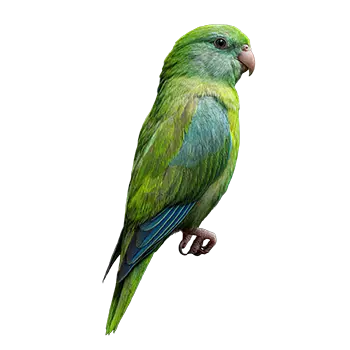

Origins & Native Range

The Green-rumped Parrotlet (Forpus passerinus) is native to a broad swath of tropical and subtropical lowlands stretching from northeastern Colombia through Venezuela, Trinidad, and the Guianas into northeastern Brazil. Within this range, the species thrives in a variety of semi-open habitats including scrublands, savannas, forest edges, and agricultural clearings. Its ability to adapt to disturbed landscapes has helped maintain stable wild populations even as surrounding forests have been altered by human activity.

Taxonomically, the Green-rumped Parrotlet belongs to the genus Forpus, a group of seven recognized species that together represent the smallest parrots in the New World. The genus name derives from a Latinized form meaning "small parrot," and the species epithet passerinus literally translates to "sparrow-like," a nod to the bird's diminutive stature. Early European naturalists who encountered these birds in the 1700s were struck by how closely they resembled sparrows in size and flight pattern, despite their unmistakably parrot-like bills and plumage.

Several subspecies of the Green-rumped Parrotlet are recognized across its range, each showing subtle variations in plumage intensity and distribution. The nominate subspecies, F. p. passerinus, is found primarily in the Guianas and northeastern Brazil, while F. p. viridissimus inhabits Trinidad and parts of Venezuela. These geographic variations reflect thousands of years of adaptation to slightly different ecological niches and have contributed to ongoing taxonomic discussions about the precise boundaries within the species complex.

The Green-rumped Parrotlet's evolutionary lineage within the broader parrot family (Psittacidae) places it among the earliest-diverging New World parrot lineages. Fossil and molecular evidence suggests that the Forpus genus separated from its closest relatives millions of years ago, evolving a compact body plan suited to exploiting food sources in open and edge habitats that larger parrots often overlook. This deep evolutionary history gives the species a significant place in understanding how parrots diversified across the Americas.

Historical Roles

Indigenous peoples of northern South America have long been familiar with Green-rumped Parrotlets, though the birds' small size meant they were never as culturally prominent as the large macaws and amazons that dominated ceremonial life. Nevertheless, parrotlets were kept as companion animals in villages throughout Venezuela and the Guianas, prized for their sociable nature and ease of taming. Historical accounts from early colonial naturalists describe indigenous children carrying hand-tamed parrotlets on their shoulders, suggesting a longstanding tradition of casual domestication.

During the colonial era, European explorers and traders took notice of the species primarily as a curiosity. Unlike the brilliantly colored macaws that were shipped back to European courts as exotic status symbols, parrotlets were considered too plain and too small to warrant the expense of transatlantic transport. As a result, the Green-rumped Parrotlet remained relatively unknown in European aviculture until well into the twentieth century, when advances in breeding and shipping made smaller species commercially viable.

In rural communities across Venezuela and Colombia, parrotlets have historically played a modest but persistent role in everyday life. Farmers have observed their flocking behavior and seasonal movements as informal indicators of weather patterns and crop readiness. Flocks descending on ripening fruit orchards have long been both a nuisance and a familiar marker of the agricultural calendar, woven into the rhythm of rural existence in ways that rarely make it into formal historical records.

The species also contributed to early ornithological science in South America. Naturalists working in the Guianas and Venezuela during the eighteenth and nineteenth centuries collected and described Green-rumped Parrotlet specimens, helping to establish foundational knowledge about Neotropical bird diversity. These early scientific efforts laid the groundwork for the more detailed ecological studies that would follow in the twentieth century.

Cultural Symbolism

In the folk traditions of Venezuela and Trinidad, small parrots like the Green-rumped Parrotlet are sometimes associated with cheerfulness, sociability, and domestic harmony. Their habit of forming tight pair bonds and staying close to a mate throughout the day has made them informal symbols of companionship and fidelity in rural storytelling. While they lack the mythological weight of larger parrot species, their presence in gardens and orchards gives them a familiar, approachable quality in local culture.

The parrotlet's bold personality relative to its tiny body has also made it a folk metaphor for courage and determination in the face of larger challenges. In some regional expressions, comparing someone to a parrotlet suggests they are small but fierce, unwilling to back down despite being outmatched in size. This cultural shorthand reflects genuine behavioral observations, as Green-rumped Parrotlets are known for aggressively defending nesting cavities against much larger birds.

In the modern avicultural community, the Green-rumped Parrotlet has taken on symbolic significance as the species that introduced many bird keepers to the parrotlet genus. For enthusiasts who went on to keep Pacific, Spectacled, or Mexican Parrotlets, the Green-rumped variety often holds a sentimental place as their "gateway parrotlet." This role has given the species an outsized cultural footprint within the hobby relative to its modest wild profile.

Among conservation-minded communities, the Green-rumped Parrotlet also serves as a reminder that not all species of concern are large and charismatic. While the species itself is not currently threatened, it shares habitat with numerous birds that are, and its familiar presence helps communicate the broader importance of protecting tropical lowland ecosystems.

Avicultural Societies & Standards

The Green-rumped Parrotlet first gained traction in organized aviculture during the latter half of the twentieth century, as breeders in the United States and Europe began working seriously with small parrot species. Organizations such as the International Parrotlet Society, founded in the 1990s, played a pivotal role in establishing breeding standards, sharing husbandry knowledge, and promoting responsible ownership of all Forpus species. These groups provided a structured community for breeders who had previously worked in relative isolation.

Breeding standards for Green-rumped Parrotlets in aviculture emphasize the retention of wild-type coloration and body proportions. Unlike some parrotlet species that have been selectively bred for color mutations, the Green-rumped variety has seen fewer dramatic color variants established in captivity. Avicultural societies generally encourage maintaining robust, genetically diverse breeding populations and discourage practices that prioritize novelty mutations at the expense of overall bird health.

The American Federation of Aviculture and similar organizations in Europe and Australia have periodically featured Green-rumped Parrotlets in their publications and conference programs, highlighting the species as an excellent choice for breeders interested in small parrots. These endorsements have helped maintain a steady, if modest, level of interest in the species among serious aviculturists who appreciate its manageable size and relatively straightforward breeding requirements.

In recent years, avicultural societies have increasingly emphasized the importance of accurate record-keeping and pedigree tracking for captive parrotlet populations. This shift reflects broader trends in aviculture toward treating captive populations as valuable genetic reservoirs, particularly for species whose wild populations may face future pressures from habitat loss or climate change.

The Species Today

Today, the Green-rumped Parrotlet occupies a comfortable but somewhat understated position in the pet bird world. It is overshadowed in popularity by its close relative, the Pacific Parrotlet (Forpus coelestis), which is more widely available in the pet trade and has been bred into a broader array of color mutations. Nevertheless, the Green-rumped variety retains a loyal following among bird keepers who appreciate its slightly calmer disposition and its status as the original parrotlet species described by Western science.

In the wild, the species continues to maintain stable populations across most of its native range. The International Union for Conservation of Nature lists the Green-rumped Parrotlet as a species of Least Concern, reflecting its broad distribution and tolerance for habitat modification. However, localized pressures from agricultural expansion and the pet trade exist in certain regions, and conservationists continue to monitor population trends to ensure that the species' overall stability is not masking regional declines.

The avicultural community has increasingly recognized the importance of maintaining captive populations of Green-rumped Parrotlets that are genetically distinct from Pacific Parrotlets. Hybridization between Forpus species, whether accidental or intentional, is a concern among serious breeders, and education campaigns emphasize the importance of species-pure breeding programs. These efforts help preserve the unique genetic heritage of each parrotlet species for future generations.

Online communities and social media have given the Green-rumped Parrotlet a modest but enthusiastic digital presence. Owners share photographs, behavioral observations, and husbandry tips through dedicated forums and social media groups, creating a decentralized but active support network for keepers of the species. This digital community has helped sustain interest in the Green-rumped Parrotlet even as trendier species capture mainstream attention.

Notable Individuals & Research Contributions

The Green-rumped Parrotlet has played a surprisingly significant role in behavioral and ecological research, thanks largely to a long-running field study conducted in Venezuela. Beginning in the 1980s, researchers established a study population using nest boxes in the llanos region, allowing detailed observation of breeding behavior, social dynamics, and population ecology over multiple decades. This project has produced some of the most comprehensive data available on any small parrot species in the wild.

One of the most remarkable findings from this research program involves vocal learning and individual identification. Scientists discovered that Green-rumped Parrotlet parents assign unique contact calls to their chicks before the young birds are old enough to vocalize on their own. This finding, published in prominent scientific journals, provided some of the first evidence that parrots may use something analogous to personal names, a discovery that generated significant interest well beyond the ornithological community.

The Venezuelan study population has also contributed valuable data on topics ranging from clutch size optimization and extra-pair paternity to the effects of habitat quality on reproductive success. Individual birds tracked over many breeding seasons have revealed complex social relationships and decision-making strategies that challenge simplistic views of avian cognition and behavior. These findings have helped elevate the Green-rumped Parrotlet from an obscure small parrot to a genuinely important model organism in behavioral ecology.

Beyond the Venezuelan field studies, individual Green-rumped Parrotlets in captivity have occasionally gained recognition within avicultural circles for exceptional longevity or breeding success. While no single captive bird has achieved widespread public fame, the collective contributions of captive populations to our understanding of parrotlet husbandry, nutrition, and veterinary care have been substantial and continue to inform best practices across the hobby.

Always consult a qualified professional before making any health-related decisions. This content is provided for informational reference only and should not replace professional guidance specific to your animal.