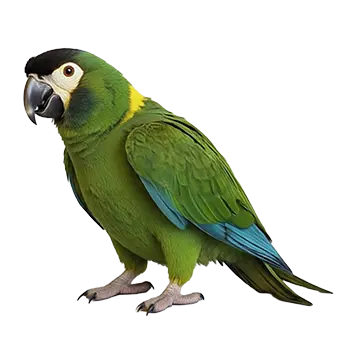

Determining when a Yellow-Collared Macaw has entered its senior years is not as straightforward as checking a calendar. Unlike mammals that show clearly age-correlated physical changes such as graying fur or clouding eyes, parrots age with a subtlety that can mask the transition from prime adulthood to the geriatric stage. As a general guideline, Yellow-Collared Macaws with a typical lifespan of thirty to forty years are considered to be entering their senior phase around twenty to twenty-five years of age, though individual variation in genetics, lifetime diet, environmental conditions, and veterinary care history can shift this timeline significantly in either direction.
The earliest signs of aging in a Yellow-Collared Macaw are often behavioral rather than physical. A bird that was once relentlessly active may begin spending more time resting on its favorite perch, napping during the day, and showing less interest in vigorous play. The reduction in activity is gradual and easy to overlook if you see the bird every day, but a comparison of the bird's current activity level against its behavior from several years earlier typically reveals a measurable decline. This decreased activity is a normal consequence of aging and should not be confused with illness, though any abrupt or dramatic change in activity level warrants a veterinary examination to rule out underlying medical causes.
Physical changes, while more subtle than in many other companion animals, do eventually become apparent. The plumage may lose some of its vibrancy over successive molts, appearing slightly duller or showing increased freckling and color irregularities in individual feathers. The skin of the bare facial patch may become somewhat rougher or more textured. The beak and nails may grow at a slightly altered rate, sometimes faster due to metabolic changes, sometimes more slowly. The feet may develop mild callusing or roughness on the plantar surfaces, particularly if perch selection has not provided adequate variety throughout the bird's life.
Establishing a new veterinary baseline at the point when your bird enters its senior years is strongly recommended. A comprehensive geriatric workup, including complete blood count, biochemistry panel, radiography, and potentially additional diagnostics such as electrocardiography or advanced imaging, creates a reference point against which future changes can be measured. Many age-related conditions in parrots develop insidiously over months or years, and detecting them early through comparison with a known baseline dramatically improves treatment options and outcomes.