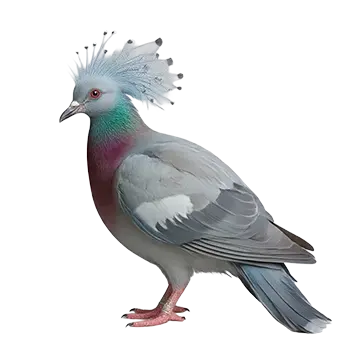

The juvenile stage of a Victoria Crowned Pigeon begins at approximately eight to ten weeks of age, when the young bird has fledged the nest and is beginning the process of weaning from parental feeding or hand-rearing formula. This transition marks a profound shift in the bird's daily existence, moving from near-total dependence on external food delivery to the gradual acquisition of self-feeding skills and environmental independence. For a species as large and slow-developing as the Victoria Crowned Pigeon, this period extends considerably longer than it does for smaller columbids, often lasting until the bird is four to six months old before full independence is achieved.
Physically, the juvenile Victoria Crowned Pigeon already resembles the adult in overall body plan but lacks the full refinement of mature plumage. The blue-grey body feathers are present but may appear duller and less iridescent than those of a fully mature bird. The signature fan-shaped crest, composed of delicate, lace-tipped feathers crowning the head, is developing but has not yet reached its full length or density. The maroon-red breast patch, another hallmark of the species, may be present but less vividly defined. The bird's eyes, which are deep red in adults, often display a darker, more muted coloration during the juvenile period.
Behaviorally, the juvenile crowned pigeon is characterized by a blend of curiosity and caution. The bird actively explores its environment, investigating surfaces, objects, and food items with its beak and feet, but it remains more easily startled than a well-socialized adult. This is a natural and adaptive response, not a sign of poor socialization. In the wild, young Victoria Crowned Pigeons remain in close proximity to their parents for an extended period, relying on the adults' vigilance and experience to navigate the forest floor where most of their activity takes place. In captivity, the caregiver partially fills this protective role, providing a stable, predictable environment that allows the juvenile to build confidence at its own pace.
The juvenile stage is also a period of significant metabolic demand. The bird is still growing in skeletal mass, muscle density, and feather coverage, all of which require substantial caloric and nutritional input. Weight gain continues during this stage, though at a slower and more variable rate than during the neonatal period. Caregivers should expect the bird to reach approximately 70 to 80 percent of its adult body weight by the midpoint of the juvenile period, with the remaining growth occurring gradually over the following months.