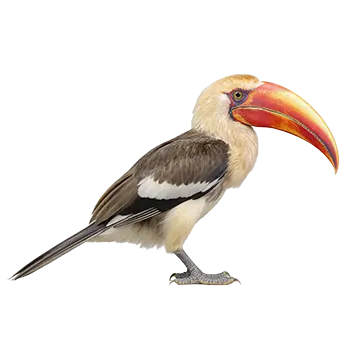

Red-Billed Hornbill chicks hatch inside the sealed cavity nest that the female prepared during the incubation period. Unlike many companion bird species that may be hand-reared from day one, hornbill chicks in both wild and managed breeding programs spend their earliest days in total darkness within the nest chamber, receiving food exclusively from the male parent who passes items through a narrow vertical slit in the mud seal. The hatchlings emerge after an incubation period of approximately 23 to 25 days, blind, naked, and weighing roughly 6 to 8 grams. Their skin is pinkish and translucent, and their oversized bills are soft and pliable, bearing no resemblance to the distinctive red-orange casque they will develop later.
The sealed nest environment provides a naturally regulated microclimate that is difficult to replicate artificially. The female's body heat maintains the interior temperature within a stable range, and the enclosed space retains humidity from respiration and waste. Because the female remains sealed inside with the chicks for the first several weeks, she serves as both incubator and primary brooder. This arrangement is one of the most distinctive features of hornbill biology and has profound implications for anyone attempting to rear these birds in a managed setting.
For breeders or aviculturists managing Red-Billed Hornbills in captivity, the priority during the first days is to support the male's provisioning efforts without disturbing the sealed nest. The male makes dozens of feeding trips per day, delivering insects, small vertebrates, fruit, and seeds. Ensuring that the male has constant access to high-quality, varied food sources directly determines whether the chicks receive adequate nutrition. Any disruption to the male's feeding routine, whether from enclosure maintenance, loud construction, or the introduction of unfamiliar animals nearby, can reduce provisioning frequency and jeopardize the chicks' survival.
In rare situations where hand-rearing becomes necessary, such as the death or illness of the female, the nest seal must be carefully opened and the chicks transferred to a brooder. This intervention is stressful for the chicks and should only be undertaken when no other option exists. Hand-reared hornbill chicks require feedings every one to two hours during the first days, using a formula of finely ground insects mixed with a high-quality avian hand-feeding preparation. The transition from parent-rearing to hand-rearing carries significant mortality risk, and an experienced avian veterinarian should be consulted before and during the process.