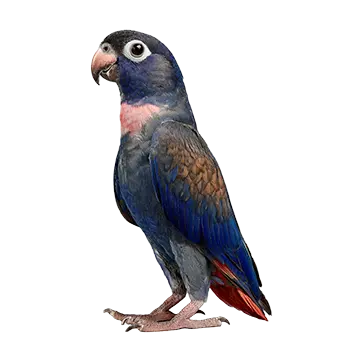

Determining exactly when a Bronze-Winged Pionus transitions from its prime adult years to its senior stage is not as straightforward as it is with dogs or cats, where breed-specific aging timelines are well documented. For a species with a potential lifespan of 25 to 40 years, the senior period is generally considered to begin around 20 to 25 years of age, though individual birds may show signs of aging earlier or later depending on genetics, lifetime diet, veterinary care history, and environmental factors.
The onset of the senior stage is typically gradual rather than abrupt. Early signs include a subtle decrease in overall activity level, longer rest periods during the day, and a reduction in the intensity of play behavior. The bird may become less interested in vigorous foraging challenges that it previously enjoyed and may prefer simpler enrichment activities. Vocalizations may become somewhat quieter or less frequent, though the bird's personality and social engagement usually remain largely intact in the early senior years.
Physical changes accompany the behavioral shifts. Feather quality may decline slightly, with the plumage appearing less lustrous or taking longer to regrow after a molt. The beak and nails may grow more quickly or unevenly as the bird's activity level decreases and natural wear diminishes. Some senior Bronze-Winged Pionus develop a slight thickening or scaling of the skin on the feet and legs, which is a normal aging change but should be monitored to ensure it does not progress to pathological lesions.
It is important to distinguish normal aging from illness. A bird that suddenly becomes lethargic, loses significant weight, stops eating, or exhibits dramatic behavioral changes is not simply getting old; it is likely sick and needs prompt veterinary attention. Age-related changes develop slowly over months and years, while illness tends to produce more rapid declines. Understanding this distinction prevents both the dismissal of treatable conditions as inevitable aging and the unnecessary anxiety that can come from interpreting every age-related change as a medical crisis.